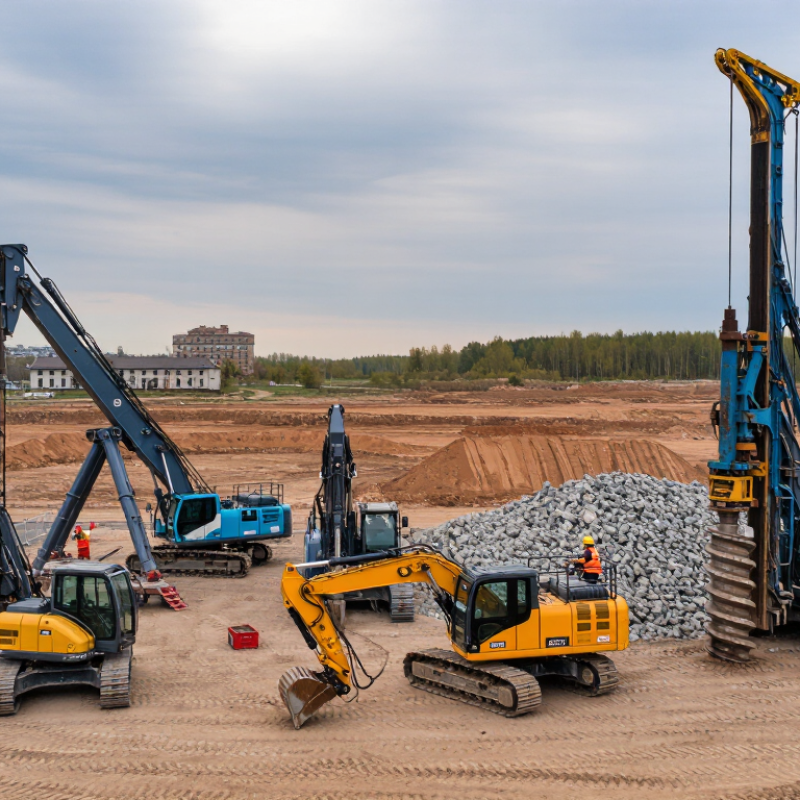
| Hydraulic Top-Hammer Anchor Rig | Soil nails, rock bolts, slope stabilization, foundation anchors, and general geotechnical work. | Percussive drilling with a hydraulic drifter mounted on a feed beam; air or water may be used for flushing. | Approximately 38–115 mm | Approximately 10–30 m per hole, depending on ground conditions and rod configuration | Guard rotating and reciprocating parts; control rod handling; manage airborne dust, noise, hydraulic pressure, and unexpected ground movement. Use emergency stops, hose restraints, and exclusion zones. | Inspect hydraulic hoses and fittings daily; lubricate the drifter and rod thread system; check feed-chain or cylinder wear, flushing lines, filters, and fasteners. | Crawler versions usually require a low-bed trailer or suitable site transporter. Confirm machine width, gross mass, loading angle, and ground-bearing capacity before mobilization. | Review machinery risk assessment requirements such as ISO 12100, guarding and control-system requirements such as ISO 13849-1 where applicable, and local rules for noise, dust, lifting, and pressure systems. | High versatility |
| Hydraulic Down-the-Hole (DTH) Anchor Rig | Hard rock, long rock anchors, micropiles, casing-assisted drilling, and projects requiring straight holes at greater depth. | A pneumatic hammer operates at the bottom of the hole; compressed air evacuates cuttings and powers the hammer. | Approximately 90–300 mm | Approximately 20–60 m or more, depending on tooling, casing, and geology | Control high-pressure compressed air, flying fragments, dust, noise, rod torque, and pressurized connections. Use whip checks, rated hoses, face protection, hearing protection, and dust suppression or extraction. | Service the air compressor and filters; inspect hammer components, drill bits, threaded joints, lubricators, air hoses, and casing shoes. Keep contaminants out of the air system. | Requires a compressor, drill rods, casing, and lifting equipment. Check axle loads, trailer capacity, compressor placement, ventilation, and access for long feeds. | Verify pressure-equipment and compressor requirements in the destination market. Apply relevant machinery, guarding, electrical, noise, dust-exposure, and occupational-safety regulations. | Best for hard rock |
| Rotary Anchor Drilling Rig | Soft to medium ground, hollow-stem or solid-stem drilling, grouting, micropiles, and applications where low-impact rotation is preferred. | Rotary or rotary-percussive drilling with augers, casing, tricone bits, or specialized anchor tooling. | Approximately 100–300 mm | Approximately 15–50 m, depending on tooling and formation stability | Prevent entanglement at the rotary head; secure rods and casing; control torque reaction, spoil discharge, grouting pressure, and unstable boreholes. Establish a clear swing and rotation zone. | Check rotary-head gearbox oil, chuck and thread condition, hydraulic filters, mast alignment, winch components, augers, and grout-pump wear parts. | Often transported on a crawler or trailer. Confirm overall height with the mast folded, transport width, machine center of gravity, and permissible road weight. | Confirm conformity assessment, operator controls, guarding, emissions, electrical systems, and local requirements for grouting and pressure injection. | Good for mixed soils |
| Crawler-Mounted Micropile and Anchor Rig | Restricted-access sites, retaining walls, basements, bridge works, underpinning, and steep or uneven terrain. | Rotary, rotary-percussive, or DTH drilling, normally using a compact mast and modular tooling. | Approximately 90–300 mm | Approximately 10–40 m, depending on mast length and rod handling | Verify stability on slopes and near excavations; use travel alarms, load charts, level indicators, crawler inspections, and controls against machine rollover or unexpected movement. | Inspect crawler chains, rollers, sprockets, travel motors, mast pins, hydraulic cylinders, leveling jacks, and structural welds. Remove mud from undercarriage components. | Crawler rigs improve site mobility but are not generally road legal without transport arrangements. Confirm folded dimensions, ramp capacity, tie-down points, and trailer loading procedure. | Check mobile-machinery rules, transport regulations, lifting and tie-down requirements, local excavation safety rules, and any requirements for work near public roads or utilities. | Best for access-limited sites |
| Compact Electric or Battery-Powered Anchor Rig | Indoor work, tunnels, urban renovation, low-emission projects, and sites where exhaust gases or noise must be minimized. | Electric-hydraulic rotary or top-hammer drilling; battery models use rechargeable industrial traction batteries. | Approximately 40–150 mm | Approximately 5–25 m, depending on model and tooling | Manage electrical isolation, battery charging, cable routing, ventilation, fire prevention, and stored hydraulic energy. Use suitable residual-current protection and lockout procedures. | Inspect power cables, connectors, cooling systems, battery condition, hydraulic oil, filters, chargers, and insulation. Follow the battery manufacturer’s service and storage limits. | Usually suitable for elevators, tunnels, and small access routes, but battery mass can be significant. Confirm doorway clearance, floor loading, turning radius, and charging access. | Check electrical safety, electromagnetic compatibility, battery transport and recycling rules, charger requirements, machine safety, and local fire-protection provisions. | Best for low-emission work |
| Handheld or Portable Anchor Drill | Light-duty rock bolts, short anchors, repair work, remote locations, and jobs where full-size rig access is impossible. | Hand-held rotary-percussive or pneumatic drilling with short rods and portable flushing equipment. | Approximately 25–75 mm | Typically up to 5–10 m per hole | Control manual reaction forces, vibration, silica dust, noise, falling rock, and awkward postures. Use a secondary support system where the operator cannot safely control the drill. | Inspect handles, chucks, trigger controls, air or power cables, lubrication points, bits, hoses, and vibration-damping components before each shift. | Easy to carry and ship, but requires a safe compressor or electrical supply and secure storage for rods, hoses, bits, and accessories. | Review occupational exposure limits for respirable crystalline silica and hand-arm vibration, as well as electrical, pneumatic, noise, and personal-protective-equipment requirements. | Best for small jobs |
| Multi-Function Anchor and Grouting Rig | Projects combining drilling, casing, anchor installation, cement grouting, jet grouting, or micropile construction. | Rotary or rotary-percussive drilling integrated with grout mixing, pumping, flushing, and optional casing systems. | Approximately 90–350 mm | Approximately 15–50 m, depending on configuration | Control multiple hazards simultaneously: rotating tools, grout injection pressure, cement exposure, hydraulic energy, suspended loads, and hose movement. Use pressure relief, guarding, and defined communication signals. | Flush grout lines after use; inspect pumps, valves, agitators, seals, pressure gauges, hydraulic systems, drilling tools, and wear liners. Prevent hardened grout from entering equipment. | Requires additional tanks, pumps, hoses, and consumables. Plan for higher payload, washout facilities, material handling, and separate transport of cement or additives. | Verify machinery safety, pressure-system controls, chemical and cement handling, environmental discharge rules, lifting provisions, and project-specific grouting specifications. | Best for integrated workflows |



 Close