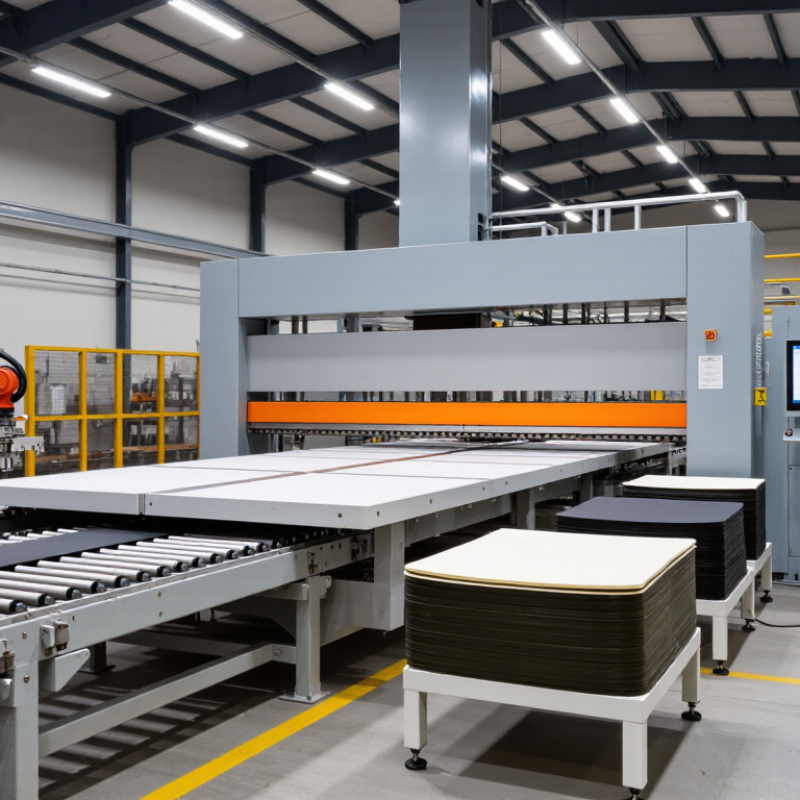
| Hydraulic drive and pressure control | Hydraulic power unit with pressure regulation and monitoring. A variable-speed or servo-driven pump can reduce unnecessary pump operation when the production cycle permits. | Review the hydraulic schematic, pressure settings, temperature behavior, leakage checks, and cycle performance under the intended load. | Provides the force needed to press a cutting die through belt materials while allowing pressure to be managed for different jobs. |
| Beam and frame construction | Rigid welded or fabricated structure designed to resist deflection under the press load. Stress-relief processes may be used where appropriate to the material and manufacturing route. | Inspect fabrication records and confirm frame and platen geometry through dimensional measurement and loaded testing. | Structural stiffness helps maintain consistent cutting conditions across the working area. |
| Platen parallelism and alignment | Machined and aligned press surfaces, with adjustment provisions where required by the machine design. | Measure platen parallelism and check pressure or cut results at multiple positions across the usable area. | Helps reduce uneven die engagement and inconsistent cuts, especially when cutting large or layered belt sections. |
| Stroke and cutting-depth control | Adjustable stroke or cutting-height settings, supported by position sensing or controlled mechanical limits according to the machine configuration. | Check repeatability of the selected settings and perform trial cuts using the specified die, cutting board, and material stack. | Supports repeatable cutting while helping prevent excessive impact on the cutting board or tooling. |
| Programmable control system | PLC-based control for operating sequences, interlocks, fault indication, and adjustable process settings. Some designs also record cycle or alarm data. | Test operating modes, emergency-stop response, interlocks, fault messages, and documented control settings. | Improves process consistency and makes operating faults easier to identify during production. |
| Operator safety systems | Risk-assessed safeguards such as fixed or interlocked guards, emergency stops, and appropriately designed presence-sensing or two-hand controls. | Review the machine risk assessment and validate safety functions and control-system design against applicable requirements, such as ISO 12100 and ISO 13849-1 where relevant. | Reduces exposure to crushing and cutting hazards around the press and its operating zone. |
| Die and cutting-board setup | Work surface and tooling arrangements designed for secure positioning of cutting dies and suitable cutting boards, with clear setup and replacement procedures. | Confirm die retention, work-surface condition, setup instructions, and cut quality using representative production tooling. | Correct setup supports stable cutting and helps protect both the die and the press surface. |
| Electrical and hydraulic system integration | Coordinated electrical controls, hydraulic components, sensors, cabling, and service access, with component documentation and circuit identification. | Check wiring and hydraulic diagrams, component labels, protective devices, hose routing, and maintenance access. | Well-documented integration simplifies troubleshooting and routine service in a production environment. |
| Manufacturing quality control | Documented inspection of incoming components, fabricated structures, machined surfaces, assemblies, and completed machines. | Review inspection records, calibration status of measurement equipment, assembly checks, and corrective-action records. | Provides evidence that the press has been built and inspected against its specified design requirements. |
| Factory acceptance and commissioning | Functional testing of operating modes, safety devices, pressure controls, stroke settings, and representative cutting tasks before handover. | Use a recorded acceptance checklist and confirm the results with the agreed material, die, operating conditions, and machine specification. | Helps confirm that the press is ready for its intended cutting application and that operators receive relevant setup information. |



 Close