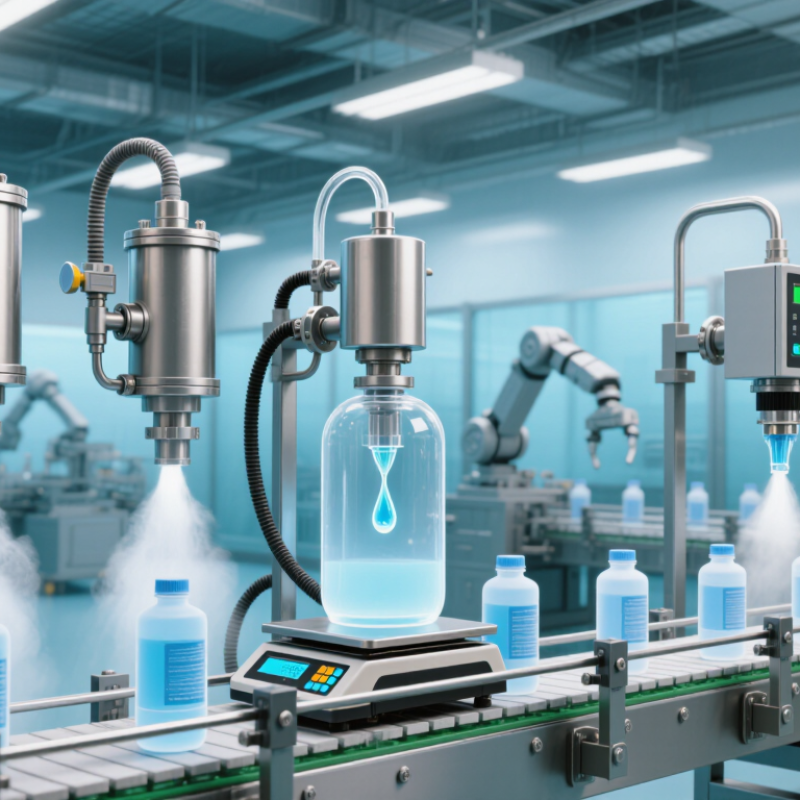
| Timed Pressure Dosing | A controlled valve opens for a calibrated time while pressure in the liquid-nitrogen vessel drives the flow. | Valve-open time, vessel pressure, and nozzle configuration. | Approximately ±5% to ±15%, depending on pressure stability, valve response, and calibration. | High-speed filling where a moderate dose tolerance is acceptable. | Simple design, low maintenance, and relatively low capital cost. | Dose can vary with pressure, liquid level, temperature, and nozzle condition. | Choose this type for robust, economical operation when the target dose has a wide tolerance. |
| Gravimetric Dosing with Load Cells | The receiving container or supply vessel is weighed before and after dosing to determine actual mass delivered. | Closed-loop control based on measured weight change. | Often approximately ±0.5% to ±2% when correctly installed and calibrated. | Laboratory filling, premium packaging, and processes requiring direct mass verification. | Measures delivered mass directly and compensates for some flow variations. | Sensitive to vibration, mechanical contact, pipe strain, and platform installation errors. | Select it when dose traceability and mass accuracy are more important than the lowest cost. |
| Mass-Flow-Controlled Dosing | A cryogenic-compatible flowmeter measures liquid flow, and a control valve regulates the target mass or volume. | Flow rate, totalized mass, or programmed dose setpoint. | Commonly approximately ±1% to ±3%, subject to meter technology and calibration. | Continuous or frequent dosing with repeatable, programmable setpoints. | Provides real-time flow information and supports automation and data logging. | Cryogenic flow measurement can be technically demanding and requires suitable instrumentation. | Use it when process integration, monitoring, and repeatability are key requirements. |
| Cryogenic Pump Dosing | A cryogenic pump transfers liquid nitrogen at a controlled flow rate to the dosing point. | Pump speed, stroke, pressure, and flow feedback. | Approximately ±1% to ±5%, depending on pump type, operating point, and feedback method. | Long transfer distances, elevated delivery points, and applications needing stable flow. | Can provide controlled delivery independent of some supply-pressure fluctuations. | Higher cost, more components, and additional maintenance compared with pressure-fed systems. | Choose it when pressure-fed transfer cannot provide the required flow, distance, or stability. |
| Vacuum-Insulated Transfer Dosing | Liquid nitrogen is delivered through vacuum-insulated piping to reduce heat ingress and unwanted vaporization. | Usually combined with timed, gravimetric, or flow-controlled dosing. | Accuracy depends on the selected metering method; insulation primarily improves transfer stability. | Fixed production lines, long pipe runs, and high-throughput installations. | Reduces heat leak, flash gas formation, and liquid loss during transfer. | Higher installation cost and more demanding layout, inspection, and maintenance requirements. | Select it for permanent systems where transfer distance and thermal efficiency justify the investment. |
| Batch or Recipe-Based Dosing | A programmable controller sequences valves, sensors, and dosing stages according to a defined recipe. | Mass, volume, time, temperature, or production-line signals. | Depends on the integrated measurement method and process control design. | Multiple products, variable dose sizes, automated lines, and traceable production. | Flexible recipes, interlocks, alarms, data recording, and integration with plant controls. | More complex software, validation, training, and commissioning requirements. | Choose it when the process has several products, dose sizes, or quality-control requirements. |


 Close
Close