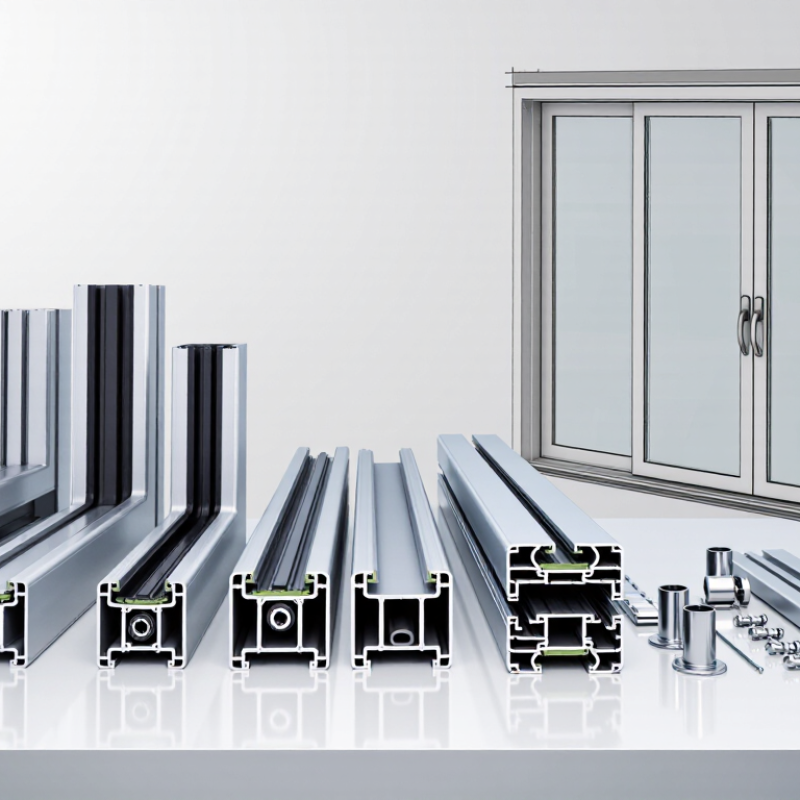
| Outer Frame Profile | Forms the fixed perimeter of the sliding-door system and transfers loads to the wall opening. | 6063, 6060, 6005A, 6061 | T5, T6, T66 | 6063-T5 commonly provides a minimum yield strength of about 110 MPa; stronger tempers and alloys are available. | Residential doors, balcony doors, patio doors, commercial storefronts and interior partitions. | Check wall thickness, frame depth, drainage paths, corner-joint design and compatibility with the glazing system. |
| Sliding Sash Profile | Supports the glass panel and moves along the rollers or track. | 6063, 6060, 6005A | T5, T6, T66 | Generally selected for adequate stiffness, accurate extrusion and moderate structural loading. | Single, double and multi-panel sliding doors. | Confirm sash weight limits, roller position, glass thickness range and weather-seal locations. |
| Meeting Stile / Interlock Profile | Connects the two moving panels and improves weather resistance, security and alignment when the panels close. | 6063, 6060, 6005A | T5, T6 | Strength depends on the profile geometry, wall thickness and reinforcement rather than alloy alone. | Two-panel and four-panel sliding-door systems exposed to wind and rain. | Look for sufficient overlap, gasket channels, anti-lift provisions and compatibility with the lock hardware. |
| Head and Sill / Threshold Profile | Provides the upper and lower frame structure; the sill or threshold also manages drainage and rolling loads. | 6063, 6060, 6005A, 6061 | T5, T6, T66 | Higher-strength alloys or reinforced sections may be preferred for large panels and heavy glazing. | Large patio doors, lift-and-slide doors, low-threshold systems and high-traffic entrances. | Evaluate water drainage, sill height, accessibility requirements, thermal breaks and floor-loading conditions. |
| Glazing Bead / Pressure Plate | Retains the glass or insulated glass unit and secures the glazing gasket. | 6063, 6060 | T5, T6 | Usually does not require the same structural capacity as the main frame members. | Fixed and sliding glazed panels using single glass or insulated glass units. | Verify gasket fit, glass bite, bead retention and the permitted glass thickness range. |
| Track and Roller Rail Profile | Creates the running surface for rollers and helps guide the sliding panel. | 6063, 6060, 6005A, stainless-steel-insert designs where specified | T5, T6 | Requires adequate wear resistance, dimensional stability and local stiffness. | Standard sliding doors, heavy sliding panels and lift-and-slide systems. | Check roller material, replaceability, rail hardness, drainage and resistance to dirt accumulation. |
| Reinforcement Profile | Increases stiffness in long stiles, tall panels, wide sashes and high-wind applications. | 6061, 6005A, 6063 | T6, T651, T66 | 6061-T6 has a typical minimum yield strength of approximately 240 MPa, subject to product standard and section size. | Oversized doors, coastal buildings, high-wind zones and heavy insulated-glass panels. | Use structural calculations to confirm deflection, fastener placement, thermal movement and galvanic compatibility. |
| Fly-Screen / Insect-Screen Profile | Forms a lightweight removable frame for insect mesh installed outside or inside the sliding door. | 6063, 6060 | T5, T6 | Moderate strength is normally sufficient because the screen frame carries limited glass or panel load. | Residential doors, balconies, patios and naturally ventilated rooms. | Confirm mesh retention, corner connectors, screen clearance and resistance to repeated removal. |
| Thermal-Break Profile | Uses a low-conductivity polyamide strip between interior and exterior aluminum sections to reduce heat transfer. | 6063, 6060, 6005A | T5, T6, T66 | Performance is determined by the complete system, including polyamide width, seals, glass and frame geometry. | Energy-efficient residential and commercial sliding doors. | Review thermal transmittance, polyamide strip dimensions, crimping quality, condensation resistance and certification. |
| Corner or Coupling Profile | Joins frame sections or connects multiple door modules while maintaining alignment and sealing. | 6063, 6060, 6061 | T5, T6 | Strength is based on joint design, fasteners, wall thickness and the applied load path. | Corner sliding doors, modular façades and multi-track assemblies. | Check dimensional tolerances, connector compatibility, screw retention and movement allowance. |
| Aluminum Alloy: 6063 | Architectural extrusion alloy with excellent surface finish and good corrosion resistance. | Al-Mg-Si series; widely used for architectural profiles. | T5, T6, T66 | 6063-T5 is commonly used where moderate strength and high extrudability are required. | Frames, sashes, glazing beads, tracks, handles and decorative sections. | Best general-purpose choice for visually exposed profiles and complex cross-sections. |
| Aluminum Alloy: 6060 | Highly extrudable architectural alloy suited to detailed and thin-walled profiles. | Al-Mg-Si series. | T5, T6, T66 | Usually selected for moderate-strength applications where surface quality and extrusion complexity are important. | Lightweight frames, trim, glazing beads and standard residential sliding doors. | Confirm the required strength because its properties can be lower than stronger structural alloys in comparable tempers. |
| Aluminum Alloy: 6005A | Higher-strength extrusion alloy for sections requiring more load capacity than common architectural alloys. | Al-Mg-Si series with increased structural capability. | T5, T6, T66 | Often used when improved strength and stiffness are needed while retaining good extrudability. | Large sashes, heavy-duty frames, thresholds and reinforcement sections. | Confirm availability, welding requirements, temper designation and applicable regional standards. |
| Aluminum Alloy: 6061 | Structural extrusion alloy offering higher strength than typical 6063 architectural sections. | Al-Mg-Si-Cu series. | T6, T651 | 6061-T6 typically has a minimum yield strength of approximately 240 MPa, depending on product form and standard. | Reinforcement members, heavy-duty tracks, large openings and structural connectors. | Surface finish and extrusion complexity may be less favorable than 6063; use where strength justifies the selection. |
| Surface Finish: Anodizing | Electrochemically thickens the natural oxide layer to improve appearance and surface durability. | Suitable for most architectural 6000-series alloys, especially 6063 and 6060. | Alloy temper remains specified separately. | Does not replace structural design; coating performance depends on thickness, sealing and pretreatment. | Exterior frames, coastal applications and modern architectural finishes. | Specify anodic film class or thickness, color consistency, sealing quality and maintenance requirements. |
| Surface Finish: Powder Coating | Applies a cured organic coating for color selection and additional environmental protection. | Commonly applied to 6063, 6060, 6005A and 6061 profiles. | Alloy temper remains specified separately. | Coating durability depends on pretreatment, film thickness, curing and exposure conditions. | Residential, commercial and high-color-variety sliding-door projects. | Request coating class, pretreatment specification, color tolerance, warranty terms and repair procedure. |



 Close