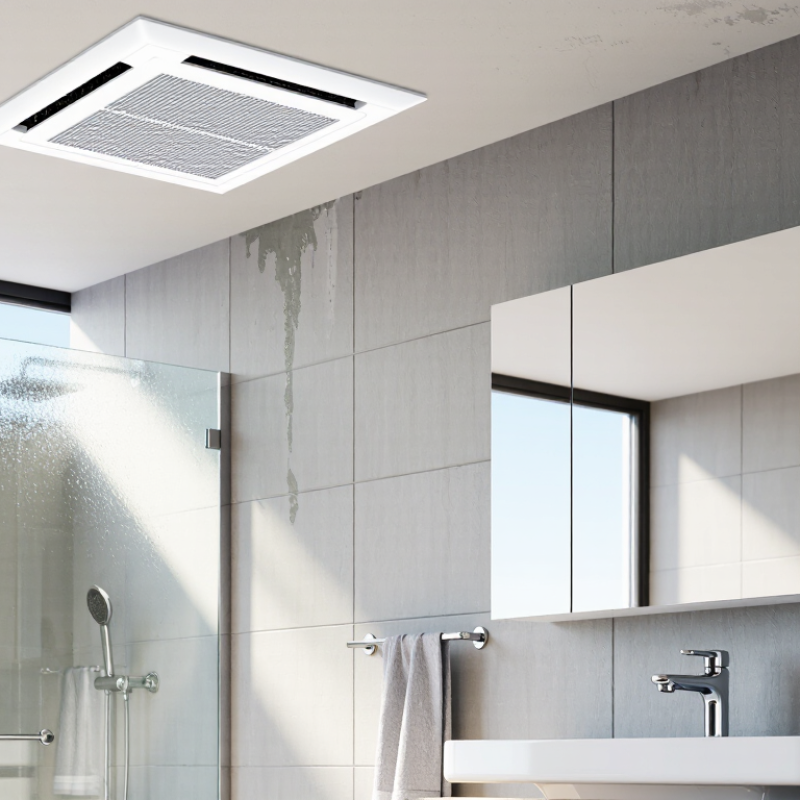
| Basic Function | A mechanical exhaust device that removes humid, odorous, and polluted air from a bathroom and discharges it outdoors. | Airflow is commonly specified in CFM or m³/h. | Correct ventilation helps reduce condensation, mold growth, material deterioration, and indoor discomfort. |
| Minimum Airflow Reference | A commonly used residential ventilation reference for bathrooms is 50 CFM for intermittent operation or 20 CFM for continuous operation. | 50 CFM ≈ 85 m³/h; 20 CFM ≈ 34 m³/h. | Local building codes may require different values, so buyers should verify the destination-market requirements. |
| Small Bathroom Airflow | Suitable capacity for compact bathrooms when the duct route is short and reasonably straight. | Approximately 50–80 CFM, or 85–136 m³/h. | Provides a practical balance between moisture removal, energy use, and operating noise. |
| Medium Bathroom Airflow | Capacity for bathrooms with larger floor areas, more occupants, or longer duct runs. | Approximately 80–110 CFM, or 136–187 m³/h. | Additional capacity can compensate for pressure losses caused by bends, dampers, and extended ductwork. |
| Large or High-Use Bathroom Airflow | Higher capacity for large bathrooms, frequent use, multiple wet areas, or humid climates. | Approximately 110–150 CFM, or 187–255 m³/h, subject to code and duct design. | Helps remove moisture faster, but may require larger ducts, stronger backdraft protection, and more electrical capacity. |
| Noise Level | Sound produced during operation, normally stated in sones. | Quiet models are often around 0.3–1.0 sone; general-purpose models may be about 1.0–3.0 sones. | Lower noise improves comfort and makes users more likely to run the fan long enough to remove moisture. |
| Duct Connection | The outlet diameter must match the exhaust duct to limit airflow restriction. | Common sizes include 4 in / 100 mm and 6 in / 150 mm. | A correctly sized, sealed, and insulated duct generally improves performance and reduces condensation risk. |
| Control Options | The method used to start and stop the fan. | Wall switch, timer, humidity sensor, occupancy sensor, or combined controls. | Timers and humidity controls can extend operation after showering and reduce unnecessary continuous running. |
| Electrical Compatibility | The fan must match the voltage, frequency, wiring method, and protection requirements of the destination country. | Common markets use approximately 100–127 V or 220–240 V at 50 or 60 Hz. | Correct electrical specifications support safe installation and reduce certification or warranty issues. |
| Bathroom Safety | The installation must account for wet locations, clearance zones, grounding, and local electrical regulations. | Use the required protection specified by the applicable local code; do not assume every fan is suitable for direct water spray. | Safety requirements differ by country and installation zone, so professional electrical review may be necessary. |
| Energy Efficiency | The amount of air moved relative to electrical power consumed. | Compare verified airflow, input power in watts, and efficiency values under comparable test conditions. | Efficient operation lowers lifetime electricity costs, especially where the fan runs continuously or frequently. |
| Backdraft Protection | A damper or shutter that helps limit reverse airflow when the fan is off. | Recommended for exterior-wall, roof, and shared-duct installations where reverse airflow may occur. | Can reduce drafts, outdoor odors, insects, and unwanted heat transfer. |
| Installation Position | Fans may be ceiling-mounted, wall-mounted, or remotely mounted in suitable duct systems. | Ceiling installation is common because warm, humid air naturally rises. | Positioning near the shower or bath generally improves moisture capture, provided clearance rules are followed. |
| Maintenance | Routine cleaning of the grille, fan wheel, and accessible duct connection. | Inspect periodically and clean when dust accumulation is visible; follow the installation manual. | Dust buildup can reduce airflow, increase noise, raise energy use, and shorten service life. |
| Global Buyer Checklist | A pre-purchase review of performance, compliance, installation, and logistics. | Confirm airflow test method, noise rating, voltage, frequency, duct size, certificates, dimensions, spare parts, and installation instructions. | A technically suitable fan may still be unsuitable if it cannot be legally installed or serviced in the destination market. |



 Close