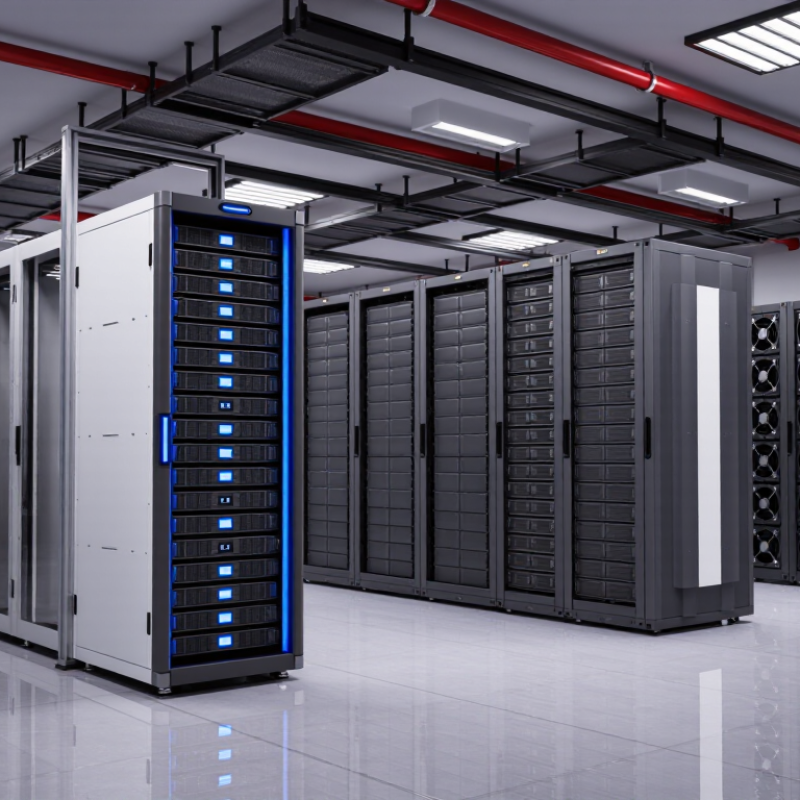
| Low-Voltage 48 V Modular Rack | 48–51.2 V | 16S LFP: 51.2 V nominal 13S NMC: approximately 48.1 V nominal | Parallel battery modules connected to a common DC bus. Each module commonly includes a BMS, contactor, fuse, and service disconnect. | Approximately 2–15 kWh, depending on module capacity and rack height. | Natural convection or low-speed forced air for moderate power levels. | Telecom backup, edge computing, small server rooms, network cabinets, and residential or light commercial UPS systems. | Simple integration and low insulation requirements, but higher current is required for the same power compared with high-voltage systems. |
| 96 V Series-Parallel Rack | 89–102.4 V | 28S LFP: 89.6 V nominal 30S LFP: 96 V nominal | Two or more monitored battery strings arranged in parallel, with module-level balancing and a central rack controller. | Approximately 5–30 kWh per rack. | Natural convection or forced-air cooling, depending on charge and discharge rate. | Medium-size UPS systems, branch data centers, industrial control rooms, and distributed energy storage. | Reduces bus current compared with 48 V designs while retaining relatively accessible service and protection requirements. |
| 192 V High-Voltage Modular Rack | 179–204.8 V | 56S LFP: 179.2 V nominal 60S LFP: 192 V nominal | Series-connected battery modules with a high-voltage BMS, pre-charge circuit, main contactors, current sensor, and isolation monitoring. | Approximately 10–50 kWh per rack. | Forced-air cooling is common for high-power operation; liquid cooling may be used for compact high-density designs. | Three-phase UPS systems, regional data centers, industrial backup power, and microgrid DC storage. | Lower current and cable losses than low-voltage racks; requires controlled pre-charge, HV interlocks, insulation monitoring, and trained service procedures. |
| 384 V Data-Center Battery Rack | 358–409.6 V | 112S LFP: 358.4 V nominal 120S LFP: 384 V nominal | Multiple series modules installed in a 19-inch or wider cabinet, with rack-level BMS communication, DC protection, and optional parallel racks. | Approximately 20–100 kWh per rack. | Forced air for moderate C-rates; liquid cooling can support higher continuous power and greater enclosure density. | Medium and large data centers, high-power UPS systems, renewable-energy buffering, and industrial DC distribution. | A practical balance between current reduction, conversion efficiency, rack scalability, and service complexity. |
| 512 V High-Density Rack | 480–537.6 V | 160S LFP: 512 V nominal 144S NMC: approximately 533 V nominal | High-voltage battery modules connected in series, usually with redundant sensing, HV contactors, pre-charge, insulation monitoring, and system-level controls. | Approximately 30–150 kWh per rack. | Air cooling is possible at low C-rates; liquid cooling is increasingly suitable for high-power and high-density deployments. | High-density data centers, large UPS plants, peak-shaving systems, and behind-the-meter commercial storage. | Efficient for high power because current is reduced, but clearances, creepage distances, arc-flash controls, and commissioning procedures become more demanding. |
| 650–800 V DC Modular Rack | 640–800 V | 200S LFP: 640 V nominal 250S LFP: 800 V nominal 216S NMC: approximately 799 V nominal | High-voltage series strings or modular sub-racks connected to a common DC bus, with coordinated rack, string, and system-level battery management. | Approximately 50–250 kWh per rack, subject to enclosure size, module capacity, and permitted thermal limits. | Liquid cooling is often preferred for high-power operation; monitored forced air may be adequate for lower C-rates. | Large-scale data centers, direct-DC architectures, high-power UPS systems, renewable integration, and utility or microgrid storage. | Minimizes current and conductor size for high-power systems, but demands robust isolation monitoring, HVIL, pre-charge, arc-flash mitigation, and specialized maintenance controls. |
| Scalable Parallel-Rack System | 48–800 V, system dependent | Series cell count is selected to match the DC bus; identical racks are paralleled through protected feeders or a DC combiner. | Repeated battery racks with independent BMS units, coordinated master controller, branch protection, and monitored rack disconnects. | From approximately 20 kWh to more than 1 MWh across multiple racks. | Cooling is selected according to total rack power, ambient conditions, enclosure density, and allowable cell temperature spread. | Modular data-center expansion, distributed UPS rooms, campus energy storage, and phased infrastructure upgrades. | Supports capacity growth and maintenance isolation; parallel protection, current sharing, communication redundancy, and fault coordination must be engineered carefully. |



 Close