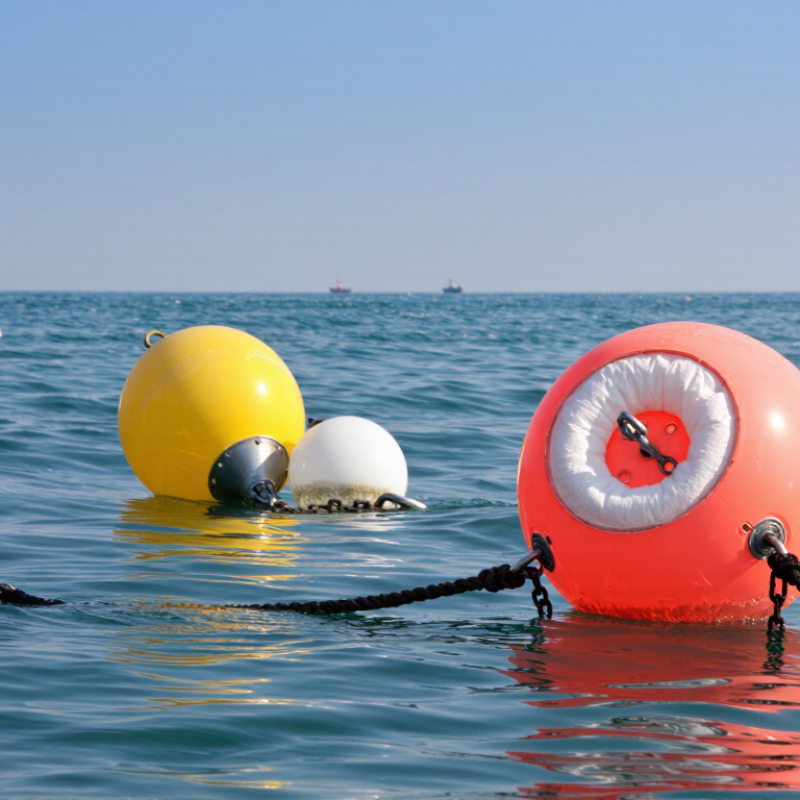
| Spherical | Typically a tough polymer outer shell around closed-cell buoyant foam, with a reinforced attachment point. | Provides buoyancy in a compact form. Its near-symmetrical shape responds similarly from different directions, though it can move noticeably in waves. | General-purpose moorings, small craft, and applications where a compact float is suitable. | No preferred horizontal orientation; easy to identify and handle in many small-to-medium sizes. | Check attachment strength, buoyancy capacity, freeboard under load, and whether wave movement is acceptable. |
| Cylindrical | Commonly a molded polymer shell with foam filling and a central or end-mounted load-bearing fitting. | A vertical cylinder can offer a relatively broad waterplane; a horizontal cylinder behaves differently and may roll. Orientation and mooring layout matter. | Mooring systems, workboat and marina applications, and installations requiring a visible, robust float. | Straightforward geometry can provide useful buoyancy and space for robust fittings. | Confirm intended operating orientation, dimensions, load path, and resistance to rolling or impact in the site conditions. |
| Conical or tapered | Usually a shaped polymer shell with foam filling; hardware is designed to transfer mooring loads into the structure. | The tapered profile changes how the buoy meets the water and can help shed water or reduce snagging, depending on its orientation and design. | Mooring and utility uses where the profile, visibility, or handling characteristics suit the installation. | A shaped profile may be useful where a broad, blunt form is undesirable. | Compare the actual displacement and attachment design rather than assuming taper alone improves stability or strength. |
| Pick-up / small mooring buoy | Often a compact foam-filled float with a molded or reinforced line attachment; shell and fitting details vary by duty. | Designed primarily to keep a pick-up line accessible at the surface, not to support a vessel or carry a large sustained mooring load by itself. | Marking the end of a line or helping retrieve a mooring line. | Compact and convenient for line retrieval and visibility. | Do not size it as the primary mooring buoy unless the manufacturer’s rated application and load data support that use. |
| Elongated / torpedo-style | An elongated foam-filled body, commonly with reinforced end fittings or a through-body load-bearing arrangement. | Its long profile can suit line or cable arrangements, but performance depends on how the buoy is oriented and connected. It may be more direction-sensitive than a spherical form. | Selected mooring, line-support, or utility installations where an elongated profile fits the layout. | Can align with a line arrangement and may provide useful buoyancy along a narrow footprint. | Verify orientation, bending and attachment loads, clearance, and suitability for the local wave and current conditions. |
| Large heavy-duty mooring buoy | Often uses a thick polymer shell, closed-cell foam, and substantial internal or through-body steel hardware; specific designs differ. | Greater displacement can support heavier mooring arrangements, but increased size also affects wind and wave loading, handling, and installation requirements. | Commercial, workboat, or other higher-capacity mooring systems when engineered for the specified loads. | Can provide higher buoyancy and robust attachment options when correctly specified. | Request rated working loads, buoyancy and freeboard data, fitting details, inspection guidance, and installation requirements. |



 Close