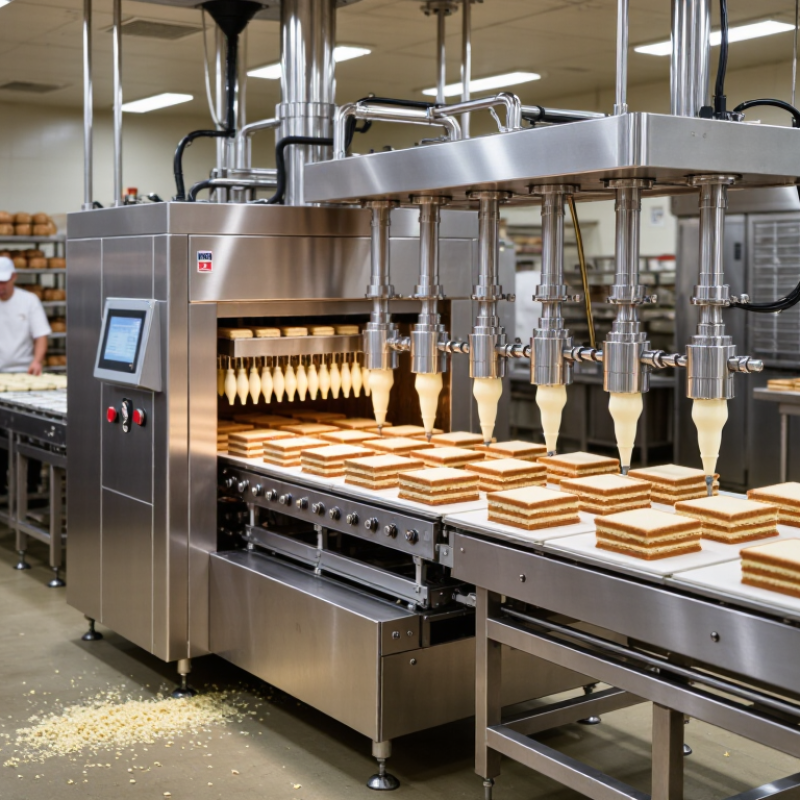
| Machine definition | A sandwich cake machine automates one or more steps in assembling cake layers with a filling between them. | Depending on the model, it may deposit filling, align layers, press or transfer the assembled cake, or combine several of these operations. | Confirm exactly which steps are included; the term does not describe one standard machine configuration. |
| Typical product | A layered cake made from two or more cake sheets or pieces with cream, jam, icing, or another suitable filling between layers. | Products can be round, rectangular, or formed in other shapes, depending on the feed system and tooling. | Test the machine with the actual cake dimensions, softness, surface condition, and filling recipe. |
| Basic operating sequence | The machine positions a cake layer, applies filling, and places or aligns another layer to form a sandwich. | A production line may then include cooling, cutting, decoration, or packaging equipment. | Check how the machine connects to upstream baking and downstream handling equipment. |
| Filling system | Controls how filling is delivered to the cake layer. | Possible methods include depositing through nozzles or spreading through a dispensing head; suitability depends on filling texture and temperature. | Ask about portion adjustment, nozzle or head changes, drip control, and performance with the intended filling. |
| Layer handling | Moves and aligns cake layers while limiting breakage or distortion. | Feed systems may be manual, semi-automatic, or integrated into an automated line. | Evaluate alignment accuracy, product changeover, and handling of fragile or irregular layers. |
| Capacity and speed | Output depends on the machine design, product size, filling method, operator input, and line layout. | Manufacturers may state output as cakes per minute or per hour; these figures are not directly comparable unless product and operating conditions match. | Request a production test using your product and confirm whether quoted output is sustained operating output or a maximum rate. |
| Product flexibility | Describes how readily the equipment can handle different cake sizes, shapes, layer counts, or fillings. | Flexibility may require adjustable guides, interchangeable parts, or recipe and setting changes. | Check the supported product range and the time, tools, and parts required for changeovers. |
| Controls and dosing | Controls help operators set and repeat machine functions such as conveyor movement and filling delivery. | Control complexity varies by model; some machines use basic adjustments, while others offer programmable settings. | Check setting repeatability, operator training needs, and whether filling quantity can be adjusted for each product. |
| Cleaning and hygiene | Food residue and allergens must be managed through suitable cleaning procedures and equipment design. | Removable product-contact parts and accessible surfaces can make inspection and cleaning easier. Food-contact materials should be identified by the supplier. | Ask for cleaning instructions, disassembly steps, material documentation, and compatibility with the facility’s sanitation procedures. |
| Installation requirements | The machine must fit the available production space and connect to required utilities and line equipment. | Requirements vary by model and may include electrical supply, compressed air, conveyor connections, and access for cleaning and maintenance. | Obtain the machine footprint, utility specifications, service clearances, and installation requirements before ordering. |
| Maintenance and support | Routine inspection and maintenance help keep the equipment operating consistently. | Common considerations include wear parts, lubrication requirements, spare-part availability, and access to technical support. | Request a maintenance schedule, recommended spare-parts list, warranty terms, and training details. |
| Best-fit buying approach | The right machine is the one that fits the product, production target, workforce, and plant layout. | Compare equipment using the same cake size, filling, operating hours, and cleaning expectations. | Prioritize a product trial and a written specification covering output, changeover, cleaning, utilities, and support. |



 Close