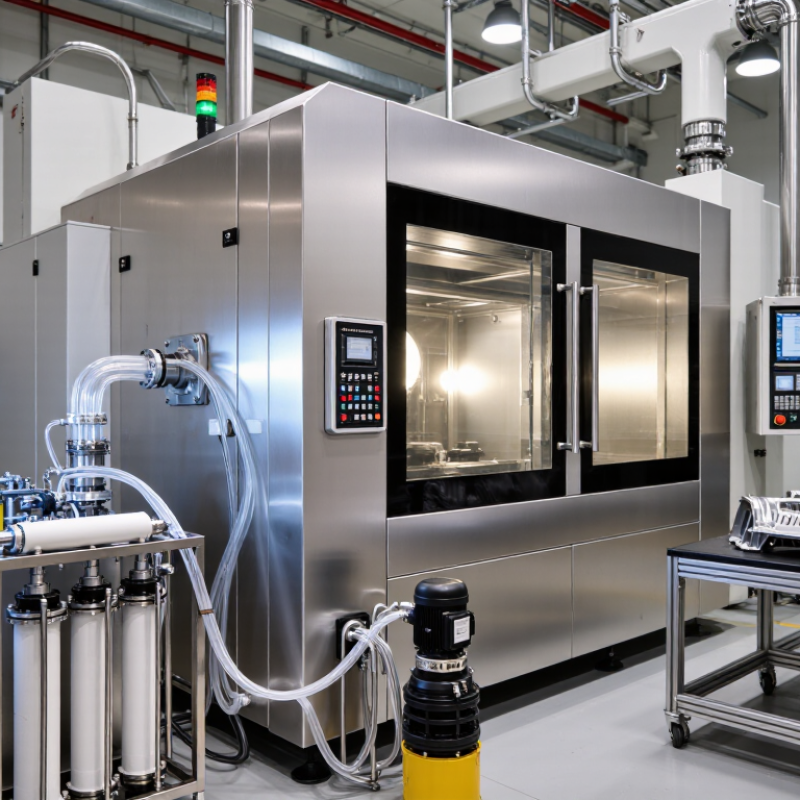
| Cleaning medium | Non-halogenated hydrocarbon solvents are commonly used to remove oils, greases, and similar residues. | Confirm solvent compatibility with the workpiece materials, soil type, and required cleanliness level. |
| Process enclosure | A sealed, vacuum-rated chamber contains the cleaning process and supports controlled solvent handling. | Compare usable chamber dimensions with the largest parts, baskets, and production loads. |
| Process stages | Typical systems can combine washing, draining, rinsing, and drying; the available sequence depends on the machine configuration. | Check which stages are included and whether the recipe can be adjusted for different parts and soils. |
| Vacuum-assisted drying | Reduced pressure lowers a liquid’s boiling point and can help remove solvent from cavities and complex geometries. | Request process validation for the actual part geometry, solvent, and required residual-solvent limits. |
| Solvent management | Closed-loop designs can limit solvent loss; some configurations include filtration, distillation, or solvent recovery options. | Identify included recovery equipment, maintenance needs, and how spent solvent and residues are handled. |
| Filtration and soil control | Particle filtration can help maintain solvent cleanliness. Filtration arrangements vary by system and process. | Check filter ratings, replacement intervals, and whether the filtration method addresses the actual contamination. |
| Process controls | Industrial systems typically manage process steps using setpoints such as time, temperature, and pressure. | Review recipe storage, alarms, process-record export, and controls for repeatable production cycles. |
| Safety provisions | Equipment design may include chamber interlocks, pressure monitoring, and controls for solvent-related hazards. | Confirm applicable local requirements, installation conditions, ventilation needs, and the machine’s safety documentation. |
| Cleanliness verification | Part-cleanliness requirements are application-specific. ISO 16232 provides methods for assessing particulate contamination on road-vehicle components. | Agree on the inspection method and acceptance criteria before testing or production approval. |
| Operating cost factors | Energy use, solvent consumption, cycle time, maintenance, and throughput all affect the total cost of operation. | Compare documented cycle data using representative parts and a consistent production schedule. |
| This table describes general equipment characteristics and selection criteria, not specifications or rankings for individual manufacturers. Exact capabilities depend on the machine model, solvent, process, and applicable regulations. |



 Close