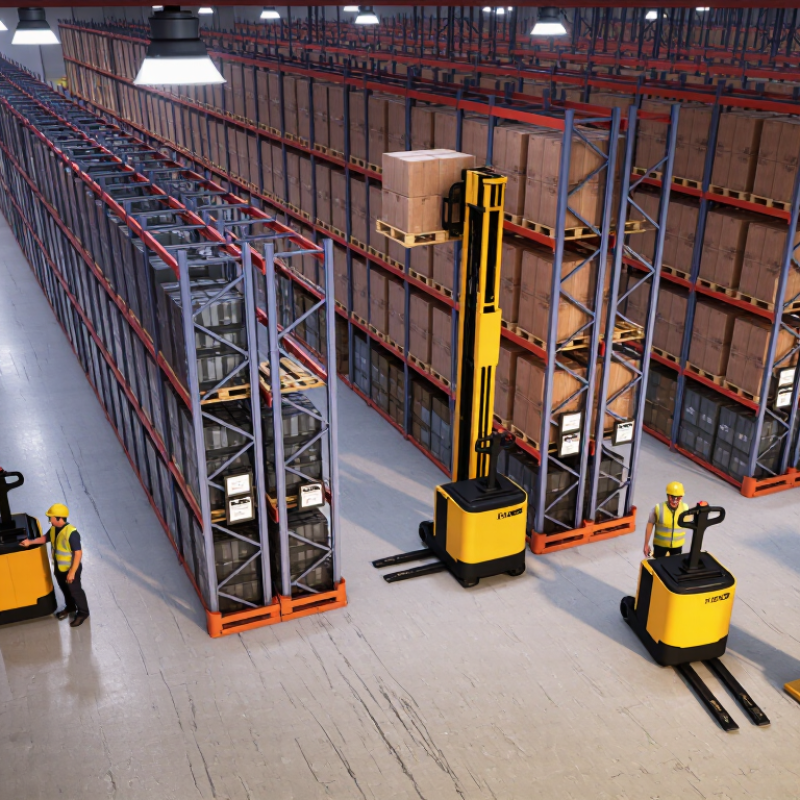
Choosing an electric stacker begins with the work pattern, not the highest advertised lift. Pedestrian models suit short travel, narrow aisles, and occasional pallet movement. Their compact chassis gives close control around storage racks. Platform models reduce walking over longer routes. Rider versions can improve throughput when pallets travel across a busy warehouse. Yet extra speed can expose poor aisle planning. Measure actual traffic first.
Lifting configuration changes more than height. A simplex mast offers limited lift and keeps the machine relatively low. It works where overhead clearance is restricted. Duplex masts provide greater elevation, often with useful free lift for low roofs or containers. Triplex masts reach higher locations while collapsing to a manageable transport height. Free lift matters when forks rise before mast sections extend. Check ceiling height, beam height, pallet weight, and load center. A small error here becomes expensive.
Capacity also depends on travel surface, battery condition, and turning space. Counterbalanced electric stackers handle loads without extended support legs, but they need wider aisles. Straddle-leg designs work well with open-bottom pallets, although leg clearance can limit flexibility. Review the residual-capacity chart at the exact lifting height. Do not rely on the rated maximum alone. The first configuration is often not the best one. I would rather accept slower lifting than choose a mast that repeatedly meets the ceiling. Test the stacker with a real pallet, uneven flooring, and the operators who will use it.



 Close