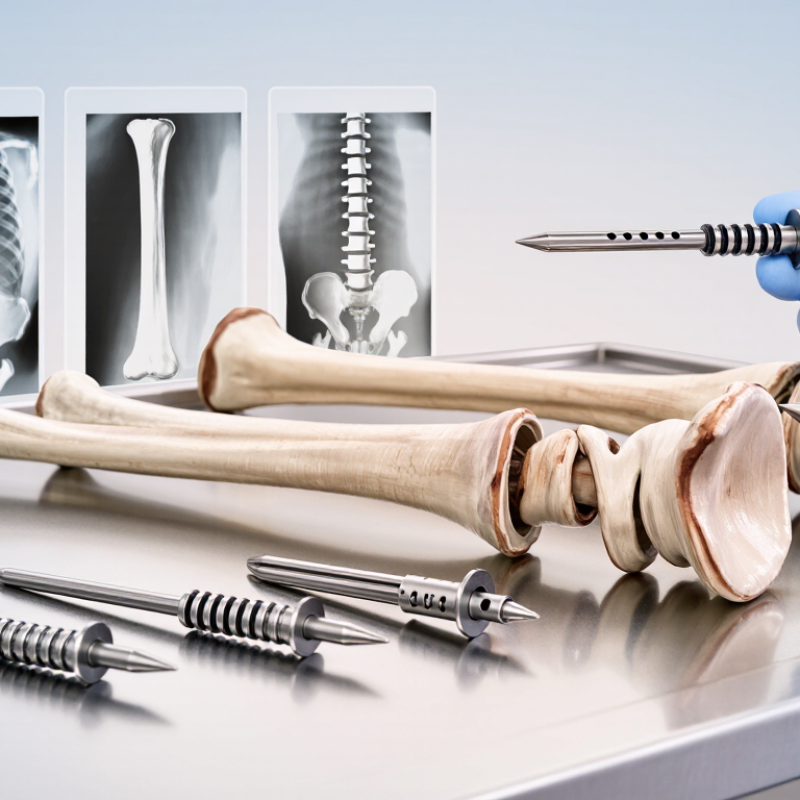
| Femoral shaft nail (antegrade) | Many fractures of the femoral shaft; inserted through an entry point near the hip. | Usually titanium alloy or stainless steel, depending on the system. | Proximal and distal transverse screws; static or dynamic configurations may be available. | Provides internal alignment and rotational control; locking can support length and stability in many fracture patterns. | Entry point, nail curvature, fracture location, and nearby anatomy matter. Proximal entry can affect the hip abductor region. |
| Femoral shaft nail (retrograde) | Selected femoral shaft fractures; inserted through the knee end of the femur. | Usually titanium alloy or stainless steel. | Distal and proximal interlocking screws; some designs offer multiple distal screw orientations. | Can be useful when an antegrade approach is unsuitable or when positioning and associated injuries favor a knee-entry approach. | The knee joint entry site and distal fracture pattern require consideration; not every fracture is suitable for this approach. |
| Cephalomedullary nail | Many intertrochanteric and subtrochanteric fractures of the proximal femur. | Commonly titanium alloy or stainless steel. | A large proximal head element, such as a screw or blade, plus distal locking screws; some designs allow controlled sliding. | Combines an intramedullary load-sharing implant with fixation into the femoral head and neck. | Head-element position, reduction quality, bone quality, and fracture stability influence fixation. Risks include cut-out or cut-through. |
| Tibial nail | Many tibial shaft fractures, including selected proximal or distal shaft patterns. | Usually titanium alloy or stainless steel. | Proximal and distal transverse screws; multiple locking directions may help control short or metaphyseal segments. | An intramedullary position can provide load-sharing fixation and allow options for early movement when clinically appropriate. | Proximal and distal fractures can be harder to align and control. Soft-tissue condition, entry technique, and screw placement are important. |
| Humeral nail | Selected fractures of the humeral shaft and, with appropriate designs, some proximal humeral fractures. | Usually titanium alloy or stainless steel. | Proximal and distal locking screws; configuration varies by nail design and fracture location. | Provides internal fixation without a long plate along the shaft; may be considered for selected fracture patterns and patients. | Shoulder entry can affect the rotator cuff, and distal locking must account for nearby nerves. Fracture pattern and patient factors guide selection. |
| Flexible or elastic nails | Selected pediatric long-bone fractures, particularly in skeletally immature patients. | Commonly titanium alloy or stainless steel; material and flexibility vary by system. | Typically paired flexible nails provide opposing support; conventional interlocking screws are not usually the primary locking method. | Small incisions and flexible fixation can suit selected pediatric fractures while avoiding a long plate. | Best suited to specific age groups and fracture patterns. Nail prominence, alignment, and growth-plate considerations need attention. |
| Long versus short nail | Available in some femoral and tibial nail systems; selected according to fracture extent and anatomy. | Material depends on the specific implant system; titanium alloy and stainless steel are common. | Short nails generally have fewer distal locking options; long nails typically extend farther along the bone and use distal locking screws. | A longer nail can span more of the bone; a shorter nail may require less extensive insertion in suitable cases. | Length should match the fracture, bone anatomy, and implant plan. A short nail is not suitable for every fracture pattern. |



 Close