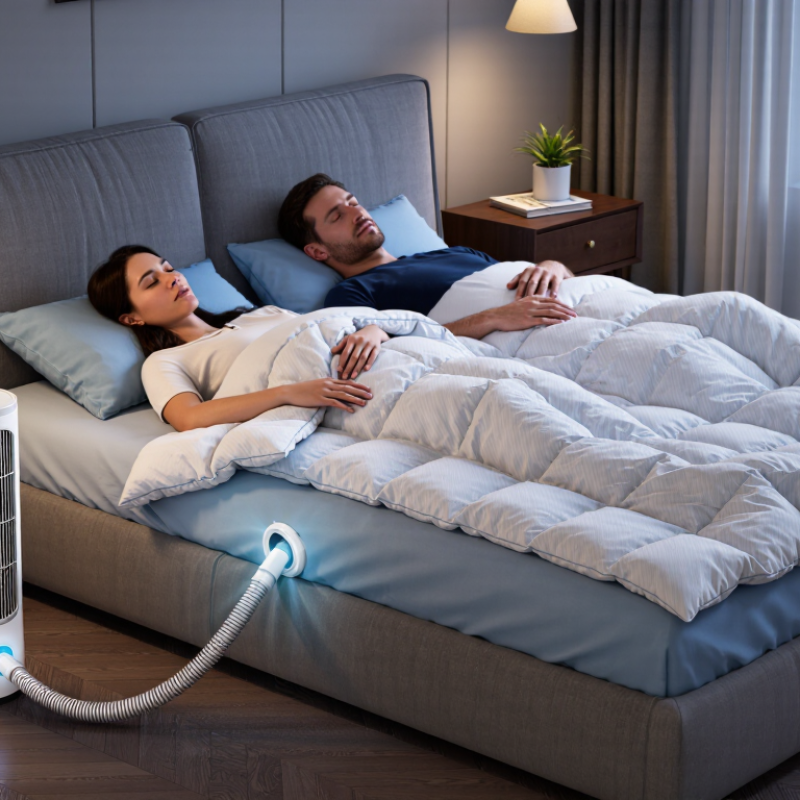
| Airflow direction | Channels air beneath the top sheet or bedding. | Directs air toward a localized area of the bed. | Circulates air through a wider area of the room. | Check whether airflow reaches the sleeper where needed and remains comfortable during the night. |
| Coverage | Can distribute airflow across a larger portion of the bed when the outlet and bedding are positioned correctly. | Usually provides more focused airflow; coverage depends on fan angle and distance. | May cover the room, but airflow at the bed can vary with placement and obstacles. | Consider bed width, whether one or two people will use it, and whether each sleeper needs separate airflow. |
| Noise | Sound comes mainly from the fan and may be softened by distance or placement. | Sound is close to the sleeper, so motor and air noise may be more noticeable. | Noise depends on fan size, speed, distance, and room acoustics. | Compare sound measurements in dBA at a stated distance and speed. Measurements taken under different conditions are not directly equivalent. |
| Airflow adjustment | May offer several fan speeds; available controls vary by design. | Often adjusted by changing speed, direction, or fan position. | Typically adjusted through speed and oscillation settings, if included. | Look for easy-to-reach controls and enough low-speed adjustment for comfortable overnight use. |
| Temperature function | Moves air; a fan alone does not actively cool or heat air. | Moves room air and does not actively change its temperature. | Moves room air and does not actively change its temperature. | Check the product’s stated functions carefully. Active heating or cooling requires additional equipment beyond a standard fan. |
| Setup and bed compatibility | May need space near the bed and a clear path for its air outlet or duct. | Needs a stable bedside surface or a compatible place to clip the fan. | Needs suitable floor or tabletop space and a safe position for its power cord. | Check clearance, bed-frame design, outlet placement, and whether the setup interferes with bedding or walking paths. |
| Power use | Depends on the fan motor, selected speed, and hours of operation. | Depends on motor power and operating speed. | Depends on fan size, motor, speed, and operating time. | Compare rated power in watts. Estimated energy use in kWh equals watts × hours ÷ 1,000. |
| Cleaning and upkeep | Check whether the air inlet, outlet, and any duct or fabric components can be accessed for cleaning. | Check access to the grille and fan blades, and whether the clip or base stays secure. | Check whether the grille and blades can be cleaned safely according to the instructions. | Choose a design that can be maintained without damaging electrical parts or airflow components. |
| Best fit | Sleepers who want airflow directed beneath bedding. | Sleepers who prefer adjustable, localized airflow near the bed. | Sleepers who want general room circulation as well as airflow near the bed. | The best choice depends on airflow preference, noise sensitivity, bed layout, and intended use—not on a single feature alone. |



 Close