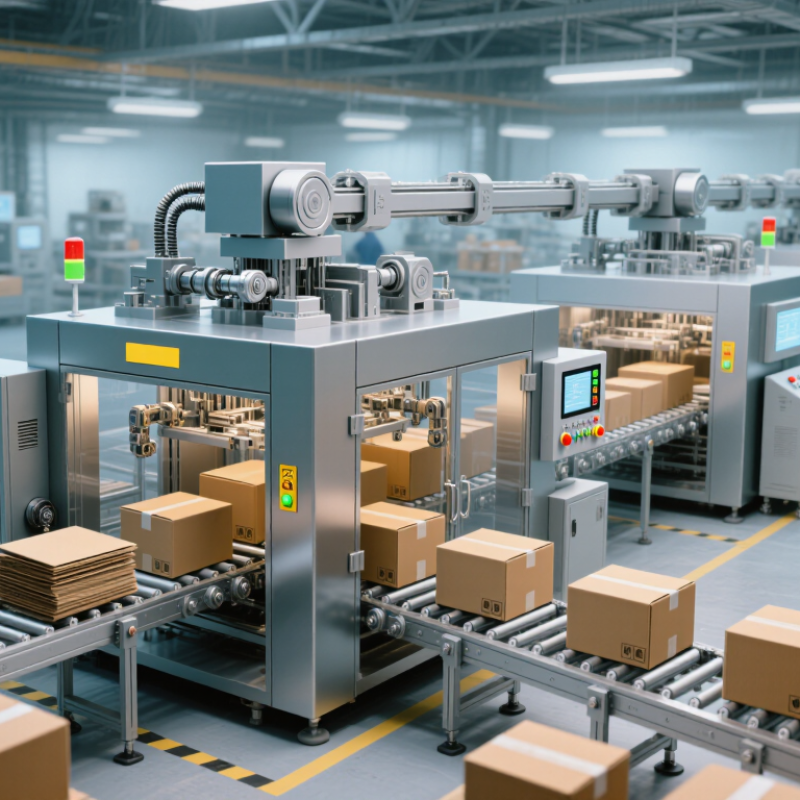
| Semi-Automatic Carton Former | Pre-glued folding cartons or manually loaded carton blanks | Approximately 10–30 cartons/minute | Commonly suitable for small and medium carton formats; confirm blank and finished dimensions with the supplier | Start-ups, seasonal production, multiple product sizes, and lower-volume operations | CE where applicable
Electrical safety documentation
Food-contact verification for product-contact parts | Best for flexibility and lower initial investment |
| Intermittent-Motion Carton Former | Folding cartons sealed by hot-melt adhesive or mechanical locking | Approximately 30–80 cartons/minute | Often supports small-to-medium cartons, subject to board quality, glue pattern, and carton design | Pharmaceutical, personal-care, food, and general consumer-goods production | CE where applicable
Risk assessment and guarding
ISO 9001 supplier quality system
Food-contact declarations when required | Best balanced option for varied global applications |
| Continuous-Motion Carton Former | High-volume folding cartons with consistent blank dimensions | Approximately 80–200+ cartons/minute | Usually optimized for defined carton ranges and stable board specifications | Large-scale production with long runs and high line utilization | CE where applicable
UL/NRTL review for North America
Servo and control-panel documentation
Formal factory acceptance testing | Best for maximum throughput and repeatability |
| Corrugated Case Erector | Regular slotted cases and other corrugated shipping boxes | Approximately 8–40 cases/minute | Commonly handles several case sizes; exact range depends on board grade and machine design | Logistics, e-commerce, warehousing, food distribution, and industrial packaging | CE where applicable
UL/NRTL review for North America
Pneumatic safety and guarding
Food-contact review if the box directly contacts unpackaged food | Best for shipping-case automation rather than retail cartons |
| Monoblock Carton Forming and Packing Line | Carton forming integrated with product loading and closing | Approximately 40–150 cartons/minute, depending on product and layout | Defined by the carton, product, loading pattern, and downstream sealing method | High-volume food, pharmaceutical, and consumer-product lines | CE where applicable
UL/NRTL review for North America
HACCP or hygienic-design assessment where relevant
Food-contact declarations for applicable materials | Best for integrated lines and reduced manual handling |
| CE Marking and EU Requirements | For machinery placed on the European Economic Area market, request the applicable CE marking, EU Declaration of Conformity, risk assessment, technical documentation summary, operating instructions, and safety-device information. | Confirm that the CE documentation covers the complete machine configuration, including integrated conveyors, electrical cabinets, guarding, and control systems. | Required when applicable to the destination market and machine category |
| UL and North American Electrical Compliance | UL certification is not automatically mandatory for every machine in the United States. However, local authorities, insurers, or end users may require evaluation by an accepted Nationally Recognized Testing Laboratory. | Request electrical schematics, panel component ratings, grounding details, short-circuit current information, and evidence of compliance with the buyer’s applicable electrical code and site requirements. | Confirm with the local authority, insurer, and end user before purchase |
| ISO 9001 | ISO 9001 certifies a supplier’s quality-management system; it does not certify that a specific machine is safe, sanitary, or suitable for food contact. | Verify the certificate scope, issuing certification body, validity period, manufacturing site, and whether design, assembly, testing, and after-sales service are included. | Strong supplier-quality indicator, but not a substitute for product compliance |
| Food-Contact Requirements | When the machine or its components may contact unpackaged food, request material declarations and migration or compliance evidence appropriate to the destination market. | Common reference frameworks include applicable FDA food-contact requirements in the United States and Regulation (EC) No 1935/2004, together with relevant EU good manufacturing practice requirements. | Applies only to product-contact or contamination-sensitive components |
| Safety and Technical File | Check emergency stops, interlocked guards, pinch-point protection, lockout provisions, pneumatic safeguards, noise information, warning labels, and safety validation records. | Documentation should be supplied in the language required by the destination market and should identify the machine model, serial number, applicable standards, and test results. | Essential for import clearance, installation, auditing, and operator training |
| Factory Acceptance and Site Acceptance Testing | Define tests for speed, carton dimensions, changeover time, glue performance, rejection rate, guarding, emergency stops, and continuous operation before shipment. | Use approved carton samples and the buyer’s actual board, adhesive, product, and electrical specifications whenever possible. | Recommended for all international purchases, especially high-speed lines |



 Close
Close