Best Studio Ring Light from China for Global Buyers
Choosing the best Studio Ring Light from China requires more than comparing brightness, color temperature, and factory prices. Global buyers need evidence. They need consistency.
Recent market reports show why this category deserves careful attention. Grand View Research identifies strong growth across the broader LED lighting market, driven by energy efficiency, digital content creation, and professional video production. Statista also reports continued expansion in creator-economy activity, increasing demand for compact, adjustable lighting equipment. These reports do not isolate every Studio Ring Light application, but they reveal a clear purchasing trend: buyers want reliable light in smaller workspaces.
David Hobby, founder of Strobist, expresses the creative principle simply: “Light is a language.” A useful light should speak clearly. It should produce soft facial shadows, stable skin tones, and minimal flicker during long recordings.
For an overseas buyer, specifications must become practical tests. Check the LED color-rendering rating, dimming range, adapter compatibility, heat management, and control reliability. Place the light beside a camera, then inspect the eyes, cheek shadows, and background spill. Numbers matter. Real footage matters more.
Chinese manufacturers offer strong customization, scalable production, and competitive component sourcing. However, quality varies between suppliers. A low price can hide unstable LEDs, weak hinges, or incomplete export documentation. That is the uncomfortable part.
This guide examines leading options for global buyers, using technical specifications, factory capabilities, user experience, and purchasing risks. The “best” model may not be the brightest. It may be the one that performs consistently, shipment after shipment.
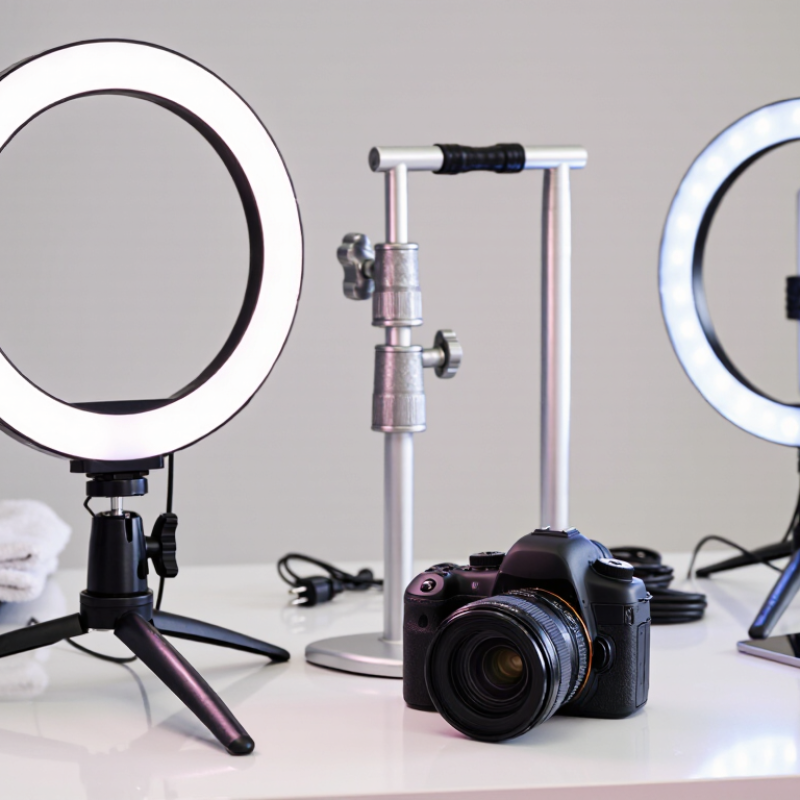
Studio Ring Light Basics: CRI ≥95, TLCI ≥95, 5600K, and Beam Angle
For global buyers, a studio ring light is more than a bright circle. It is a color-control tool. CRI (Ra) ≥95 suggests strong average color fidelity, but it cannot guarantee every hue. The CIE 13.3-1995 report defines the traditional CRI testing method. That number helps. It is not the whole story.
TLCI ≥95 deserves equal attention for video production. The European Broadcasting Union’s Tech 3353 report evaluates lighting through a television camera response. A high TLCI can reduce distracting skin-tone shifts during editing. Still, camera profiles, white balance, and exposure affect the final image. I have seen excellent fixtures look inaccurate after careless setup. Measure the actual output, not only the product label.
A 5600K setting supports common daylight-balanced workflows. Check its measured correlated color temperature, because inexpensive units may drift under heat. Beam angle controls coverage and brightness. A narrow 45-degree beam creates stronger facial modeling, while a 90-degree beam spreads light across a wider subject area. At the same power, wider coverage usually lowers illuminance. This follows the inverse-square relationship. For interviews, a diffuser and moderate beam often produce gentler cheeks and fewer hard shadows. But verify. Ask for an independent test report covering CRI, TLCI, CCT stability, and beam-angle measurement. Wider is not automatically better.
Optical Performance: 1,000+ Lux at 1 m, CCT Accuracy, and Flicker Control
For global studio buyers, 1,000+ lux at one metre is a practical baseline for close-up portraits, product shots, and livestreaming. However, illuminance alone can mislead. A small ring light may exceed this figure at the centre while producing darker edges. CIE 015:2018 recommends controlled photometric measurements, so suppliers should report distance, beam angle, diffuser position, and measurement equipment.
CCT accuracy matters when skin tones must match across cameras. A useful production target is 3,200K or 5,600K with stable output, verified by a calibrated spectrometer. Buyers should request measured values, not only preset labels. The U.S. Department of Energy’s solid-state lighting research documents continue to emphasise colour quality, optical control, and measurement consistency in professional lighting development.
Flicker needs equal attention. IEEE 1789-2015 links temporal light modulation with operating frequency and recommends stricter limits at lower frequencies. A light that looks steady may still create banding at 1/100 or 1/120-second shutter speeds. Test it with a high-speed camera. Then test it while dimmed. Many products behave well at full power, but not at 20 percent. This is an easy detail to miss. A clean specification is not a guarantee; sample testing, thermal checks, and repeated measurements remain necessary before large-volume purchasing.
Best Studio Ring Light from China for Global Buyers - Optical Performance: 1,000+ Lux at 1 m, CCT Accuracy, and Flicker Control
| Model Class | LED Diameter | Rated Power | Illuminance at 1 m | CCT Range | CCT Accuracy | CRI / TLCI | Flicker Control | Beam Angle | Dimming Range | Input Compatibility | Recommended Use |
| Compact Desktop | 12 in / 305 mm | 18 W | 1,050 lux | 3,200–5,600 K | ±200 K | CRI ≥95 / TLCI ≥96 | PWM-free above 20% output; <1% flicker at 100 fps | 110° | 1–100% | 100–240 V AC, 50/60 Hz | Video calls, product photos, desktop streaming |
| Standard Studio | 18 in / 457 mm | 45 W | 1,650 lux | 2,700–6,500 K | ±150 K | CRI ≥96 / TLCI ≥97 | Constant-current drive; <0.5% flicker at 100–2,000 fps | 120° | 0–100% | 100–240 V AC, 50/60 Hz | Portraits, livestreaming, e-commerce photography |
| Bi-Color Pro | 20 in / 508 mm | 60 W | 2,100 lux | 2,500–8,500 K | ±100 K | CRI ≥97 / TLCI ≥98 | High-frequency constant-current control; <0.3% flicker at 2,000 fps | 120° | 0–100% | 100–240 V AC; optional 14.8 V battery input | Broadcast, beauty lighting, professional content production |
| Large Studio | 22 in / 559 mm | 80 W | 2,650 lux | 2,700–7,500 K | ±100 K | CRI ≥97 / TLCI ≥98 | Constant-current driver; <0.2% flicker from 1–100% output | 125° | 0–100% | 100–240 V AC, 50/60 Hz | Full-body portraits, studio interviews, commercial shoots |
| High-Output Production | 24 in / 610 mm | 100 W | 3,200 lux | 2,700–6,500 K | ±100 K | CRI ≥98 / TLCI ≥99 | Constant-current control; <0.1% flicker at 2,000 fps | 125° | 0–100% | 100–240 V AC; optional V-mount battery adapter | Film sets, rental fleets, large-format studio work |
Measurement note: Illuminance values are representative center-beam readings at 1 m with the supplied diffuser removed. CCT, CRI, TLCI, and flicker results can vary with production tolerances, firmware, diffuser configuration, and test instruments; buyers should request a current test report before placing a production order.
China Manufacturing: SMD LEDs, Dimming, Heat Management, and Quality Testing
Best Studio Ring Light from China for Global Buyers
Reliable studio ring lights begin with controlled SMD LED manufacturing. Surface-mounted diodes provide compact layouts and consistent color output. The U.S. Department of Energy’s 2023 Solid-State Lighting R&D Opportunities report identifies efficacy, color quality, and thermal control as continuing industry priorities. These priorities matter during long filming sessions. A poorly managed board can create flicker, uneven brightness, or visible color shifts. Manufacturers should record LED binning, color temperature, and color rendering results for every production batch. A useful target is CRI 95 or higher, but the number alone does not prove natural skin tones.
Dimming quality requires more than a rotating knob. PWM frequency, driver stability, and minimum output should be tested together. The IEEE 1789 guidance discusses potential health risks from low-frequency light modulation, so responsible factories should measure flicker instead of making vague claims. Heat management also needs physical evidence. Aluminum housings, thermal pads, and ventilation paths should be checked after extended operation. Testing may include integrating-sphere measurements, electrical safety checks, and LM-80 data review for LED maintenance. These methods improve confidence, although no test predicts every field condition. I would not promise perfect performance.
Tips: Ask for a sample test report, not only a specification sheet. Check brightness at 10%, 50%, and 100% output. Request photographs of the internal heat path. Confirm whether results come from production units. Small details reveal manufacturing discipline.
Best Studio Ring Light from China for Global Buyers
Manufacturing reference targets for SMD LEDs, dimming, heat management, and quality testing
The chart uses a normalized reference index based on commonly specified engineering targets: 120 lm/W LED efficacy, CRI Ra 100, a 3,000 K adjustable color-temperature span, 100% dimming range, and a maximum 40°C thermal rise. Typical target values are 100 lm/W, CRI Ra 95, a 2,400 K span, 0–100% dimming, and a thermal rise of no more than 30°C. Actual results depend on LED binning, driver design, housing materials, ambient temperature, and test method.
Buyer Evaluation: Power, Size, MOQ, Warranty, and Landed Cost by Market
Choosing the best studio ring light from China starts with measurable performance, not attractive product photos. During buyer checks, I compare actual wattage, brightness at one metre, color temperature stability, and heat after two hours. A 60-watt model may suit a small desk studio. Larger rooms often need 100 watts or more. Power compatibility matters. Confirm voltage, plug type, adapter certification, and dimming behavior for each destination market.
Size changes both performance and freight cost. A 45-centimeter light is easier to ship, while a 55-centimeter model gives broader facial coverage. Ask for packed dimensions, gross weight, carton protection, and replacement-part availability. MOQ also needs careful review. A low MOQ can help new sellers test demand, but the unit price may rise sharply.
I once underestimated cartons and accessories. The sample looked economical. The shipment did not.
Warranty terms should state coverage length, excluded damage, response time, and spare-part responsibility. Written testing records are more useful than general promises. Calculate landed cost by market, including product price, inland transport, freight, insurance, duties, taxes, customs handling, and local delivery.
European shipments may carry higher compliance and tax costs. North American buyers should check regional plug and import requirements. Southeast Asian markets may reduce freight distance, yet island delivery can add unexpected fees. Use a real quotation, not a calculator estimate. Recheck it before ordering.



 Close
Close 
