Our company only collects the necessary data and respects your privacy, in accordance with the General Law for the Protection of Personal Data 13.709/2018. By continuing, you confirm that you have read and accepted the Privacy Notice. Privacy Policy.

Medal Pt Br Medal Es

Medal Group

What Is the Best CNC Spring Machine from China?

Choosing the best Cnc Spring Machine from China requires more than comparing speed, price, and catalog photographs. A serious evaluation must examine wire range, forming accuracy, servo response, tooling life, and after-sales support. Grand View Research identifies automotive, electronics, and industrial equipment as important demand sectors for precision springs. These sectors require stable production, not impressive showroom claims. Research and Markets also reports continued growth in automated wire-forming equipment, driven by labor pressure and tighter quality expectations.

Repeatability matters most.

Li Wei, an independent CNC spring-machine consultant with factory commissioning experience, explains: “The best machine is not the fastest one; it is the one that repeats the customer’s geometry.” That principle deserves attention. A machine producing 80 parts per minute may still fail if its pitch changes after several hours. Buyers should request sample springs, dimensional reports, tool-change records, and a live production test. Inspect the control interface closely. Check whether operators can correct coil diameter without stopping the entire line.

Chinese manufacturers offer strong value, but value is not automatic. Some machines provide excellent servo systems and affordable tooling. Others may hide weak documentation or limited technical support. This is where careful judgment becomes necessary. ISO 9001 certification can support process confidence, but it cannot replace an actual acceptance test. Buyers should compare tolerance stability, maintenance access, training, spare-part availability, and regional service response.

The best Cnc Spring Machine is therefore application-specific. It must match the material, wire diameter, spring geometry, production volume, and inspection method. A cheaper machine may be the wrong investment. Sometimes, a slower machine delivers better long-term results.

What Is the Best CNC Spring Machine from China?

What Is a CNC Spring Machine and How Does It Work?

What Is a CNC Spring Machine and How Does It Work?

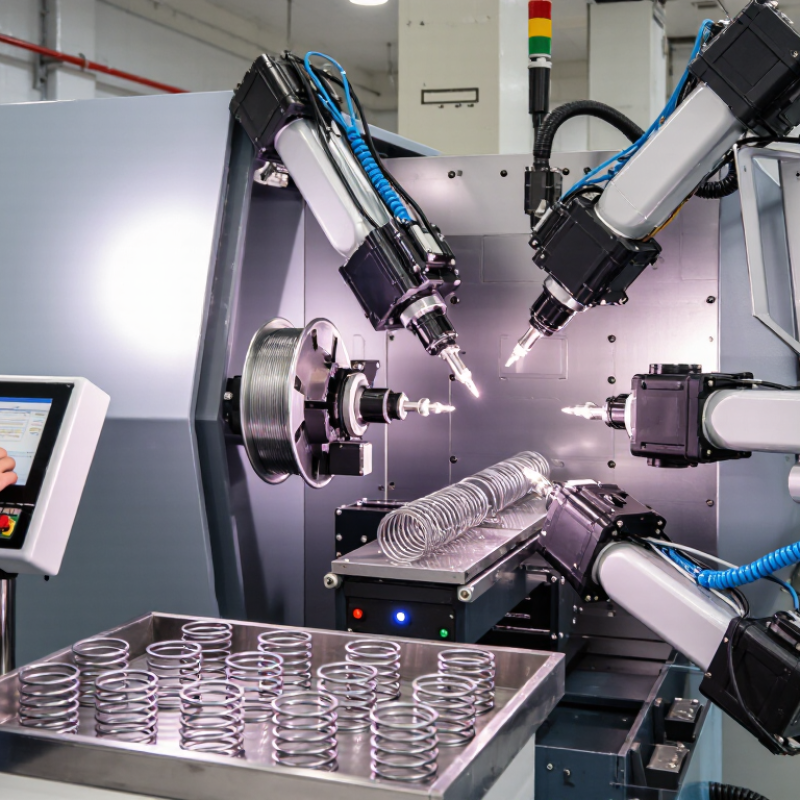
A CNC spring machine is a computer-controlled system that forms metal wire into springs. It can produce compression, extension, torsion, and special-shaped springs. The machine usually includes a wire feeder, straightening rollers, forming tools, and a cutting unit. A digital controller coordinates each movement with precise timing.

The process starts with a drawing or programmed spring specification. An operator enters the wire diameter, coil diameter, pitch, number of turns, and cutting position. The feeder pushes wire forward at a controlled speed. Forming tools then bend the wire around a mandrel or against adjustable guides. Servo motors control rotation, feeding, and tool movement. Sensors help detect feeding errors and unstable wire tension.

Small adjustments matter. A slight tool offset can change the spring angle or free length. In production work, I check the first pieces with calipers, gauges, and load testing equipment. The first setup is rarely perfect. Material hardness, lubrication, and room temperature can also affect results. This is where practical experience becomes important.

When comparing a CNC spring machine from China, buyers should examine control stability, tool accessibility, maintenance support, and documented test results. A lower purchase price may not reduce operating costs if changeovers are slow. Some machines look highly automated, yet operators still need strong setup skills. That point is easy to underestimate. Reliable performance comes from accurate mechanics, clear programming, consistent wire quality, and careful inspection during production.

What Is the Best CNC Spring Machine from China?

A CNC spring machine uses programmable servo axes to feed wire, rotate it, and form coils, bends, hooks, or ends with repeatable accuracy. The most suitable machine depends largely on the wire diameter and spring type required.

The chart shows typical wire-diameter bands used in CNC spring-forming applications. Fine-wire machines are suited to miniature springs, general-purpose machines cover common industrial spring sizes, and heavy-wire machines are designed for higher forming loads. Actual capacity depends on machine configuration, tooling, material, and forming process.

Which Features Define the Best CNC Spring Machine from China?

The best CNC spring machine from China is defined by control, repeatability, and practical flexibility. A reliable model should handle common wire diameters without constant tooling changes. Its servo-driven axes must coordinate smoothly during coiling, bending, and cutting. Small timing errors can create uneven pitch or open ends.

Look closely at the control system. Clear programming screens, stored recipes, and quick parameter adjustments reduce setup time. A strong machine should remember production data for different spring sizes. Automatic wire feeding also matters, especially during long runs. In a real workshop, stable feeding prevents scratches, vibration, and material waste. Good guarding, emergency stops, and accessible maintenance points show serious engineering.

Precision is not enough by itself. Ask for sample springs made from your actual wire and target dimensions. Measure free length, coil diameter, and load performance after production. Technical support, spare-part availability, electrical documentation, and operator training also define value. A low purchase price may become expensive when troubleshooting takes days. No machine is perfect. Some systems still need manual correction for unusual shapes or difficult materials. That limitation should be discussed honestly before ordering. A capable supplier will explain tolerances, testing methods, and realistic output instead of promising every result.

How to Compare Chinese CNC Spring Machine Manufacturers

Choosing the best CNC spring machine from China requires more than comparing prices. Compare the manufacturer’s process, evidence, and after-sales discipline.

The International Federation of Robotics reported 276,288 industrial robot installations in China during 2023. This figure shows strong automation capacity, but it does not prove spring-machine quality. Request a live trial using your wire grade, diameter, and target spring design. Measure pitch accuracy, coil diameter, production speed, and scrap rate. Ask for factory acceptance records, calibration certificates, and repeatability data. A reliable supplier should explain tolerances clearly, not hide behind general claims. ISO 9001 certification helps, yet certification alone cannot replace an audit. I have seen attractive brochures fail during simple changeover tests. That remains an uncomfortable, but useful, warning.

Tips: Compare complete production costs, not only the machine quotation. Record tooling prices, setup time, training hours, spare-part availability, and remote response time. Ask for three recent customer references in similar spring applications. Check whether the quoted output includes inspection pauses and rejected pieces. Also review electrical specifications, software support, and operator safety documentation. The ISO Survey 2023 recorded over 1.2 million ISO 9001 certificates worldwide, so certification is common. It is not a guarantee of consistent workmanship. A short video call is insufficient. Inspect the workshop, test finished springs, and keep your own measurement records.

What Materials and Spring Types Can These Machines Process?

What Is the Best CNC Spring Machine from China?

The best CNC spring machine depends on the wire materials and spring forms your workshop needs. In production trials, carbon steel and stainless steel are common choices. Music wire gives strong tension and stable memory. Stainless steel handles moisture better, especially in medical, food, and outdoor applications. Copper alloys suit electrical contacts, but they may require gentler forming settings. Titanium wire is possible on specialized equipment, though it demands careful speed control and tooling.

These machines can usually produce compression, extension, torsion, conical, and double-torsion springs. They can also form small wire components with hooks, loops, or custom bends. Wire diameter, tensile strength, and coil pitch affect machine selection. A specification sheet can look convincing. Real samples reveal more. I have seen machines perform well on stainless steel but struggle with harder music wire. That gap deserves attention.

Tips: Request sample production with your exact material and wire size. Check coil accuracy, hook position, surface marks, and repeatability. Ask about cutter life and setup time. Confirm whether the controller stores forming programs. Trial testing matters. Also review heat-treatment needs after forming. Some springs lose their intended shape without stress relief. A skilled supplier should explain these limits clearly, not promise perfect results for every material.

How to Select, Install, and Maintain the Right Machine

What Is the Best CNC Spring Machine from China?

Choosing the right CNC spring machine starts with your wire range, spring shape, and daily production volume. A machine designed for fine wire may struggle with thick, high-tension material. Ask the supplier for test samples using your actual wire, pitch, diameter, and forming sequence. Review dimensional reports, tooling drawings, controller functions, and spare-part availability. A low purchase price can become expensive when custom tooling arrives late. I would also check operator access, guarding, noise, and local electrical requirements. Small details matter.

Installation should begin with a level floor, stable power, clean air, and enough space around the machine. Follow the supplied wiring diagram and verify voltage before switching on. Calibrate feeding rollers and forming tools slowly. Run a short batch first. Measure coil diameter, free length, and end shape after every adjustment. A common mistake is changing several settings together. That makes faults harder to trace. Even experienced operators sometimes overlook roller wear.

Tips: Keep a setup record for each spring model. Store tools in labeled trays. Lubricate only where the manual permits. Inspect wire guides daily, especially after long runs. Replace worn parts before they mark the wire. Recheck accuracy after maintenance, because a small alignment error can affect hundreds of springs. Leave room for improvement; the first setup is rarely perfect.

What Is the Best CNC Spring Machine from China? - How to Select, Install, and Maintain the Right Machine

Evaluation Area Recommended Specification or Practice Typical Range / Target Why It Matters Selection or Maintenance Check
Wire Diameter Choose a machine whose rated wire range covers the smallest and largest wire used in production. Common CNC compression and extension spring machines: approximately 0.2–4.0 mm; heavy-duty models may handle larger wire. Wire size affects forming force, tooling, motor load, and dimensional accuracy. Verify the range using the actual material, tensile strength, spring index, and production speed—not wire diameter alone.
Spring Types Match the machine configuration to compression, extension, torsion, conical, barrel, or special-shaped springs. Compression machines are generally simpler; multi-axis CNC systems support more complex geometries. A machine designed for one spring family may require different tooling or software for another. Request sample trials with drawings that include coil diameter, free length, pitch, end type, and tolerances.
Number of Controlled Axes Select the minimum axis count that can complete the required forming operations without excessive manual adjustment. Typical systems offer roughly 3–8 controlled axes, depending on spring complexity and tooling. More axes can improve flexibility, but they also increase programming, maintenance, and training requirements. Confirm simultaneous interpolation, axis resolution, repeatability, and the number of stored programs.
Dimensional Accuracy Evaluate repeatability under real production conditions rather than relying only on no-load specifications. Many precision spring applications target repeatability in the hundredths of a millimeter, subject to material and process conditions. Material variation, tool wear, temperature, and wire feeding strongly influence final dimensions. Run a documented capability test and check free length, outer diameter, pitch, and load at specified points.
Production Speed Compare completed good parts per minute, not only the machine’s maximum feed or shaft speed. Output varies widely by spring geometry, wire diameter, pitch, cut-off method, and inspection requirements. Higher theoretical speed may reduce quality if vibration, wire slip, or tooling wear increases. Use a production trial to measure cycle time, scrap rate, changeover time, and sustained operating temperature.
Control System Prefer an industrial CNC interface with recipe storage, alarm history, parameter backup, and manual jog functions. A practical system should support password levels, program backup, fault diagnostics, and multilingual operating instructions. Good controls shorten setup time and make troubleshooting more consistent. Confirm file export, remote support options, spare control components, and operator training.
Wire Feeding Check the straightener, feed rollers, guide tubes, tension control, and compatibility with the selected wire material. Feed stability should be verified across the full rated wire range and the intended production speed. Inconsistent feeding can cause pitch variation, surface damage, length errors, and sudden wire breaks. Inspect roller alignment and pressure; clean guides regularly and replace worn contact surfaces.
Tooling and Changeover Choose accessible tooling with repeatable adjustment references and readily available wear parts. Changeover time depends on spring design, tool count, operator skill, and program preparation. Short, repeatable changeovers improve overall equipment utilization and reduce setup scrap. Ask for a documented changeover demonstration using two different spring specifications.
Installation Foundation Install on a level, rigid floor with sufficient load capacity and clearance for feeding, maintenance, and material handling. Follow the supplier’s foundation drawing, leveling tolerance, anchor requirements, and machine weight data. Poor leveling or vibration can reduce accuracy and accelerate wear on bearings, guides, and tooling. Complete floor, lifting, ventilation, and access checks before delivery.
Electrical and Air Supply Confirm voltage, frequency, grounding, compressed-air quality, and connection capacity before commissioning. Electrical ratings and air pressure vary by configuration; use the machine nameplate and installation manual as the controlling references. Incorrect power or contaminated air can cause alarms, unstable operation, or component damage. Use proper grounding, surge protection where appropriate, filtration, and a drainable air regulator.
Safety Systems Require guarding, emergency stops, interlocks, overload protection, and clear lockout procedures. Safety design should comply with the regulations applicable at the installation site. High-speed wire and rotating tooling present cutting, entanglement, and ejection hazards. Test emergency stops and door interlocks during commissioning and at scheduled intervals.
Lubrication Follow the specified lubricant type, quantity, and interval for bearings, guides, gears, and moving mechanisms. Inspection frequency is commonly daily or weekly, while lubricant replacement intervals depend on duty cycle and the manual. Insufficient or incorrect lubrication increases friction, heat, backlash, and premature component failure. Keep a maintenance log and never mix incompatible lubricants without technical confirmation.
Inspection and Calibration Use calibrated gauges to verify spring dimensions and load characteristics at defined sampling intervals. Inspection frequency should be based on risk, volume, process capability, and customer requirements. Regular measurement detects drift before large quantities of nonconforming springs are produced. Record gauge identification, measurement conditions, results, corrective actions, and calibration dates.
Spare Parts and Service Evaluate the availability of feed rollers, guides, cutting tools, sensors, belts, bearings, and control components. Keep critical wear parts according to consumption rate and supplier lead time. Parts availability directly affects downtime and the total cost of ownership. Obtain a parts list, electrical drawings, troubleshooting guide, and support response procedure before purchase.
Best Overall Selection Method Select the machine that passes a documented sample trial and meets the required safety, quality, capacity, and service conditions. Use a weighted comparison covering technical fit, total cost, delivery, training, warranty, and long-term support. The lowest purchase price does not necessarily provide the lowest production cost. Approve the machine only after reviewing test parts, capability data, installation requirements, and service commitments.

Note: Technical ranges are typical industry reference values. Always confirm final specifications, utilities, tolerances, safety requirements, and maintenance intervals in the machine’s official documentation.