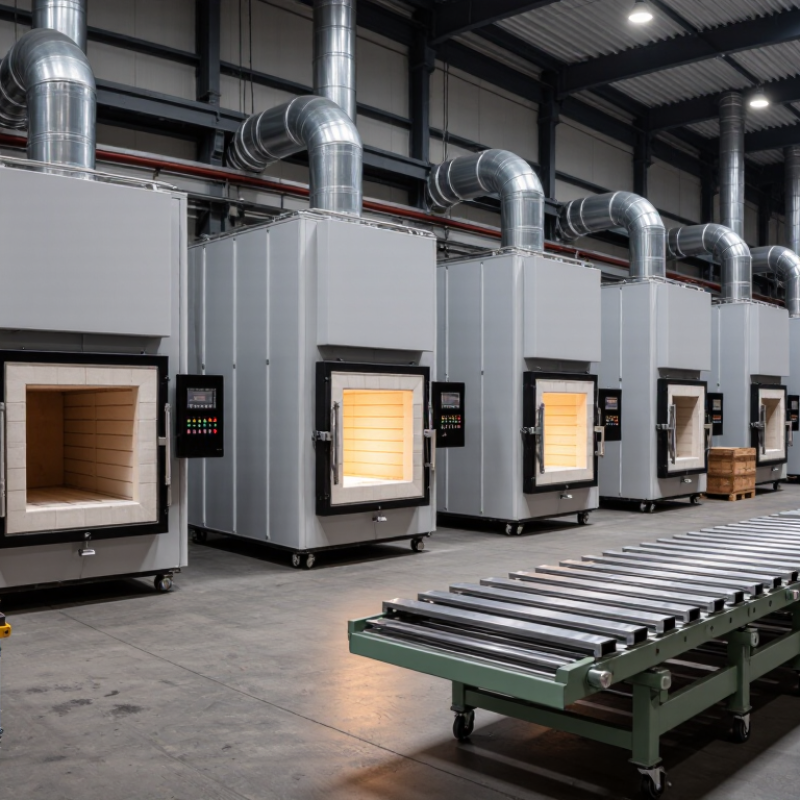
| 1 | High-Temperature Box Hardening Oven | Up to approximately 1,200°C | Small laboratory size to large production chamber | Forced air or controlled atmosphere, depending on process | Electric resistance elements with insulated steel casing | Tool steel, alloy steel, dies, punches, and general heat treatment | Versatile format, simple loading, broad international availability, and straightforward maintenance |
| 2 | Forced-Convection Circulation Oven | Approximately 150–750°C | Typically 100–2,000 litres | Recirculated hot air with adjustable airflow | Electric heaters, circulation fan, and temperature-control system | Small and medium metal parts requiring consistent temperature distribution | Good temperature uniformity, adaptable power supplies, and convenient batch processing |
| 3 | Atmosphere-Controlled Hardening Furnace | Approximately 800–1,100°C | Batch chambers from compact to industrial scale | Nitrogen, argon, endothermic gas, or other specified protective atmospheres | Electric or gas heating with sealed chamber and gas-control equipment | Carbon-steel, low-alloy steel, and parts where oxidation or decarburization must be reduced | Improved surface protection and better repeatability for controlled heat-treatment cycles |
| 4 | Vacuum Hardening Furnace | Approximately 600–1,300°C, depending on design | Laboratory, tool-room, and production batch sizes | Vacuum processing followed by inert-gas quenching | Vacuum chamber, resistance heating, pumping system, and controlled gas quench | High-speed steel tools, moulds, precision dies, and high-value components | Low oxidation, clean surfaces, reduced post-treatment cleaning, and controlled distortion |
| 5 | Continuous Mesh-Belt Hardening Oven | Approximately 500–1,050°C | Throughput-based; commonly used for high-volume production | Controlled atmosphere with continuous gas monitoring | Multiple heating zones, conveyor belt, cooling, and optional quench sections | Fasteners, bearings, automotive components, and repetitive small-part production | Consistent production flow, reduced manual handling, and suitability for automated lines |
| 6 | Carburizing and Hardening Furnace Line | Approximately 850–950°C for carburizing stages | Modular batch or continuous production systems | Carbon-controlled atmosphere followed by oil, gas, or polymer quenching | Multi-zone heating, carburizing chamber, transfer system, and quench tank | Gears, shafts, transmission parts, and components requiring a hard case with a tougher core | Suitable for high-volume case hardening and integration with washing, tempering, and testing equipment |
| 7 | Salt-Bath-Compatible Hardening System | Typically up to approximately 1,000°C, depending on salt chemistry | Small to medium batch volumes | Molten salt provides direct heat transfer; ventilation is essential | Electrically heated salt pot with temperature and bath-composition controls | Tool steels, small precision parts, and applications requiring rapid heating | Fast heat transfer and compact footprint, with strict requirements for safety, waste handling, and operator training |



 Close
Close