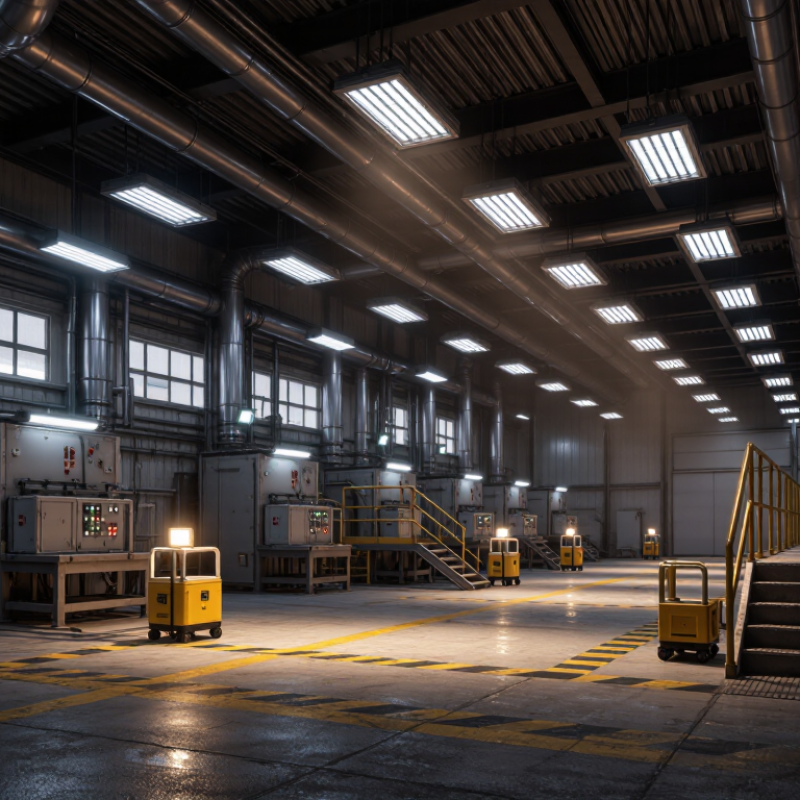
| LED explosion-protected high-bay luminaire | High ceilings in process plants, tank farms, and indoor production areas | Potentially Class I, Division 1 or 2 for gases and vapors; Zone 1 or 2. Dust suitability requires a separate dust approval. | Seek a model-specific hazardous-location listing. International markings may include Ex db or Ex eb for gas, and Ex tb for dust, with the appropriate equipment group and protection level. | Check mounting height, beam distribution, ambient-temperature range, ingress protection, and the certified temperature class. |
| Hazardous-location LED linear luminaire | Pipe racks, corridors, conveyors, utility rooms, and long work areas | Commonly specified for Class I, Division 1 or 2, or Zone 1 or 2; some models also carry separate dust approvals. | Confirm the exact gas and dust markings on the luminaire. Zone 2-only models may use Ex ec; that marking does not establish suitability for Zone 1. | Compare length, mounting method, lens material, glare, and whether the complete fixture—not just the LED components—is approved. |
| Hazardous-location LED floodlight | Outdoor process equipment, loading areas, storage tanks, and perimeter work zones | Choose ratings to match the site’s documented gas, vapor, or dust classification; a common target is Zone 1 or 2, or the corresponding specified Division location. | Verify the certified protection concept, gas or dust group, temperature class, and ambient range. Check that the approval covers the intended orientation and mounting arrangement. | Review beam angle, aiming adjustment, corrosion resistance, wind exposure, and the location of the driver or power supply. |
| LED wall-pack or bulkhead luminaire | Doors, exterior walls, access routes, platforms, and low-clearance areas | May be available for Class I or Class II locations and for selected Zones; the approved hazardous material group and zone vary by model. | Check the nameplate for the exact classification and applicable certification. An IP rating alone is not hazardous-location approval. | Assess mounting height, light distribution, impact resistance, washdown exposure, and access for maintenance. |
| Hazardous-location pendant luminaire | Localized lighting over workstations, vessels, and equipment | Use only where the fixture’s certification matches the specified Class/Division or Zone and the gases or dusts present. | Confirm approval for the complete pendant assembly, including the enclosure, hub, and any supplied wiring entry components. | Check pendant length, vibration, heat exposure, cable or conduit entry requirements, and whether a guard is required. |
| Portable intrinsically safe LED handlamp | Inspection, confined maintenance tasks, and temporary work where portable lighting is needed | Use only for the gas or dust locations stated on its certificate; portable equipment may have different ratings from fixed luminaires. | Look for a recognized, model-specific intrinsic-safety approval and its complete Ex marking, such as Ex ib or Ex ia where applicable. Confirm permitted battery type. | Check runtime, charging restrictions, allowed accessories, impact protection, and whether the certificate covers the lamp and battery together. |
| Hazardous-location emergency luminaire | Escape routes, emergency exits, and areas requiring backup illumination during power loss | Must match the classified location where it is installed; ordinary emergency lighting is not automatically suitable for hazardous areas. | Verify both the hazardous-location approval and the applicable emergency-lighting requirements for the market and installation. | Review rated emergency duration, battery type, charging temperature, test method, and whether the emergency mode remains approved. |
| Hazardous-location exit sign | Marked egress routes and exit points in classified facilities | Classification must match the particular exit location; do not assume a sign rated for an adjacent safe area is suitable inside a classified area. | Check that the complete sign, enclosure, and power arrangement carry the required hazardous-location certification and egress approvals. | Confirm viewing distance, legend and language, mounting position, backup power, and local code requirements. |
| Low-voltage hazardous-area task light | Fixed or temporary task lighting near machinery, inspection points, and maintenance benches | Low voltage does not remove ignition risk. Select a certified model for the site’s exact Class/Division or Zone and material group. | Verify the complete light assembly’s approval, including any remote power supply, connectors, and cable entry components. | Compare supply voltage, cable length, light output, mounting flexibility, and restrictions on power-supply placement. |
| Dust-ignition-protected LED high-bay or floodlight | Grain handling, food processing, woodworking, and other combustible-dust work areas | Assess Class II or Class III, Division 1 or 2, or Zone 20, 21, or 22 as applicable to the dust hazard and location. | For IEC-style markings, check the dust group and protection level, such as Ex tb with an appropriate IIIC marking where required. Gas approval alone does not establish dust suitability. | Check maximum surface temperature, dust-layer conditions, enclosure cleaning needs, and the site’s dust hazard analysis. |



 Close