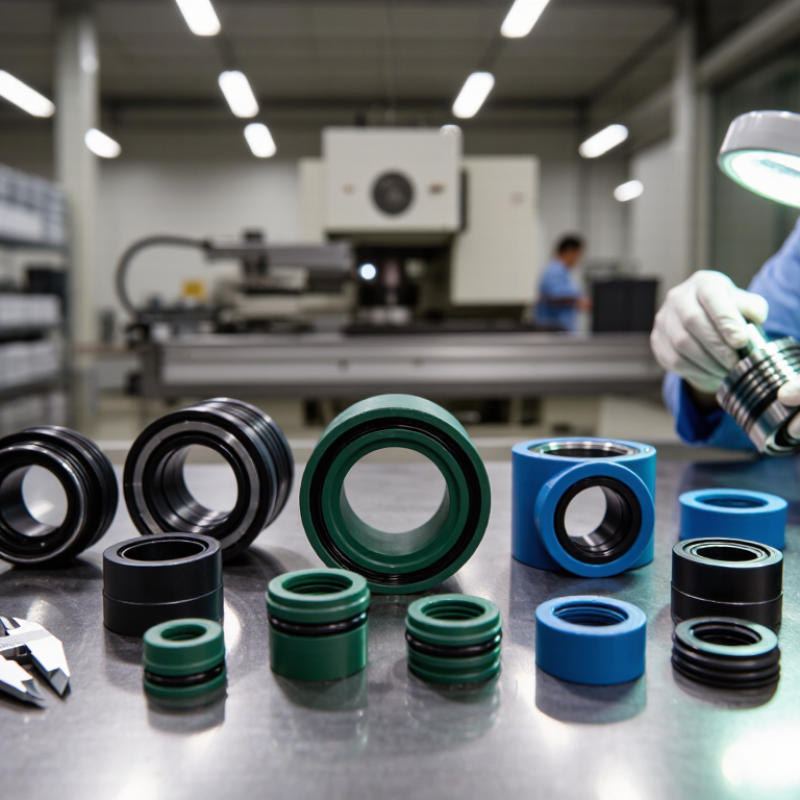
| Primary function | A piston seal limits fluid leakage between the two sides of a hydraulic cylinder piston, helping the cylinder maintain pressure and deliver force. | The seal must suit the cylinder’s pressure, speed, temperature, fluid, and operating cycle. | Ask for application-specific recommendations rather than selecting by seal material alone. |
| Single-acting piston seal | Designed to seal pressure primarily from one direction; the cylinder’s return movement may be provided by a spring, gravity, or an external load. | Pressure direction and the required sealing behavior during the return stroke. | Confirm the seal profile and installation orientation for the cylinder design. |
| Double-acting piston seal | Designed to seal pressure acting from either side of the piston, allowing powered movement in both directions. | Bidirectional pressure, friction, and the possibility of pressure trapped between sealing elements. | Request guidance on the complete seal arrangement, including any backup or anti-extrusion rings. |
| Common seal profiles | U-cup seals are commonly used for single-acting service; symmetrical profiles and compact assemblies are among the options used for double-acting service. | Profile geometry affects sealing behavior, friction, installation, and resistance to extrusion. | Check profile drawings, groove dimensions, and compatibility with the cylinder’s mating parts. |
| Polyurethane (PU) | Often selected for hydraulic seals because suitable grades can provide good wear and abrasion resistance. | Performance depends on the specific compound and its temperature, fluid, and pressure limits. | Request the compound specification and application limits for the proposed grade. |
| PTFE-based materials | PTFE-based sealing elements are used in some designs where low friction or chemical compatibility is required; some designs use an elastomer energizer. | The complete design and compound determine pressure capability, wear behavior, and compatibility. | Verify the full material construction, not just the name of the base polymer. |
| Operating conditions | Seal performance is affected by pressure, reciprocating speed, temperature, hydraulic fluid, cylinder clearance, and surface finish. | A seal suitable for one cylinder may not be suitable for another with different conditions. | Provide operating data and confirm allowable clearances and surface-finish requirements. |
| Supplier evaluation | A suitable manufacturer should be able to match seal design and material to the application and provide consistent, inspectable products. | Compare technical support, dimensional control, material traceability, sample evaluation, and production consistency. | Request drawings, material data, inspection records, and test evidence relevant to the intended application. |
| Standards and dimensions | ISO 7425-2 covers housing dimensions for elastomer-energized plastic seals used as piston seals in fluid power applications. | A standard dimensional interface does not by itself establish suitability for every operating condition. | Confirm the applicable standard, edition, groove dimensions, and any application-specific deviations. |


 Close
Close