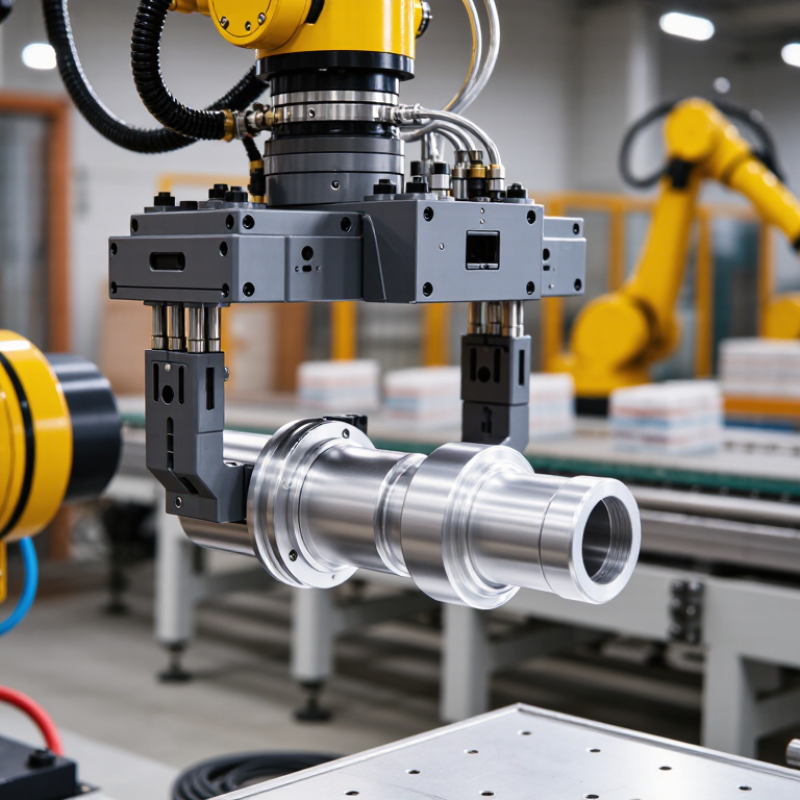
| Two-Finger Parallel Gripper | Two jaws move linearly toward or away from the workpiece and hold it by external or internal contact. | Machine tending, assembly, pick-and-place, packaging, and part transfer. | Rigid, regularly shaped parts with accessible gripping surfaces, including machined components, housings, and fixtures. | Simple design, repeatable positioning, broad jaw and finger options, and easy integration with robot tooling. | Less suitable for irregular, fragile, highly slippery, or very thin parts unless custom fingers are used. | Six-axis robots, SCARA robots, Cartesian systems, and collaborative robots. | Jaw stroke, gripping force, repeatability, finger length, payload, and protection against part rotation. |
| Two-Finger Angular Gripper | Jaws pivot around a hinge and open or close through an angular motion. | Basic handling, low-cost pick-and-place, packaging, and applications with limited jaw travel requirements. | Rigid parts that can be accessed from above or from the side and do not require a long parallel stroke. | Compact construction, relatively low weight, and convenient operation in restricted spaces. | Jaw motion changes the contact point during closing, which can reduce positioning accuracy for some parts. | Small robotic cells, pneumatic automation, and general-purpose handling systems. | Opening angle, available mounting space, closing force, part geometry, and repeatability. |
| Three-Finger Centric Gripper | Three fingers move toward a common center to create a balanced radial grip. | Turning-lathe loading, cylindrical-part handling, concentric assembly, and inspection operations. | Round, hexagonal, or approximately symmetrical components such as shafts, rings, tubes, and fittings. | Good centering capability, balanced gripping, and improved stability for cylindrical workpieces. | Usually less effective for flat, asymmetrical, or highly irregular parts; access can be more demanding. | CNC machine tending, rotary indexing systems, and industrial robot applications. | Centering accuracy, gripping diameter range, radial force, jaw stroke, and chip or coolant resistance. |
| Vacuum Gripper | Vacuum pressure creates a differential force between a suction cup and the workpiece surface. | Sheet handling, carton handling, glass transfer, packaging, palletizing, and smooth-surface pick-and-place. | Clean, relatively smooth, non-porous surfaces with sufficient contact area and suitable load orientation. | Fast handling, no mechanical jaw marks, ability to cover large surfaces, and suitability for thin sheets. | Performance decreases on porous, dusty, rough, oily, or heavily textured surfaces; vacuum loss can cause dropped parts. | Industrial robots, gantry systems, palletizing cells, and high-speed packaging machines. | Suction-cup material and diameter, vacuum level, leakage rate, safety reserve, surface condition, and filtration. |
| Magnetic Gripper | Permanent magnets or controllable electromagnets attract ferromagnetic workpieces. | Steel sheet handling, stamped-part transfer, metal loading, and movement of ferrous components. | Ferromagnetic materials with an adequately flat or accessible contact area. | Fast engagement, effective handling of steel parts, and good performance where mechanical access is limited. | Not suitable for aluminum, copper, plastics, or most stainless steels; residual magnetism and contamination may be concerns. | Press lines, material-transfer systems, robots, and automated storage or loading equipment. | Material type, air gap, surface contamination, load orientation, release behavior, and fail-safe requirements. |
| Soft or Adaptive Gripper | Compliant fingers deform around the workpiece using elastomeric, flexible, pneumatic, or tendon-driven structures. | Food handling, consumer-product packaging, laboratory automation, and mixed-part handling. | Fragile, irregular, delicate, or variable-shaped items that benefit from gentle and conforming contact. | Low contact stress, adaptable gripping, reduced part damage, and reduced need for complex custom fingers. | Lower stiffness and precision than rigid grippers in some applications; wear and cleaning requirements vary by design. | Collaborative robots, light-duty industrial robots, and flexible production cells. | Payload, compliance, hygiene requirements, gripping speed, material durability, and repeatability. |
| Internal Expanding Gripper | Expandable fingers or elements move outward inside a bore or cavity to create an internal grip. | Ring handling, tube handling, machining operations, and transfer of parts with accessible internal diameters. | Parts with a sufficiently strong and consistent internal hole, bore, or cavity. | Leaves exterior surfaces accessible, supports stable transfer, and can reduce interference with external features. | Requires a suitable internal feature; excessive expansion force may deform thin-walled components. | CNC machine tending, assembly equipment, and robotic transfer systems. | Expandable diameter, internal surface condition, radial force, insertion depth, and part-wall strength. |
| Long-Stroke Gripper | Extended jaw travel allows the gripper to handle a comparatively wide range of part sizes. | Mixed-size component handling, pallet transfer, bin picking, and operations requiring wide jaw adjustment. | Parts with significantly different dimensions but reasonably consistent gripping surfaces. | Wide operating range, fewer tool changes, and greater flexibility for varied production batches. | Longer stroke can increase size, mass, closing time, and potential jaw deflection. | Industrial robots, collaborative robots, and flexible manufacturing systems. | Total stroke, gripping force across the stroke, weight, cycle time, rigidity, and sensor feedback. |
| Needle Gripper | Thin needles penetrate or engage a porous or fibrous workpiece to create a mechanical hold. | Textiles, insulation, foam, cardboard, and other porous materials that are difficult to grip with suction. | Soft, fibrous, porous, or compressible materials that tolerate controlled needle penetration. | Can handle porous materials without depending on an airtight surface and can work with irregular shapes. | May leave marks, damage delicate products, or create safety and maintenance concerns if needles are exposed. | Specialized handling machines, packaging equipment, and selected robotic applications. | Needle length, penetration force, material damage tolerance, guarding, maintenance, and cleaning access. |



 Close
Close