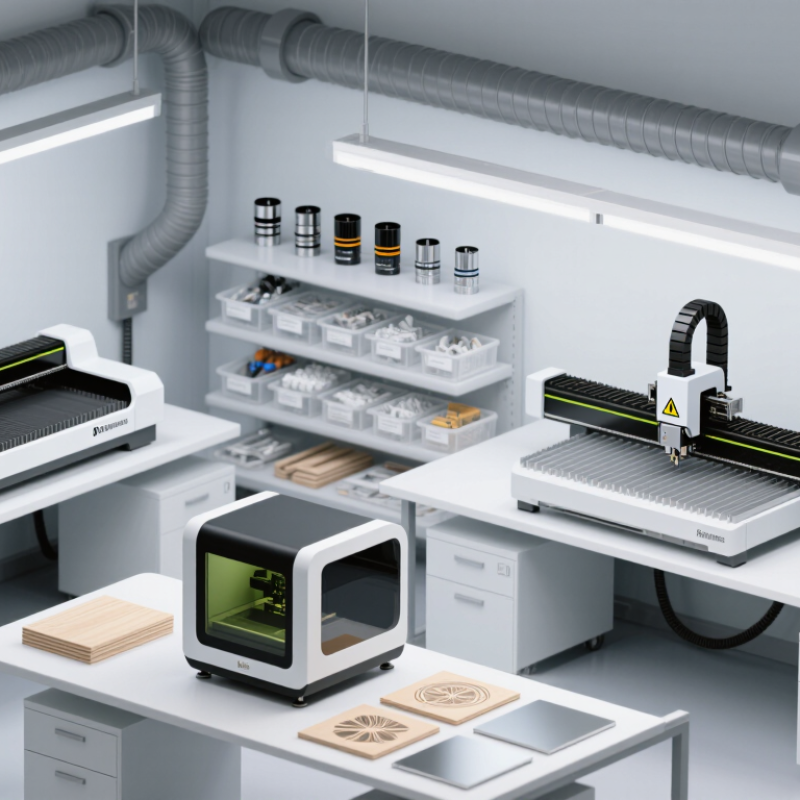
| Enclosed CO₂ laser cutter or engraver | Cutting or engraving suitable wood, acrylic, paper, and other compatible materials | Often emits infrared light near 10.6 μm; output and working area vary by model | Fully enclosed beam path; interlocks that stop emission when access panels open; emission warning indicator; emergency stop; suitable exhaust and fire-risk controls | Ask for the laser classification and test documentation under IEC 60825-1. In the United States, check applicable FDA laser-product requirements under 21 CFR 1040.10 and 1040.11. For machinery, check applicable electrical and local requirements. | Confirm the enclosure remains protective during normal operation and that the exhaust system is suitable for the materials you plan to process. Do not process materials unless their hazards are understood. |
| Open-frame diode engraver | Light-duty engraving and marking of compatible materials | Visible or near-infrared wavelengths are common; wavelength and optical output depend on the device | Prefer a fully enclosed configuration with interlocked access. For open-beam systems, check beam stops, restricted access, warning signs, key control, emergency stop, and eyewear specified for the exact wavelength and optical density. | Verify the declared laser class and IEC 60825-1 documentation. Check applicable national laser-product rules; a seller’s “CE” statement alone does not establish laser safety or suitability for every jurisdiction. | Open-frame equipment can expose users and bystanders to direct or reflected beams. Consider whether an enclosed model better fits the workspace and the people who may enter it. |
| Fiber laser marking system | Marking or engraving metals and certain engineered materials | Many systems use near-infrared output around 1 μm, but the exact wavelength and pulse characteristics vary | Check for a fully enclosed, interlocked work area; guarded viewing windows rated for the relevant wavelength; emission indicator; key control; emergency stop; and extraction appropriate to the process. | Request laser classification and IEC 60825-1 documentation. For protective guards, ask whether relevant IEC 60825-4 requirements apply. Confirm applicable local laser-product, machinery, and electrical requirements. | Do not assume the beam is safe because it is invisible. Verify the enclosure’s specified protection and service procedures, including controls for alignment and maintenance. |
| Industrial laser cutting or welding cell | Production cutting, welding, or processing in a controlled industrial environment | May use fiber, CO₂, or other laser sources; wavelength, power, and beam delivery are application-specific | Check engineered guarding, interlocked doors, controlled access, beam containment, emergency stops, warning indicators, documented lockout procedures, and fume extraction. Confirm that safety functions are maintained during setup and service. | Review IEC 60825-1 classification and, where applicable, IEC 60825-4 for laser processing machine guards. Check machinery electrical requirements such as IEC 60204-1 or applicable national equivalents, plus workplace rules in the installation location. | Have the complete cell—not just the laser source—assessed for the intended process and installation. Include operator training, maintenance access, ventilation, and integration with existing safety systems. |
| Medical or aesthetic laser system | Clinical procedures specified by the device’s intended use and instructions | Wavelength, pulse duration, and output vary substantially by treatment and device | Check controlled access, treatment-room warning indicators, a keyed control where applicable, emergency shutoff, device-specific protective eyewear, and clear operating and maintenance instructions. | Verify the medical-device authorization or registration required in the country of use. For applicable medical laser equipment, ask about IEC 60601-2-22 and the relevant general medical electrical safety requirements; applicability depends on device type and jurisdiction. | Confirm the intended use, operator qualifications, training requirements, and local clinical rules. A general laser safety certificate does not replace required medical-device authorization. |
| Portable laser alignment or measurement tool | Alignment, leveling, surveying, or measurement tasks | Often a low-power visible beam, but the actual class and wavelength must be checked on the product label and documentation | Check the labeled class, beam aperture, output specifications, warning labels, and instructions for avoiding direct eye exposure. Use only as directed and do not defeat safety features. | Look for a clearly stated classification and supporting IEC 60825-1 documentation, along with applicable local product requirements. | Choose a class and feature set appropriate for the task and environment. “Low power” or “eye safe” marketing language is not a substitute for the product’s classification and instructions. |



 Close
Close