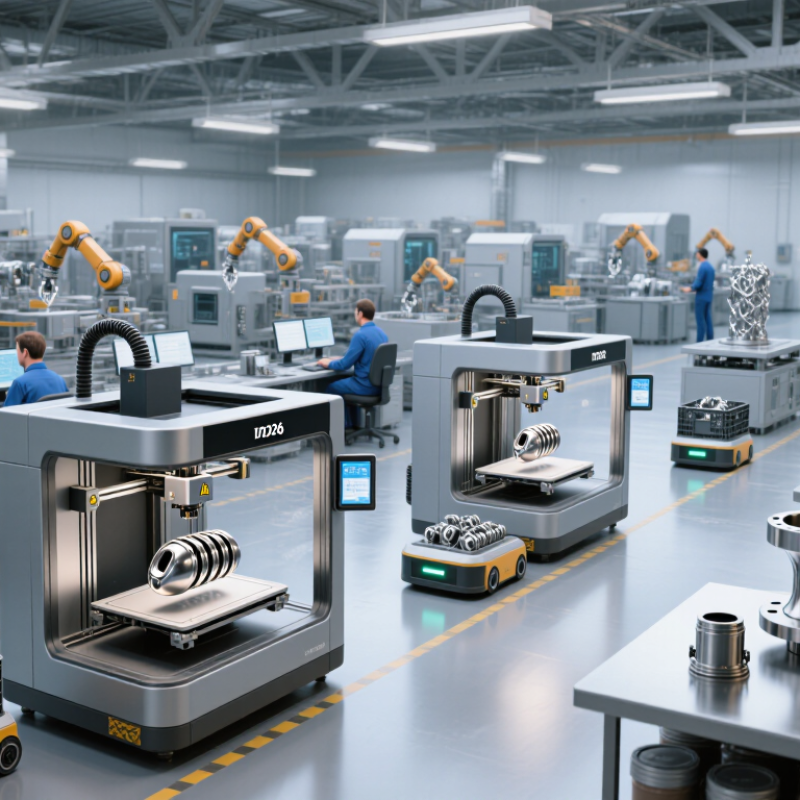
| Laser Powder Bed Fusion (LPBF) | A laser selectively melts regions of a thin metal powder layer; the build platform lowers and the process repeats. | Stainless steel, aluminum alloys, titanium alloys, nickel-based alloys, and cobalt-chrome alloys. | Commonly about 20–60 µm per layer, depending on the machine, material, and build strategy. | Complex brackets, lightweight structures, conformal-cooling inserts, and small-to-medium precision parts. | High feature detail and the ability to make intricate internal channels and consolidated assemblies. | Usually requires support structures, powder handling, and post-processing such as stress relief or machining. Build size and rate can limit throughput. |
| Electron Beam Powder Bed Fusion (EB-PBF) | An electron beam selectively fuses metal powder in a vacuum chamber, generally with elevated powder-bed temperatures. | Most commonly titanium alloys; cobalt-chrome and selected other alloys are available for specific systems. | Often about 50–100 µm per layer; actual settings vary by alloy and equipment. | Porous or lattice structures, orthopedic components, and other parts where titanium properties and design freedom are useful. | Suitable for reactive alloys such as titanium and can produce complex structures with reduced residual stress in many builds. | Surface finish and fine-feature resolution are generally less refined than those of many laser powder-bed builds; vacuum processing and powder management are required. |
| Directed Energy Deposition (DED) | A focused energy source melts feedstock as it is delivered to the build area. Feedstock may be metal powder or wire. | Stainless steel, titanium alloys, nickel-based alloys, and other weldable engineering metals. | Typically coarser than powder-bed processes; bead and layer dimensions depend strongly on the energy source, feedstock, and setup. | Repair, feature addition, cladding, and manufacture of larger near-net-shape parts. | Can add material to existing components and is well suited to repair or localized deposition. | Usually needs finish machining to achieve precise dimensions and surface quality. Geometry and feature detail are more limited than in powder-bed fusion. |
| Wire Arc Additive Manufacturing (WAAM) | An electric arc melts metal wire and deposits it in successive weld beads to form a near-net-shape component. | Commonly weldable steels, stainless steels, aluminum alloys, and titanium alloys. | Coarse deposition, typically measured in millimeters rather than tens of micrometers; bead size depends on the welding setup. | Large structural preforms, tooling, and components that can be machined after deposition. | High material deposition rates and comparatively efficient use of wire feedstock make it attractive for large parts. | Requires substantial machining allowance and careful control of heat input, distortion, and build strategy; it is not intended for fine details. |
| Metal Binder Jetting | A printhead deposits binder into selected areas of a powder bed. The printed part is then cured, debound, and sintered. | Stainless steels, tool steels, and selected other alloys supported by the material and sintering process. | Often approximately 50–100 µm per layer, with settings varying by powder and equipment. | Batch production of relatively small parts, including components with complex shapes that can be sintered reliably. | No laser melting is needed during printing, and multiple parts can be arranged in a build for batch processing. | Debinding and sintering are essential. Shrinkage must be compensated for, and final density, dimensions, and properties depend on process control. |
| Metal Material Extrusion | A feedstock containing metal powder and a polymer binder is extruded layer by layer, then debound and sintered. | Commonly stainless steels and selected tool steels or other supported alloys. | Layer heights are generally in the hundreds-of-micrometers range and vary with nozzle and feedstock. | Small parts, prototypes, fixtures, and production components where the feedstock and sintering route meet requirements. | Uses a relatively straightforward extrusion step and can be suitable for smaller parts and lower-volume manufacturing. | Requires debinding and sintering, with shrinkage compensation and support or orientation planning as needed. Material and part-size choices are process-specific. |



 Close