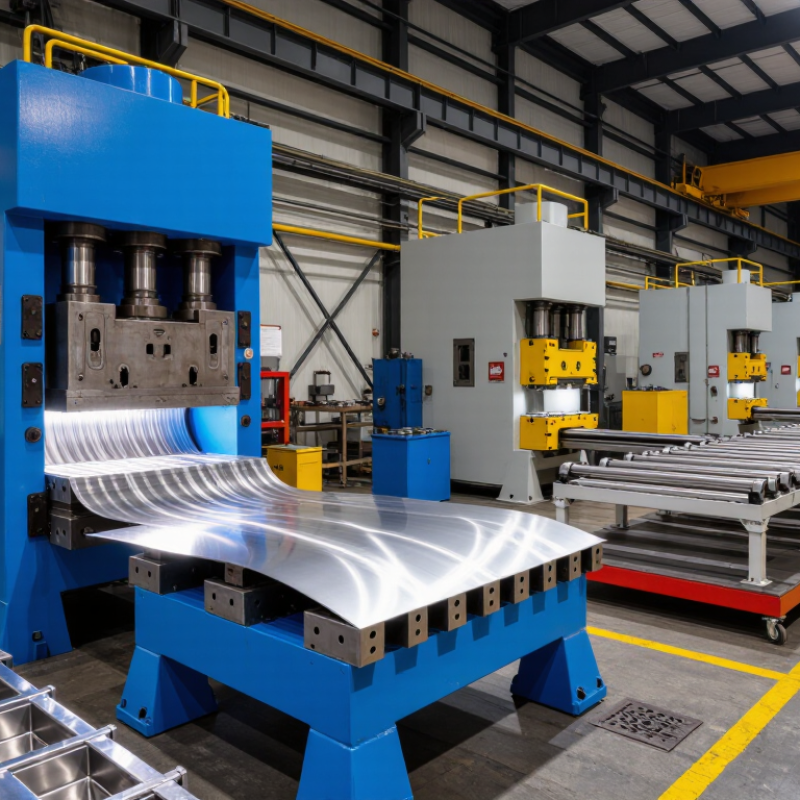
| Progressive die stamping | A coil-fed strip advances through a sequence of stations; each station performs an operation, and the finished part is separated at a later station. | Repeat production of relatively small or connected strip-fed parts with multiple features. | Die design capability, strip layout, feed control, and inspection of critical features. |
| Transfer die stamping | A blank or partly formed workpiece is moved between stations by a transfer system, allowing each station to work on an individual part. | Parts that need more room or movement between operations, including some larger or deeper formed components. | Part handling method, station sequence, forming feasibility, and production-line setup. |
| Deep-draw stamping | A sheet-metal blank is drawn into a die cavity by a punch to create a cup-like or hollow shape; the process may use multiple draws. | Hollow parts such as cans, housings, shells, and drawn enclosures, subject to material and geometry limits. | Material formability, draw sequence, blank-holder approach, and controls for thinning or wrinkling. |
| Blanking and piercing | Shearing operations cut a part outline or create holes and openings in sheet metal. | Flat blanks and parts requiring holes or cutouts before or during forming. | Cut-edge requirements, burr direction, tool clearance, and dimensional inspection method. |
| Bending and forming | The sheet is plastically deformed into angles, flanges, channels, or other shapes without relying only on cutting. | Brackets, clips, panels, and components with formed features. | Bend radii, springback compensation, material direction, and part-to-part consistency. |
| Material capability | The supplier’s ability to process specified sheet or coil materials and thicknesses using suitable tooling and equipment. | Projects with defined mechanical, corrosion-resistance, weight, or surface requirements. | Approved material grades, thickness range, traceability, and material certification requirements. |
| Tooling design and maintenance | Tooling determines how stamping operations are performed; maintenance helps keep tools functional and parts consistent. | Custom parts where die design, tool life, and ongoing production support matter. | Tool ownership terms, design approvals, maintenance responsibility, and spare-tool arrangements. |
| Quality control and measurement | Inspection checks whether parts meet agreed drawings, specifications, and acceptance criteria. | All production parts, especially those with close tolerances or critical fit and function. | Inspection plans, measurement equipment, control records, and the process for handling nonconforming parts. |
| Secondary operations | Additional steps may include deburring, cleaning, coating, heat treatment, or assembly, depending on the part specification. | Parts that need finishing or further processing beyond the stamping operation. | Which operations are performed in-house or externally, applicable specifications, and final-part inspection scope. |
| Export and logistics readiness | Packaging and shipping arrangements protect parts and support delivery to the buyer’s destination. | Cross-border sourcing and programs with defined delivery, packaging, or documentation requirements. | Packaging specifications, shipping responsibilities, export documents, and the agreed delivery terms. |



 Close