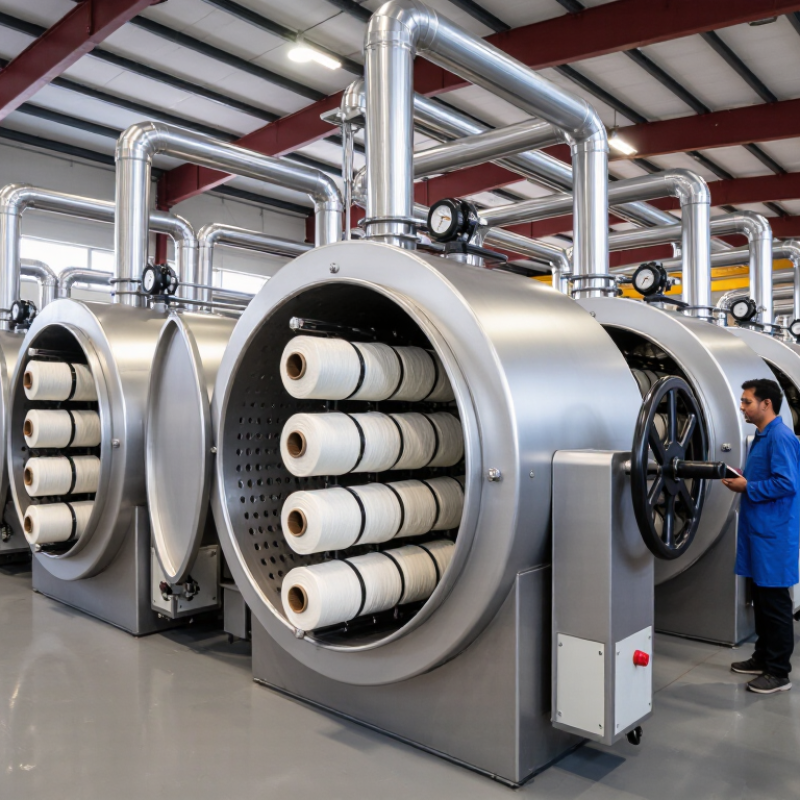
| 1. Laboratory Package Dyeing Machine | Approximately 1–10 kg | Recipe development, shade matching, small trials, and quality-control testing. | Uses less yarn, water, and dye for trials; supports process development before production-scale dyeing. | Confirm that package holders and liquor circulation represent the intended production process. Check temperature control, repeatability, and available sample-package formats. |
| 2. Pilot-Scale Package Dyeing Machine | Approximately 10–50 kg | Scale-up trials, customer sampling, and small production runs. | Bridges laboratory testing and factory production; can help identify differences in circulation and shade between scales. | Ask how the pilot machine’s flow direction, package density, and liquor ratio compare with the planned production machine. |
| 3. Atmospheric Package Dyeing Machine | Commonly tens to several hundred kilograms, depending on design | Suitable processes for cotton, viscose, wool, and other yarns dyed under atmospheric conditions. | Designed for processes that do not require high-pressure operation; may be suitable for yarns and recipes processed at or below the boiling point of the dye bath. | Verify the yarn’s permitted temperature and chemistry. Check corrosion-resistant wetted parts, heating method, circulation uniformity, and whether the selected process is compatible with atmospheric operation. |
| 4. High-Temperature, High-Pressure (HTHP) Package Dyeing Machine | Commonly tens to around 1,000 kg, depending on vessel size and configuration | Often used for polyester and other synthetic yarn processes requiring temperatures above 100°C. | A pressure-rated vessel enables high-temperature dyeing; many designs support controlled heating, cooling, and liquor circulation. | Check the rated working temperature and pressure, applicable pressure-vessel certification, safety interlocks, inspection records, and suitability for the intended yarn and recipe. Polyester processes commonly use temperatures around 130°C, but the required conditions vary. |
| 5. Low-Liquor-Ratio Package Dyeing Machine | Available across sample and production scales | Factories seeking to reduce dye-bath volume for compatible yarns, recipes, and loading conditions. | Can reduce water, heating, and wastewater volumes when the process achieves the specified liquor ratio without compromising dyeing quality. | Request the guaranteed liquor ratio at the proposed batch load. Check pump performance, package wetting, circulation uniformity, and actual water and energy data from comparable production trials. |
| 6. Multi-Spindle Production Package Dyeing Machine | Often several hundred kilograms or more; capacity depends on spindle count and yarn-package loading | Regular, larger-scale yarn production with consistent package sizes and repeatable recipes. | Processes multiple yarn packages in one batch and can provide high output when loading, circulation, and recipe control are well matched. | Confirm the usable capacity for the actual yarn count and package dimensions—not just the vessel’s nominal capacity. Review spindle layout, pressure drop, flow distribution, loading time, and unloading access. |
| 7. Automated, Recipe-Controlled Package Dyeing Machine | Available from laboratory to production scale | Plants that need repeatable recipes, batch records, and controlled process steps. | Programmable control can manage process stages such as heating, holding, cooling, and dosing, subject to the machine’s installed equipment. | Check recipe storage, sensor accuracy, dosing connections, alarm and safety functions, data export, operator training, and compatibility with the factory’s power supply and control systems. |


 Close
Close