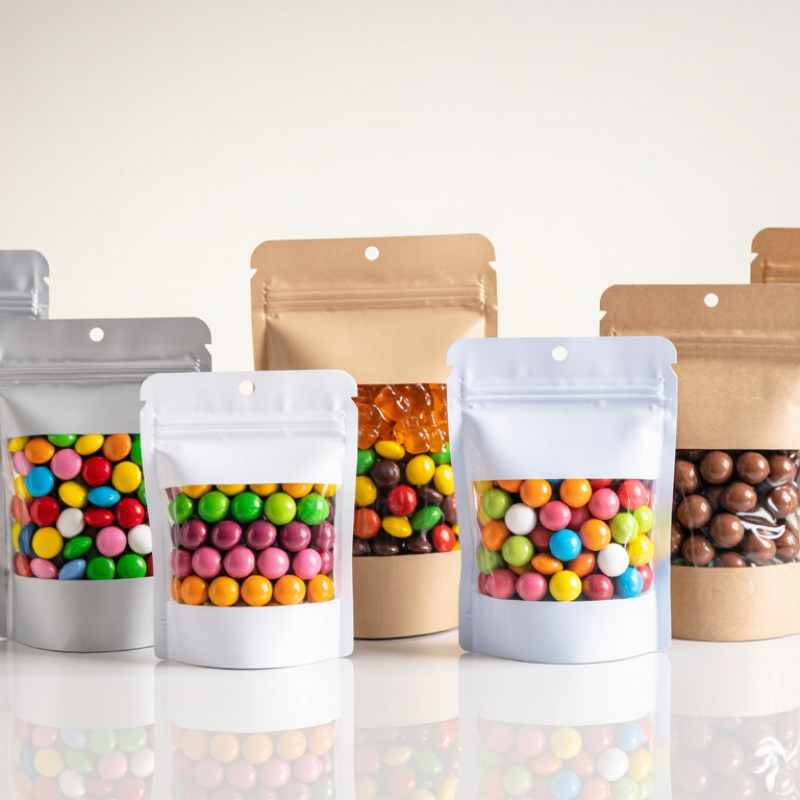
| Clear high-visibility pouch | Clear PET/PE laminate or another clear, heat-sealable multilayer film | Colorful hard candies, jelly beans, and other products where shoppers benefit from seeing the contents | Offers product visibility, but clear film does not provide the light protection of opaque or foil-containing structures. Confirm that the selected film’s moisture and oxygen barrier suits the candy and its intended shelf life. | Check that the zipper opens and closes smoothly and that the top seal area remains clean during filling. Allow enough headspace for a reliable heat seal. | Request samples to check clarity, pouch dimensions, bottom-gusset stability, and seal performance on the filling line. |
| Metallized barrier pouch | Commonly PET/metallized PET/PE or a comparable laminated structure | Individually wrapped sweets, gummies, and candies needing more protection from light and moisture than a clear pouch generally provides | A metallized layer can improve light and gas barrier compared with a basic clear structure. Barrier performance depends on the complete laminate and seal quality; it is not the same as a solid aluminum-foil layer. | Verify heat-seal compatibility with the equipment and check that the zipper and seals are not contaminated by sugar, oil, or candy pieces. | Ask for the full film specification and confirm whether the quoted structure and thickness will remain consistent across production runs. |
| Opaque foil-laminate pouch | Often PET/aluminum foil/PE or another foil-containing laminate | Light-sensitive or aroma-sensitive candies, and products requiring a stronger barrier against moisture, oxygen, and light | Foil laminates can provide a strong barrier when intact and properly sealed. They conceal the product and should be checked for pinholes, fold damage, and seal integrity. | Check the recommended sealing temperature, pressure, and dwell time with the actual filling equipment. Avoid overfilling or placing candy in the seal zone. | Compare the required barrier with the supplier’s technical data, and test filled samples through the planned storage and distribution conditions. |
| High-puncture-resistance pouch | May use a nylon-containing laminate, such as PET/NY/PE, depending on the supplier’s design | Hard or irregular candies that may stress the pouch during handling and transport | A tougher structure can help resist punctures, but it does not automatically provide the barrier level needed for every candy. Confirm both mechanical and barrier requirements. | Test the filled pouch for sharp edges, corner pressure, zipper function, and leaks after handling. Use a seal width suitable for the product and filling process. | Request filled samples, not just empty pouches, and assess them after case packing and representative shipping handling. |
| Wide-mouth, easy-fill pouch | Typically a clear or printed PET/PE-based laminate; structure varies by required barrier | Bulkier gummies, mixed candies, or manual filling where a wider opening makes loading easier | Choose the barrier based on the candy’s sensitivity to humidity, oxygen, and light. A wide opening is convenient but must be fully resealed after filling. | Check opening width, zipper position, and usable fill space. Confirm that the filling method does not leave candy or crumbs across the zipper or top-seal area. | Measure the filled pouch rather than relying only on nominal dimensions, since product size and fill method affect how the pouch stands. |
| Window pouch | Printed or opaque laminate with a clear-film window, commonly built from laminated plastic layers | Assorted candies where a product view is useful but a fully clear pouch is not preferred | The window area may have different light-barrier properties from the rest of the pouch. Check that the window size and placement fit the product’s storage requirements. | Inspect window seals and pouch seams for defects. Keep the zipper and heat-seal area clear of candy during filling. | Confirm window dimensions, print registration, and appearance with a production sample; printed artwork can make inspection of contents less straightforward. |
| Reclosable zipper pouch | Often PET/PE or a higher-barrier laminate with a zipper fitted above the gusset | Multi-serving candy packs intended to be opened and closed by consumers | A zipper helps with repeated opening and closing but is not a substitute for the initial hermetic heat seal or for selecting an appropriate barrier film. | Check zipper alignment, opening force, and closure after filling. Verify that the first-opening seal is intact and that the consumer can separate it as intended. | Test zipper operation across a representative production sample and confirm the pouch’s finished dimensions, zipper position, and case-pack requirements. |



 Close