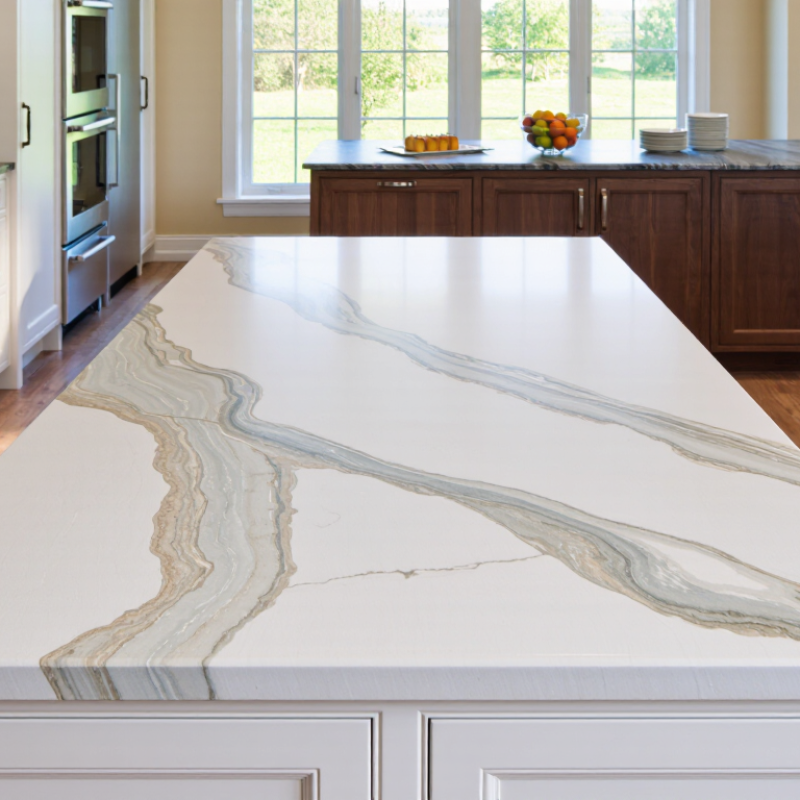
When choosing quartzite for countertops, durability starts with the stone’s structure, not its color.
True quartzite is usually very hard, often near 7 on the Mohs scale. It resists scratches from knives and daily cookware. However, natural slabs vary. Some contain softer minerals or weathered areas.
Look closely at the slab.
A fabricator should inspect veins, fissures, and thin edges before cutting. Ask for the stone’s technical data, including water absorption and abrasion performance. A small sample test can reveal more than a polished showroom surface. Try staining it with coffee, oil, and lemon juice, then clean each mark after several hours. This is not a perfect laboratory test, but it exposes practical weaknesses. Sealing improves stain resistance, yet it does not repair cracks or prevent careless maintenance.
Heat resistance needs a separate check. Quartzite generally handles brief contact with warm or hot cookware better than engineered surfaces containing resin. Still, sudden temperature changes can stress a slab. A cast-iron pan placed directly on a cold counter may cause damage, especially near a sink cutout or seam. Use trivets for repeated high heat. Experienced installers also reinforce long overhangs and vulnerable corners. I would not rely on hardness alone. A stone can resist scratching but chip at the edge. Ask to see an installed sample, not only a showroom piece. Even careful selections can disappoint when lighting changes the appearance of natural fissures.



 Close
Close