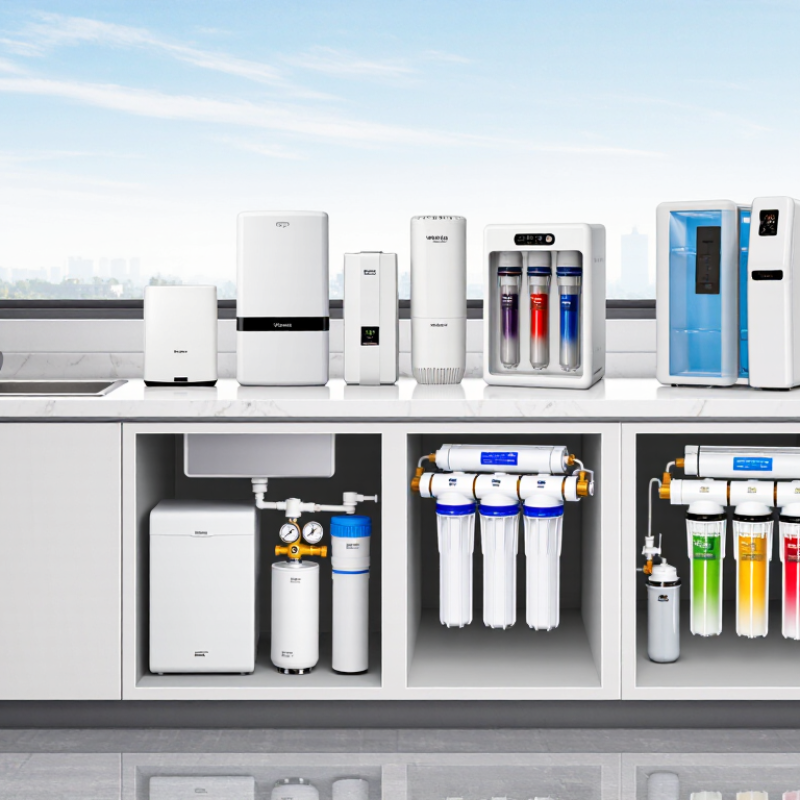
| 1. Standard under-sink RO with storage tank | Households seeking a familiar, point-of-use setup for drinking and cooking water. | Usually includes sediment and carbon pretreatment, an RO membrane, a storage tank, and a dedicated faucet. | Check cabinet space, drain access, faucet-hole requirements, and whether feed pressure meets the model’s stated minimum. | The tank stores treated water; actual delivery rate depends on pressure, temperature, membrane condition, and tank pressure. | Confirm replacement cartridge sizes and local availability. Compare the system’s tested contaminant-reduction claims, not just its number of stages. |
| 2. Tankless under-sink RO | Homes with limited cabinet space or users who prefer water produced on demand. | Typically uses a compact membrane assembly and may include an electric booster pump and electronic indicators. | Check power requirements, pump noise, electrical safety, and access to compatible replacement filters. | Some models advertise faster dispensing or lower wastewater ratios; compare independently documented figures at stated test conditions. | Review filter-change alerts and confirm that proprietary cartridges can be obtained in the destination country. |
| 3. Countertop electric RO | Renters, small kitchens, or users who cannot modify plumbing. | A freestanding appliance with a water reservoir or inlet connection, internal filtration, and a dispensing container. | Check appliance dimensions, voltage and plug compatibility, reservoir capacity, and where reject water is collected or discharged. | Output per hour and batch size vary considerably. A reservoir may need refilling, and reject water still requires appropriate disposal. | Verify that replacement filters are available locally and that the appliance has suitable electrical and food-contact approvals. |
| 4. Low-pressure RO with booster pump | Locations where incoming water pressure is below the selected membrane system’s operating requirements. | An RO unit paired with a pressure-boosting pump and the required electrical components. | Measure dynamic feed pressure and confirm reliable power, pump compatibility, and safe installation. | A pump can help maintain membrane operating pressure, but it does not correct unsafe source water or inadequate pretreatment. | Check pump noise, power use, service access, and replacement-pump availability. Follow the system maker’s pressure limits. |
| 5. RO with remineralization stage | Users who prefer a mineral-containing taste after RO treatment. | A conventional RO system followed by a mineral or pH-adjustment cartridge. | Check the media composition, replacement schedule, and whether the added stage is compatible with the system. | Remineralization changes water chemistry and taste; it is not a substitute for a verified contaminant-reduction claim. | Look for clear information about the minerals added and test the finished water if a specific mineral profile matters. |
| 6. RO system with UV disinfection | Some users with microbiological concerns, especially where a qualified water assessment recommends UV treatment. | RO filtration combined with a UV chamber, usually requiring electricity and periodic lamp or module service. | Assess source-water quality, power reliability, UV component availability, and installation guidance from a qualified professional. | UV performance depends on the unit’s validated dose and water conditions. UV does not remove dissolved salts or particles by itself. | Verify the exact microbial claims and relevant certification. Replace or service the UV component on schedule. |
| 7. RO with enhanced pretreatment for well water | Private-well users whose water test identifies sediment, hardness, iron, or other issues requiring pretreatment. | A treatment train selected from water-test results, potentially including sediment filtration or other dedicated pretreatment before RO. | Test the well water first; some contaminants require specific treatment and cannot be addressed by a standard RO unit alone. | Pretreatment can help protect the membrane, but its design must match the actual water chemistry and contaminant levels. | Budget for water testing and scheduled service. Seek advice from a qualified water-treatment professional for complex well water. |
| 8. RO system for high-dissolved-solids feed water | Users whose tested source water has elevated total dissolved solids (TDS) and is within the system’s specified limits. | A membrane system selected for the documented feed-water TDS, pressure, temperature, and required output. | Compare laboratory water results with the model’s maximum feed-water limits; do not assume every domestic membrane is suitable for every source. | Salt rejection and production rate depend on operating conditions. A handheld TDS reading alone does not identify which contaminants are present. | Request performance data at comparable test conditions and establish a routine for checking water quality and membrane condition. |
| 9. Compact RO for small households | One- or two-person households with modest daily drinking-water needs and limited installation space. | A lower-capacity under-sink or countertop system, with or without a small storage tank. | Check daily capacity against actual household demand, peak use, inlet pressure, and available space. | Rated production is commonly measured under specified test conditions; real-world output can be lower when feed water is cold or pressure is low. | Compare the total cost and availability of replacement filters, not only the initial purchase price. |
| 10. Commercial or high-demand point-of-use RO | Small food-service, office, or other applications with greater demand than a typical household faucet can supply. | Higher-capacity RO equipment, often installed with storage, a delivery pump, and application-specific pretreatment. | Have demand, drainage, power, feed-water quality, and local plumbing requirements assessed before installation. | Capacity and recovery depend on system design and operating conditions; household performance figures should not be used to size commercial equipment. | Plan for professional commissioning, routine sanitization where specified, and an ongoing supply of service parts. |



 Close