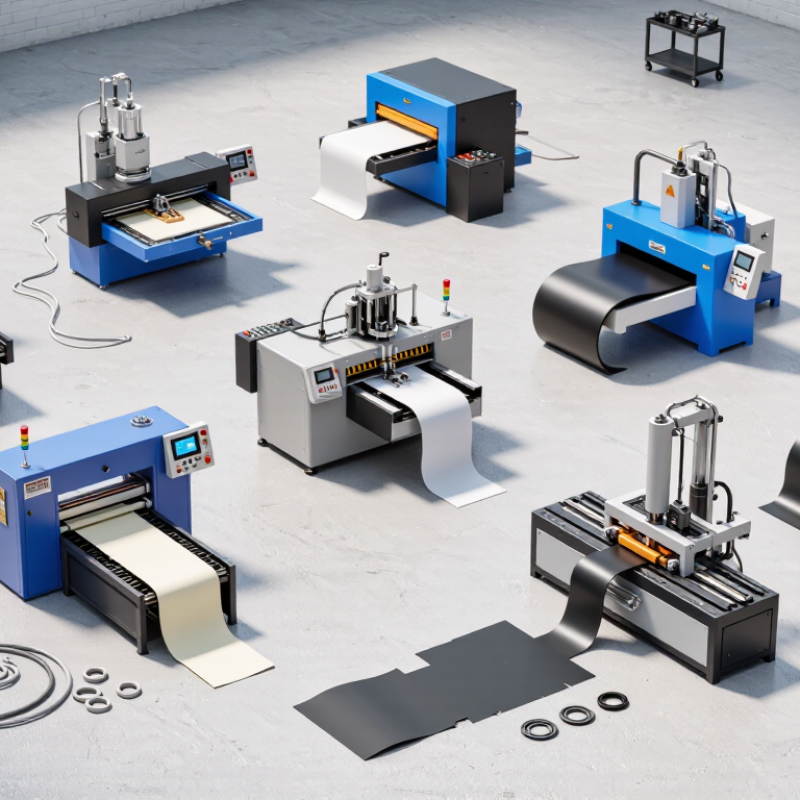
| 1 | CNC oscillating-knife flatbed cutter | A powered blade moves rapidly up and down while following programmed contours. | Gaskets, seals, foam rubber, sheet rubber, and cut kits. | Well suited to programmed profiles, short runs, and frequent design changes; conveyor loading can support longer runs. | Hardness can affect blade choice, feed rate, and edge quality. Use Shore A as one material property, not as the sole machine-selection criterion. | Check usable cutting area, material hold-down, blade options, nesting software, and support for the required sheet thickness. |
| 2 | CNC drag-knife flatbed cutter | A knife is drawn through the material along a programmed path. | Thin rubber sheet, gasket stock, films, and flexible laminates. | Suitable for flexible materials and digitally defined parts, particularly low-to-medium volume work. | Test the actual compound: a harder or more elastic sheet may resist the blade or pull at corners differently from a softer sheet. | Review blade geometry, corner accuracy, material clamping, cutting depth control, and sample-cut results. |
| 3 | Conveyor-fed reciprocating-knife cutter | A reciprocating blade cuts programmed shapes as sheet or roll stock advances through the system. | Roll-fed rubber sheet, flexible mats, liners, and repeated component patterns. | Useful where continuous material feeding and repeatable layouts reduce manual handling. | Hardness readings can help document incoming-material variation, but the cutting program should be validated on the actual compound and thickness. | Check conveyor accuracy, roll handling, registration, waste removal, and whether the material can be held flat during cutting. |
| 4 | Automatic traveling-head clicker press | A traveling press head applies force to a cutting die positioned over the rubber. | Gaskets, washers, footwear components, and repeated shapes from sheet or board stock. | Effective for repeated die-cut shapes; automatic head positioning can reduce repositioning between cuts. | Hardness and thickness influence the force needed for a clean cut. Confirm performance using the intended die and production material. | Check available cutting force, working area, die compatibility, safety guarding, and material positioning accuracy. |
| 5 | Automatic beam or bridge press | A broad press beam descends onto a die and material to cut one or more shapes. | Large gasket patterns, rubber mats, sheet components, and footwear parts. | Can suit medium-to-high repeat production when paired with suitable feeding, positioning, and die handling. | Shore A alone does not determine press capacity; material thickness, die perimeter, compound behavior, and cut quality also matter. | Verify platen or beam coverage, pressure distribution, guarding, die changeover, and the intended cut pattern. |
| 6 | Hydraulic platen die-cut press | A platen applies controlled pressing force through a cutting die. | Rubber pads, seals, gaskets, washers, and components cut from sheet stock. | Appropriate for repeatable die cutting where the part shapes and tooling are stable. | Test cut quality across the specified Shore A range and thickness range; hardness values do not directly translate into a universal press-force setting. | Check platen size, force control, cycle and loading arrangements, die clearance, and operator safety systems. |
| 7 | Rotary die cutter | A cylindrical die cuts moving material as it passes through a rotary cutting station. | Continuous rubber strips, repeated profiles, labels, thin gasket stock, and roll-fed parts. | Best suited to stable, repeatable patterns and continuous or high-volume processing. | Material thickness, compressibility, and hardness affect die engagement and cut-through. Validate the setup with the actual roll stock. | Review roll width, die availability, registration control, changeover needs, and waste handling. |
| 8 | Automatic roll slitter and rewinder | Rotary or razor-style blades divide rubber rolls into narrower strips while the material is unwound and rewound. | Rubber strip, tape, sheet rolls, and continuous narrow profiles. | Designed for longitudinal slitting and roll processing rather than intricate individual part shapes. | Hardness and elasticity can affect edge distortion and winding tension. Evaluate edge quality at the intended material width and roll tension. | Check slitting method, roll diameter and width capacity, tension control, edge alignment, and blade-change requirements. |
| 9 | Automatic guillotine or swing-beam cutter | A straight blade moves through the material to make linear cuts. | Rubber sheets, strips, blocks, and stock cut to length or width. | Useful for straight-line cuts and basic sizing; automated stops or feeding systems can improve repeatability. | Harder or thicker stock may require different blade and machine settings. Confirm that the cut remains square without excessive compression. | Check maximum material size, blade clearance, cut-length control, hold-down method, and guarding. |
| 10 | CNC waterjet cutter | A high-pressure water stream, sometimes with abrasive depending on the application, follows a programmed path. | Thick rubber sheet, large profiles, and complex shapes where mechanical tooling may be less convenient. | Suitable for programmed contours and varied part geometries; it does not require a dedicated shaped die for each profile. | Shore A does not predict waterjet performance by itself. Check cut quality, water exposure, edge condition, and material-specific process settings. | Review work envelope, water management, tolerances on the intended material, cut-edge requirements, and operating costs. |



 Close