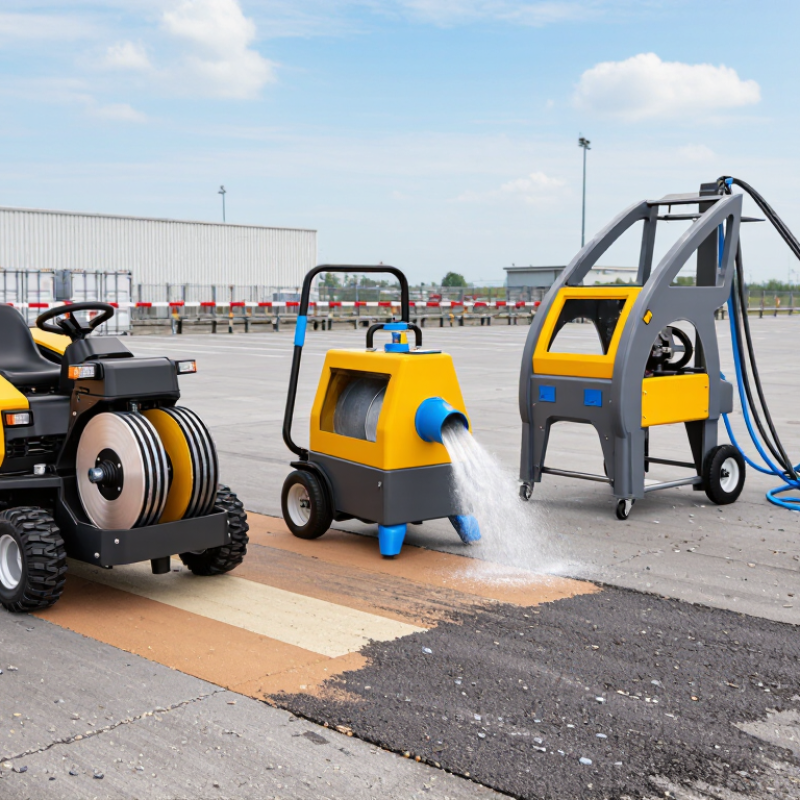
| Walk-behind scarifier (milling machine) | Rotating cutters mechanically chip or mill the marking and a shallow layer of the surface. | Thick or stubborn markings on asphalt or concrete; localized road and parking-area work. | Direct removal action; adjustable cutting depth on many models; effective on durable marking materials. | Can leave grooves or a textured track, especially if depth or travel speed is poorly controlled; cutter wear adds operating cost. | Check depth adjustment, cutter availability, dust-control options, maneuverability, and whether the surface can tolerate mechanical profiling. |
| Ride-on scarifier | Uses a powered rotating cutter assembly to mill markings while the operator rides the machine. | Large, open areas where long working runs and reduced operator pushing are useful. | Higher operator comfort and practical coverage on extensive projects; suitable for sustained milling work. | Requires more space for transport and turning; may be unsuitable for narrow areas or delicate surfaces. | Compare working width, turning requirements, transport access, visibility, depth control, and support for dust collection. |
| Planetary floor grinder | Rotating abrasive tooling grinds the marking from the surface; dust extraction can be connected to the machine. | Thin paint or coating removal on concrete floors, garages, and other relatively even areas. | Can produce a more uniform finish than aggressive milling when correctly tooled; useful for surface preparation as well as removal. | May be slow on thick, strongly bonded markings; abrasive tooling wears, and poor technique can polish or unevenly abrade the surface. | Assess tooling compatibility, extraction connection, machine weight, edge access, finish requirements, and the coating thickness. |
| Shot blaster | Propels abrasive media at the surface and recovers the media and debris through a contained collection system. | Concrete and other surfaces where a consistent, profiled finish is acceptable or desired. | Can remove coatings and create a textured profile in one operation; many systems collect spent media during operation. | May alter the surface profile and is not suitable for every pavement or finish; requires appropriate abrasive handling and maintenance. | Check surface compatibility, profile requirements, media recovery, dust collection, working width, and access to replacement parts. |
| High-pressure water-jet system | Uses a concentrated water stream to break the bond between a marking and the pavement; some systems collect the resulting water and debris. | Road-marking removal where minimizing mechanical cutting is important and wastewater can be managed. | Avoids abrasive cutting tools; can remove markings while limiting direct mechanical impact on the pavement when properly operated. | Requires water supply and wastewater collection or treatment; performance depends on marking material, pressure, nozzle setup, and pavement condition. | Review water use, wastewater recovery, operating pressure controls, traffic-site logistics, surface testing, and local discharge requirements. |
| Handheld angle grinder with suitable abrasive tooling | Abrasive discs or cups grind marking material from a small area. | Small patches, edges, corners, and touch-up work that larger machines cannot reach. | Portable and useful for detail work; relatively simple to bring to confined locations. | Labor-intensive for large areas; requires careful control to avoid gouging, heat buildup, and excessive dust exposure. | Consider guarded tooling, dust extraction, operator ergonomics, personal protective equipment, and the total area to be removed. |


 Close
Close