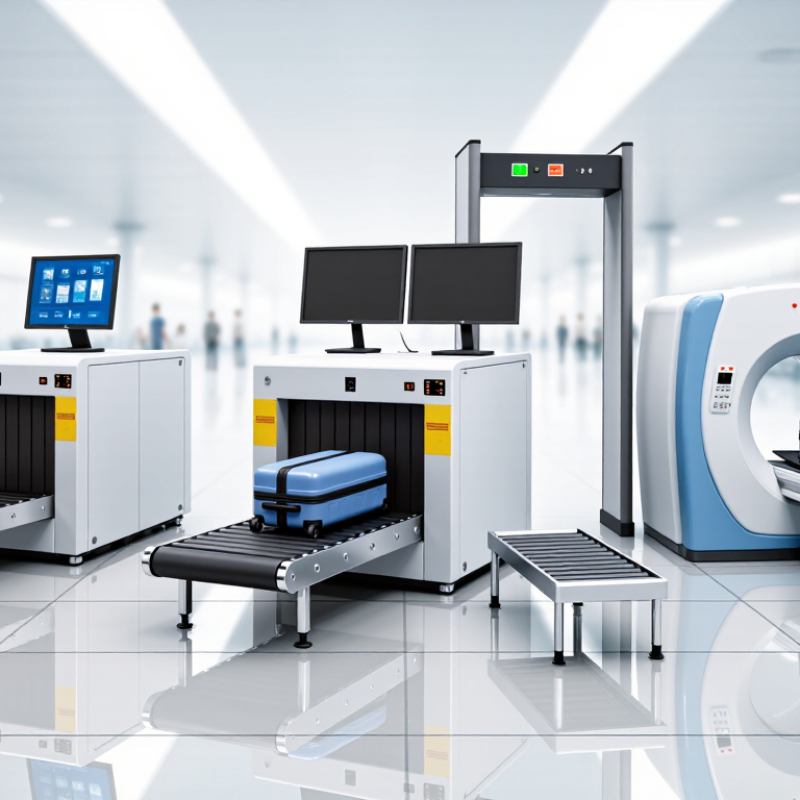
| Cabinet / Conveyer-Belt X-Ray Scanner | Carry-on bags, parcels, mail, and other small or medium-sized items | Items pass through a shielded inspection tunnel on a conveyor. The system creates an image of the contents, often using material-sensitive colour or density display. | Continuous throughput; compact installation options; widely used for routine screening; available with single-view or multi-view imaging. | Item size is limited by the tunnel opening. Image interpretation may be difficult when objects overlap or are densely packed. | Building entrances, event venues, offices, and checkpoints handling bags or parcels. |
| Computed Tomography (CT) Scanner | Cabin baggage, parcels, and selected security-screening applications | Collects multiple X-ray measurements from different angles and reconstructs cross-sectional or three-dimensional images. | Provides more spatial information than a conventional two-dimensional image and can support automated detection functions, depending on the system and deployment. | Generally costs more and can require more space, power, maintenance, and image-review training than basic cabinet systems. | High-throughput checkpoints or sites where detailed three-dimensional inspection and applicable screening requirements are priorities. |
| Checked-Baggage / Hold-Baggage Scanner | Suitcases and other baggage processed through airport baggage-handling systems | Uses larger, high-throughput X-ray equipment integrated with baggage conveyors; some installations use CT-based screening. | Designed to inspect baggage at operational scale and integrate with automated handling and screening workflows. | Requires substantial infrastructure and careful integration with conveyor systems, screening procedures, and baggage operations. | Airports and other facilities screening large volumes of checked baggage. |
| Cargo and Pallet X-Ray Scanner | Freight, palletized goods, large packages, and containerized cargo | Uses a larger inspection opening and higher-energy X-rays than small-item systems to image dense or oversized loads. | Can inspect shipments without unpacking every item and is available in configurations for different cargo sizes and workflows. | Image quality depends on load density, material composition, and cargo arrangement. Large installations need significant floor space and operational controls. | Logistics hubs, freight facilities, customs operations, and distribution sites requiring non-intrusive cargo inspection. |
| Vehicle and Container X-Ray Scanner | Cars, trucks, cargo vehicles, and shipping containers | Uses high-energy X-rays to inspect the vehicle or container and reveal differences in internal density. Systems may be fixed, mobile, or designed for drive-through operation. | Can screen large loads and help identify concealed or undeclared contents without a full manual search. | Requires controlled access, trained operators, substantial safety procedures, and careful management of vehicle flow. Suitability depends on the vehicle and screening objective. | Ports, border crossings, secure logistics sites, and other controlled vehicle-inspection areas. |
| Portable or Mobile X-Ray System | Selected objects or cargo inspected at temporary or changing locations | Equipment is transported to the inspection location or mounted on a mobile platform; system design and imaging method vary by application. | Offers greater deployment flexibility than a permanently installed inspection lane. | Capability, image detail, throughput, and operating requirements vary considerably. A mobile system is not automatically suitable for every item or environment. | Temporary screening operations or sites where fixed installation is impractical, subject to applicable safety and operational requirements. |
| Backscatter X-Ray System | Selected vehicle, cargo, or object-screening applications | Forms an image using X-rays scattered back from an object rather than relying only on radiation transmitted through it. | Can provide useful imaging of surface and near-surface features in applications designed for backscatter inspection. | Penetration and image characteristics differ from transmission systems; it may not provide the same information for dense or deeply concealed contents. | Specialized screening tasks where the system’s backscatter imaging method matches the inspection objective. |



 Close