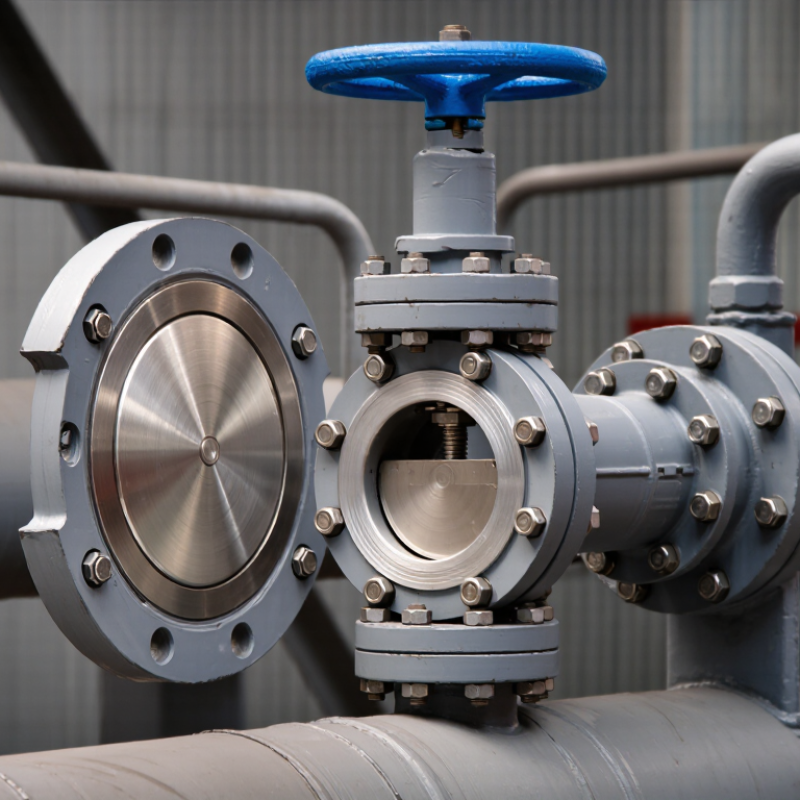
| Valve Definition | Butterfly Valve | A quarter-turn valve that controls fluid flow with a circular disc mounted on a shaft. The disc rotates inside the flow passage to open, throttle, or shut off the line. | Disc rotation: approximately 90° from fully open to fully closed |
| Operating Principle | Rotary Disc and Shaft | When the shaft turns the disc parallel to the flow direction, the passage is substantially open. When the disc turns across the passage, it blocks the flow and the seat provides shut-off sealing. | Open position: low flow obstruction
Closed position: disc contacts or compresses the seat |
| Main Components | Valve Construction | The principal parts are the body, disc, stem or shaft, seat, and operating mechanism. Depending on the design, the stem may be centered or offset from the disc and seat. | Body, disc, shaft, seat, actuator, position indicator |
| Common Designs | Concentric and Offset Types | Concentric designs place the shaft along the centerline of the disc and seat. Offset designs move the shaft away from one or more centerlines to reduce seat contact during operation and support lower-friction movement. | Concentric: general-purpose service
Double-offset or triple-offset: reduced rubbing and higher-temperature applications |
| Flow Control | Isolation and Throttling | Butterfly valves are widely used for on/off isolation and can also regulate flow when the valve, actuator, and process conditions are suitable. Throttling performance depends on disc geometry, pressure drop, and control requirements. | Suitable for quarter-turn isolation
Throttling capability varies by design and service |
| Actuation | Manual or Powered Operation | Operation may be provided by a hand lever, gearbox, pneumatic actuator, electric actuator, or hydraulic actuator. Actuator sizing must account for breakaway torque, running torque, shut-off torque, and safety factors. | Manual: lever or gearbox
Automatic: pneumatic, electric, or hydraulic |
| Design Standard | API 609 | API 609 covers butterfly valves used in petroleum, petrochemical, and natural gas industries. It addresses valve types, pressure-temperature ratings, materials, dimensions, design requirements, inspection, and testing requirements for applicable valve constructions. | Covers wafer, lug, and flanged configurations depending on the applicable design category and edition |
| API 609 Valve Categories | Category A and Category B | Category A generally refers to resilient-seated butterfly valves, while Category B generally refers to high-performance butterfly valves with a seat arrangement intended for more demanding pressure, temperature, or service conditions. | Category A: resilient seat
Category B: high-performance seat design |
| Pressure Rating | API 609 and Applicable Piping Class | The allowable pressure and temperature are determined by the valve design, body and trim materials, seat material, and the applicable pressure class. The pressure rating must be checked at the intended operating temperature. | Common flange classes include Class 150 and Class 300; actual limits depend on construction and materials |
| Leakage Testing | ISO 5208 | ISO 5208 specifies production pressure testing for industrial valves, including shell strength testing and closure tightness testing. The test method, test fluid, test pressure, duration, and acceptance criteria should be stated in the purchase or inspection specification. | Shell test: verifies pressure boundary integrity
Closure test: verifies seat tightness |
| Leakage Rate | ISO 5208 Rate Designations | ISO 5208 defines leakage-rate designations rather than assuming that every valve has the same allowable leakage. The selected rate must be matched to the valve type, seat material, service, and project requirement. | Examples include Rate A, Rate AA, Rate B, Rate C, Rate CC, Rate D, Rate E, Rate EE, Rate F, and Rate G |
| Seat Material | Resilient or Metal Seat | Resilient seats can provide tight shut-off across a broad range of general services but have temperature and chemical compatibility limits. Metal seats are selected for higher-temperature, abrasive, or severe-service applications where permitted by the design. | Common resilient materials: EPDM, NBR, PTFE
Metal seat: selected for temperature and service conditions |
| Installation Style | Wafer, Lug, and Flanged | Wafer valves are clamped between flanges. Lug valves use threaded or tapped lugs and may permit end-of-line service when specifically designed for it. Flanged valves have integral flange ends for bolted connection. | Selection depends on piping layout, maintenance needs, pressure class, and end-of-line requirements |
| Advantages | Compact Quarter-Turn Design | Butterfly valves are generally compact, lightweight, and economical for large nominal pipe sizes. They require less installation space than many multi-turn valve types and can be automated with relatively simple quarter-turn actuators. | Low weight, compact face-to-face length, fast operation, suitable for large bore piping |
| Selection Factors | Application Engineering | Selection should consider fluid composition, pressure, temperature, flow velocity, cavitation risk, solids content, corrosion, fire-safety requirements, emission control, actuator torque, installation orientation, and required leakage rate. | Confirm materials, pressure-temperature rating, end connection, seat design, actuation, and test requirements before purchase |



 Close