| Resin selection | HDPE geomembrane sheet is made from polyethylene resin selected for the required strength, chemical resistance, and service conditions. Resin and additives are controlled through incoming-material checks. | Resin identification and supplier documentation; density can be measured using ASTM D1505 or ASTM D792. | Consistent raw materials help support consistent sheet properties from batch to batch. |
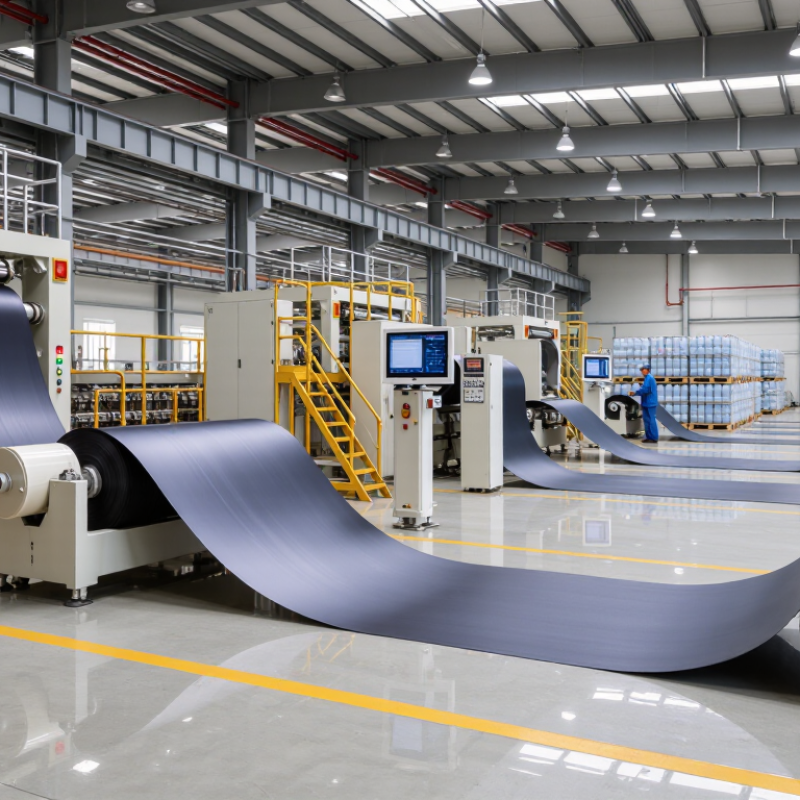
| Sheet forming | Common production methods include flat-die extrusion and blown-film extrusion. Smooth sheet can be textured during manufacture where the project requires increased interface friction. | Production records typically track line settings, roll identification, and product dimensions. | Manufacturing method and surface finish should suit the installation design and contact materials. |
| Nominal thickness | Geomembranes are supplied in a range of nominal thicknesses; 0.75 mm, 1.0 mm, 1.5 mm, and 2.0 mm are common product options, subject to project specifications. | Nominal thickness is measured using ASTM D5199. Acceptance limits depend on the specified product and applicable specification. | Thickness affects design capacity, handling, installation, and the project’s specified minimum requirements. |
| Density | Density is checked on production samples as one indicator of material composition and consistency. | ASTM D1505 or ASTM D792. GRI-GM13 is a commonly referenced specification for HDPE geomembranes; applicable criteria depend on product thickness and specification edition. | Provides a standardized material-property check, but should be considered alongside other test results. |
| Carbon black content and dispersion | Carbon black is commonly incorporated to improve resistance to ultraviolet exposure. Testing checks both its amount and how evenly it is dispersed through the material. | Carbon black content: ASTM D4218. Carbon black dispersion: ASTM D5596. | Appropriate content and dispersion help reduce risks associated with uneven protection and material variability. |
| Tensile properties | Specimens are tested to evaluate tensile behavior, including yield and break properties, where required by the product specification. | ASTM D6693 covers tensile properties of nonreinforced geomembranes. Required values depend on the specified product and thickness. | Supports assessment of material strength and elongation characteristics during handling and service. |
| Tear and puncture resistance | Laboratory samples may be tested for resistance to tear propagation and puncture using standardized procedures. | Tear resistance: ASTM D1004. Index puncture resistance: ASTM D4833. | Relevant to evaluating potential damage during transport, placement, and contact with the prepared subgrade. |
| Oxidative stability | Oxidative-induction testing is used to assess the material’s resistance to oxidation under a defined laboratory procedure. | ASTM D3895 uses differential scanning calorimetry; ASTM D5885 covers high-pressure oxidative-induction time. The selected method and criteria should match the project specification. | Helps compare oxidative stability under controlled test conditions; it does not by itself predict a precise field service life. |
| Roll and surface inspection | Finished rolls are checked for visible surface defects, edge condition, labeling, roll identification, and recorded dimensions. | Inspection records commonly include roll number, width, length, nominal thickness, and observed nonconformities. | Traceable roll records support receiving inspection, installation planning, and resolution of quality issues. |
| Field seam strength | After panels are joined, destructive samples can be taken from trial seams or completed seams to assess peel and shear behavior. | ASTM D6392 covers destructive testing of nonreinforced geomembrane seams. Project-specific requirements determine sampling and acceptance. | Seam performance is an important part of the installed liner system and should be assessed under the project quality plan. |
| Non-destructive seam testing | Depending on the seam type and site procedure, crews may use air-pressure testing of suitable dual-track seams or vacuum-box testing of applicable seams. | Air-pressure testing: ASTM D5820. Vacuum-chamber testing: ASTM D5641. | Allows inspection of completed seams without removing a destructive sample from every tested location. |
| Quality documentation | Buyers can request product data, test reports, roll traceability, and the inspection or testing plan applicable to the order. | Check that reports identify the test method, sample or lot, test date, measured result, and applicable acceptance criteria. | Clear documentation makes it easier to compare products and verify that supplied material matches the project requirements. |



 Close