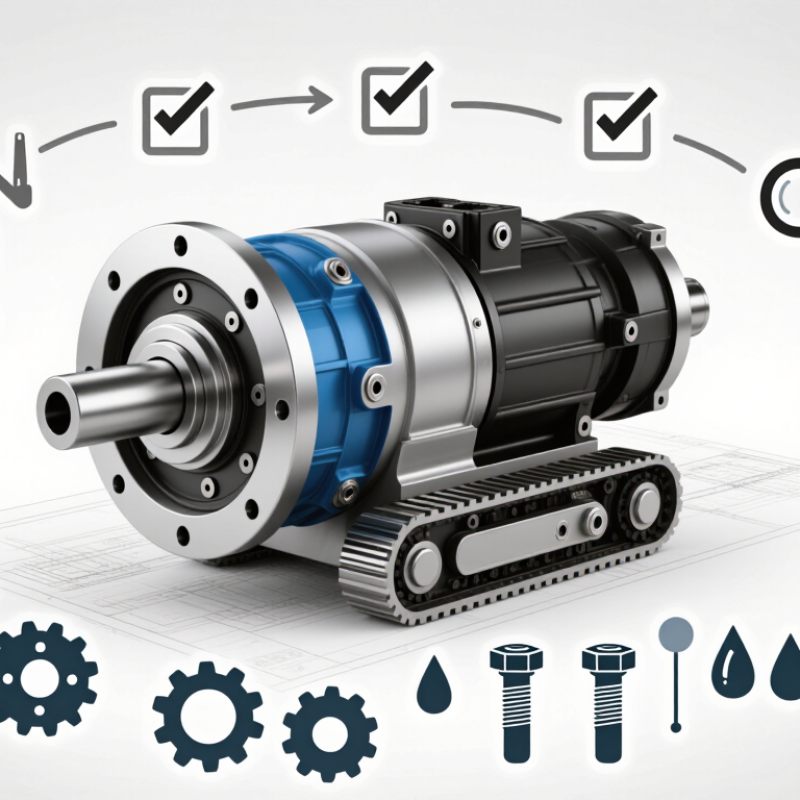
| Compact excavators and mini excavators | Hydraulic travel motor with reduction gearbox; often supplied as a matched final-drive assembly. | Confirm machine model and serial number, motor displacement, reduction ratio, mounting dimensions, port locations, braking arrangement, and required travel speed. | Use ISO 4413 as a general hydraulic-system safety and design reference. Check pressure, leakage, rotation, and dimensional results against the agreed product specification. | Request a dimensioned drawing, connection details, installation instructions, inspection records, and confirmation of compatibility before ordering. |
| Tracked skid-steer loaders and compact track loaders | One hydraulic travel drive per track, selected to suit the machine’s hydraulic circuit and duty cycle. | Verify continuous and intermittent pressure ratings, flow requirements, torque and speed at the specified operating conditions, case-drain requirements, and track-side mounting. | ISO 4413 provides general guidance for hydraulic systems. Test acceptance limits should be agreed in writing for pressure, performance, temperature, and leakage. | Confirm left/right installation requirements, shaft and housing interfaces, hose-port thread type, packaging protection, and spare-part availability. |
| Drilling rigs and tracked construction equipment | Heavy-duty hydraulic motor and planetary reduction stage sized for high torque and frequent load changes. | Evaluate peak and continuous load, shock loading, operating temperature, duty cycle, braking needs, and the motor’s allowable pressure and speed limits. | ISO 4413 is a useful system-level reference. Hydraulic-fluid cleanliness can be specified using ISO 4406 particle-contamination coding. | Ask for material and process traceability where required, test documentation, preservation measures, and shipment packaging suitable for the transport route. |
| Tracked agricultural and forestry machinery | Travel drive selected for low-speed control, traction demands, and operation in changing environmental conditions. | Check required tractive effort, travel speed, oil type and viscosity range, seal compatibility, contamination protection, and service access. | Specify the required fluid cleanliness level using ISO 4406 where appropriate; confirm the target code with the equipment designer or hydraulic-system supplier. | Confirm the operating-fluid recommendation, storage and corrosion-protection requirements, warranty terms, and availability of service documentation in the required language. |
| Mobile platforms and other tracked specialty equipment | Compact hydraulic motor and reduction gearbox matched to the machine’s speed, load, and control requirements. | Check rated and maximum pressure, flow, output speed, mounting interface, braking or holding requirements, and compatibility with the control circuit. | Use ISO 4413 for general hydraulic safety principles. Electrical or machine-level compliance requirements depend on the finished equipment and destination market. | Clarify the product’s intended use, required declarations or certificates, customs classification, country-of-origin documents, and delivery terms before purchase. |
| Incoming inspection for any application | Inspect the complete assembly and compare it with the approved drawing and purchase specification. | Check model identification, dimensions, ports, shaft or hub interface, visible damage, corrosion protection, and supplied accessories. | ISO 4406 defines a method for reporting solid-particle contamination levels in hydraulic fluid; it is not a product certification. Record agreed inspection and test results. | Match packing list, commercial invoice, product identifiers, quantity, and shipping marks. Retain inspection records and photographs for receiving documentation. |



 Close