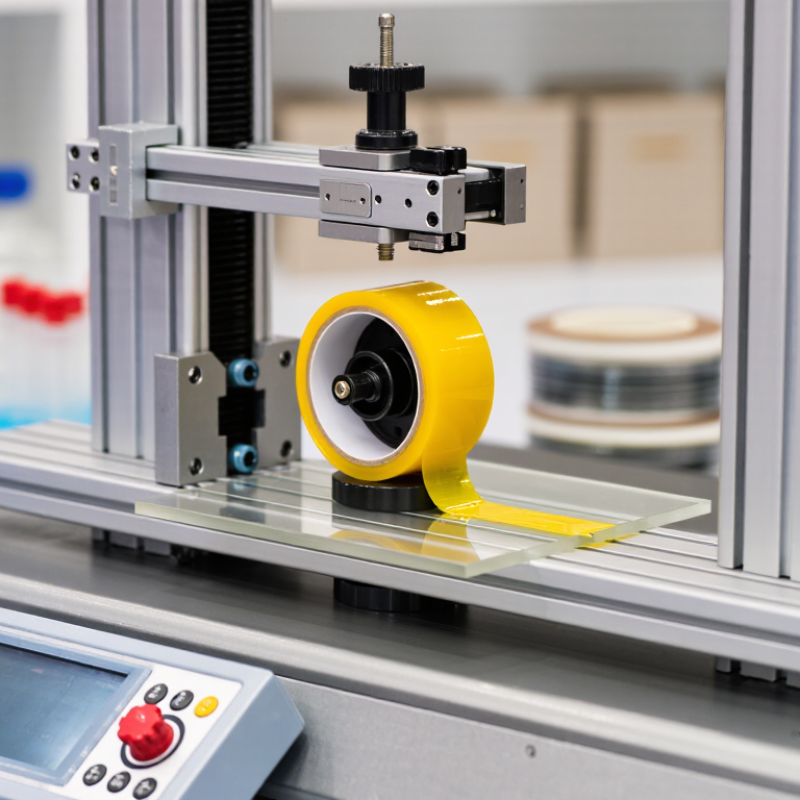
| Test purpose | Measures the force required to peel a pressure-sensitive adhesive tape from a specified substrate. | The result indicates adhesive bond strength under controlled preparation, contact, dwell, angle, and pulling conditions. |
| Peel angle | 90° for a 90° peel configuration. | The free end of the tape is pulled perpendicular to the bonded substrate while the tape is peeled. |
| Important ASTM scope note | ASTM D3330/D3330M primarily specifies peel adhesion tests for pressure-sensitive tape, including 180° test methods. It is not, by itself, a universal 90° peel standard. | A 90° procedure should clearly identify the applicable standard, customer specification, or validated laboratory method used for the test. |
| Common ASTM D3330 test speed | 300 mm/min is specified for several ASTM D3330 peel methods. | The speed should be programmed and verified before testing; a different speed can produce different peel-force results. |
| Test specimen width | ASTM D3330 methods commonly use tape specimens approximately 24 mm wide; the exact width depends on the selected method and specification. | The width must be measured or controlled because peel force is commonly reported as force per unit width. |
| Substrate preparation | The substrate should be clean, smooth, dry, and identified in the test report. | Surface contamination, roughness, coatings, and surface energy can significantly affect adhesion results. |
| Application pressure | A controlled application method, such as a specified roller or pressure procedure, should be used according to the selected test method. | Consistent pressure improves repeatability by reducing differences in initial contact between specimens. |
| Dwell time | The conditioning or dwell period must be defined and kept consistent; the selected ASTM method or product specification determines the required procedure. | Adhesive wet-out and bond development can change with time, temperature, and humidity. |
| Load measurement | A calibrated force-measuring system records the peeling force during the defined travel distance. | The tester should provide stable speed, suitable force capacity, adequate resolution, and traceable calibration. |
| Typical result unit | N/25 mm, N/mm, or another force-per-width unit defined by the test method. | Reporting force per unit width allows specimens of different widths to be compared more meaningfully. |
| Data evaluation | The report should include the average peel force and relevant variation, together with the test setup and specimen details. | A single peak value may not represent the bond accurately when the force curve contains substantial fluctuations. |
| Failure mode | Record adhesive transfer, adhesive separation, substrate failure, backing rupture, or other visible failure behavior. | Failure mode helps explain whether the measured result reflects adhesive strength, cohesive strength, or substrate damage. |
| Environmental control | Temperature and relative humidity should be controlled or reported, especially when required by the product specification. | Pressure-sensitive adhesives can be sensitive to temperature, humidity, aging, and conditioning history. |
| Recommended buyer checklist | Confirm peel angle, test speed, specimen width, force range, travel length, calibration, software output, and applicable standard before purchase. | A suitable tester is defined by application requirements and validated test conditions rather than by a generic “best” label. |



 Close
Close