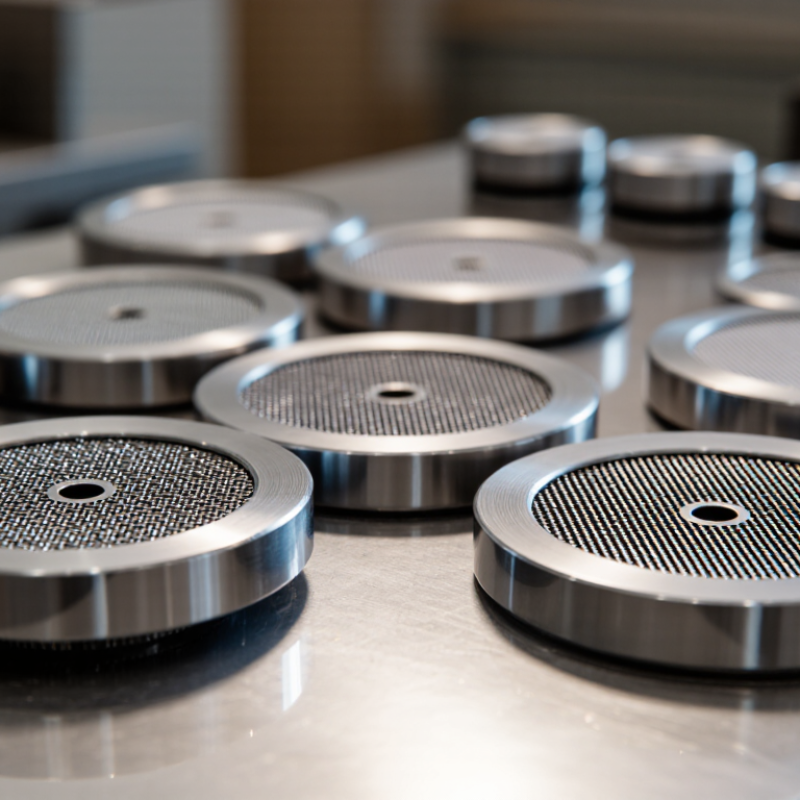
| Product basics | What a metal filter disc is | A circular porous metal component used to retain particles while allowing fluid or gas to pass through. | Disc performance depends on the material, pore structure, thickness, filtration rating, and operating conditions. |
| Construction | Common disc types | Sintered metal powder, woven wire mesh, multilayer mesh, and perforated metal sheet. | Sintered media can provide a rigid porous structure; mesh and perforated discs have openings defined by their weave or hole pattern. |
| Materials | Common stainless steels | 304 stainless steel and 316L stainless steel are widely used. Other alloys may be available for specific service conditions. | Choose based on corrosion exposure, temperature, cleaning method, and compatibility with the process fluid. |
| Filtration | Filtration rating | Available ratings vary by media type and design; sintered metal products are offered in a range of nominal pore ratings. | Confirm whether a rating is nominal or absolute and request the supplier’s test method and particle-retention data. |
| Dimensions | Diameter and thickness | Discs can be supplied in standard or custom diameters and thicknesses, subject to material and manufacturing limits. | Provide the required outside diameter, thickness, flatness, tolerances, and any mounting or sealing details. |
| Manufacturing | 1. Material preparation | Metal powder is selected and prepared for sintered media; wire mesh or sheet is selected for mesh or perforated designs. | Material grade and incoming material inspection help ensure consistency with the specification. |
| Manufacturing | 2. Forming the porous medium | For sintered discs, powder is shaped in a die. Mesh discs are cut from woven material and may be stacked in layers. | Forming and layer arrangement affect strength, porosity, and flow characteristics. |
| Manufacturing | 3. Sintering or joining | Sintered powder parts are heated in a controlled atmosphere so particles bond without fully melting. Mesh layers may be bonded or joined as specified. | Temperature, atmosphere, and time must be controlled to achieve the intended structure and mechanical integrity. |
| Manufacturing | 4. Finishing and cleaning | Parts may be trimmed, machined, edge-finished, cleaned, and inspected after forming or sintering. | Finishing requirements should account for edge condition, cleanliness, and compatibility with the application. |
| Quality checks | Dimensional inspection | Outside diameter, thickness, flatness, and other drawing dimensions can be checked using appropriate measuring equipment. | Agree on tolerances and inspection records before production, particularly for parts that fit into a housing. |
| Quality checks | Performance and integrity tests | Depending on the product, checks may include permeability or flow testing, bubble-point testing, visual inspection, and strength testing. | Test selection should match the filter design and the acceptance criteria required by the application. |
| Supplier assessment | Manufacturer evaluation | Review material traceability, process controls, inspection capability, sample results, and experience with the required disc construction. | Request drawings, test reports, material documentation, and a sample for evaluation. No single manufacturer is best for every application. |
| Application | Operating conditions | Consider fluid or gas, temperature, pressure differential, flow rate, particle load, and cleaning or regeneration requirements. | Confirm that the selected disc and support arrangement are suitable for the actual operating conditions before installation. |



 Close