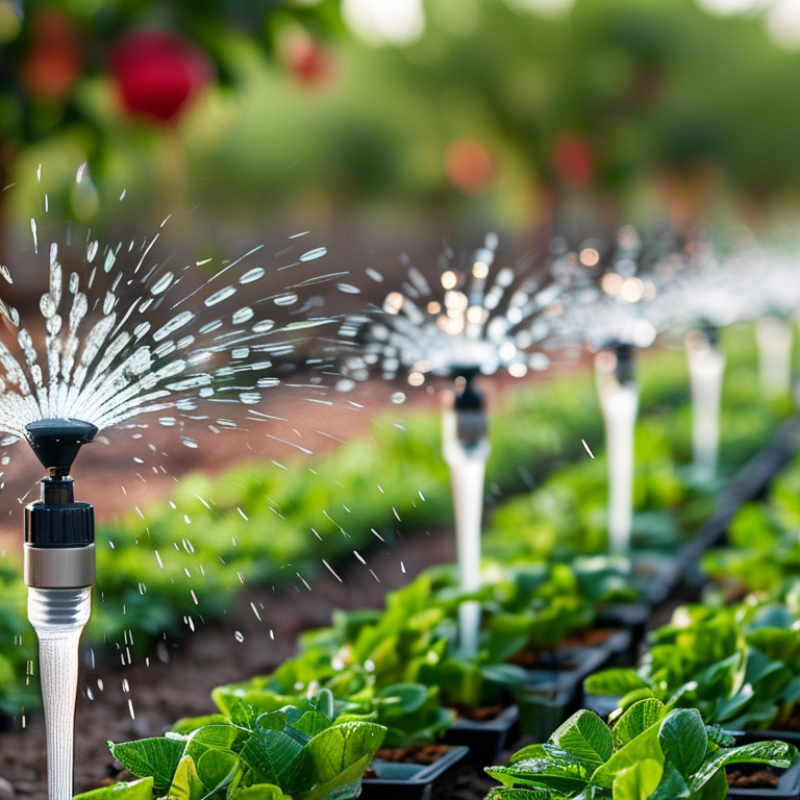
| Definition | Small-area irrigation sprinkler | A mini sprinkler distributes water as fine droplets or small streams over a limited area, commonly for nurseries, gardens, orchards, greenhouses, and landscape beds. |
| Typical Operating Pressure | 1.0–3.0 bar (15–44 psi) | Water pressure forces water through the nozzle and determines spray distance, distribution pattern, and flow rate. Always confirm the working range for the selected model. |
| Flow Rate | Approximately 20–200 L/h | Flow varies with nozzle size, operating pressure, spray angle, and sprinkler design. Lower-flow models are suitable for small planting areas and young plants. |
| Spray Radius | 1–5 m | The radius is measured from the sprinkler to the outer edge of the wetted area and changes with pressure, nozzle geometry, wind, and installation height. |
| Spray Coverage | 90°, 180°, 270°, or 360° | Quarter-, half-, three-quarter-, and full-circle patterns help match irrigation coverage to bed edges, rows, corners, and open areas. |
| Water Droplet Pattern | Fine droplets to small streams | The nozzle breaks the incoming water into droplets or rotating streams, helping provide relatively uniform surface irrigation when the system is correctly spaced and filtered. |
| Common Installation Height | 10–50 cm above the ground | Stakes, risers, or support tubes position the sprinkler above plants or soil. The required height depends on crop size and the desired spray clearance. |
| Common Connection Sizes | 4 mm, 6 mm, or 16 mm tubing systems | Mini sprinklers may connect to micro-tubing, distribution tubing, or polyethylene irrigation pipe through barbed fittings, adapters, or threaded connections. |
| Typical Materials | UV-stabilized plastics; optional stainless-steel parts | Polypropylene, polyethylene, or engineering plastics are commonly used for bodies and nozzles because they resist moisture and many agricultural chemicals. Material suitability should be checked for each application. |
| Filtration Requirement | Usually mesh filtration is recommended | A filter helps prevent nozzle blockage caused by sand, algae, and suspended particles. The appropriate filtration level depends on the nozzle passage and water quality. |
| How It Works | Pressure-driven spray distribution | Water enters the body, passes through a calibrated nozzle or spinner, and is dispersed over the target area. Some designs use a rotating deflector to create a circular or adjustable spray pattern. |
| Suitable Applications | Nurseries, vegetables, orchards, greenhouses, and landscaping | Mini sprinklers are useful where localized overhead irrigation is preferred over full-size agricultural sprinklers or where a broader wetted area than drip emitters is needed. |
| Recommended Spacing | Based on 50%–70% spray overlap | Spacing should be selected according to the tested radius, wind conditions, crop layout, and required uniformity. Overlap generally improves coverage but increases the number of sprinklers required. |
| Main Advantages | Broad coverage, simple layout, and flexible installation | They can irrigate groups of plants, operate with relatively low flow, and be repositioned or expanded using modular tubing and fittings. |
| Key Limitations | Wind drift, evaporation, and wet foliage | Compared with subsurface or drip irrigation, overhead spray can lose more water to wind and evaporation and may leave plant foliage wet. Scheduling and correct placement help reduce these effects. |



 Close
Close