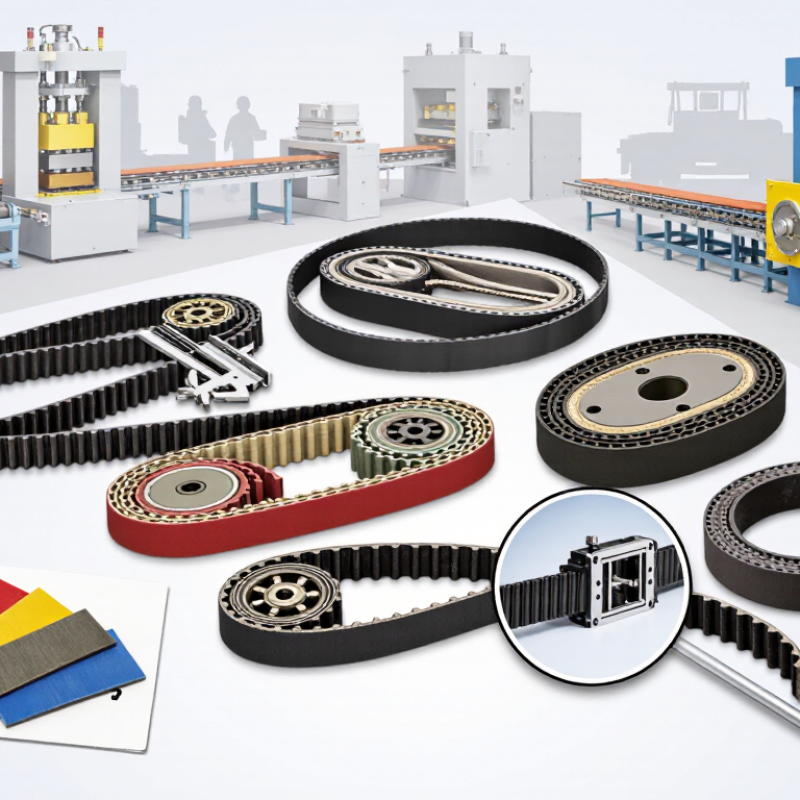
| Definition | A rubber timing belt is a toothed synchronous belt that transmits motion through positive engagement between its teeth and matching pulley grooves. | It maintains a synchronized relationship between the driving and driven shafts without relying primarily on friction. | It is different from a flat belt or V-belt, which normally depends more heavily on frictional contact. |
| Primary Function | To transfer torque and rotational motion while preserving a precise timing relationship between shafts. | It supports accurate indexing, positioning, and coordinated machine cycles. | Commonly used where shaft synchronization is more important than belt slip tolerance. |
| Main Construction | - Toothed elastomer body
- Embedded tensile cords
- Tooth-facing fabric or protective covering
- Optional backing or additional protective layers
| Each layer contributes to flexibility, tensile strength, wear resistance, dimensional stability, or environmental protection. | Construction varies according to torque, speed, temperature, noise, and chemical exposure requirements. |
| Common Elastomers | Chloroprene rubber is widely used for general industrial applications; hydrogenated nitrile rubber is selected for improved heat, oil, and aging resistance in demanding environments. | The elastomer affects operating temperature, resistance to oils and chemicals, flexibility, and service life. | Material selection should be based on the actual operating environment rather than belt appearance alone. |
| Tensile Cord Materials | Typical cord materials include fiberglass, aramid, and polyester. | The cords carry the main tensile load and help control elongation during operation. | Fiberglass offers dimensional stability; aramid provides high strength-to-weight performance; polyester offers flexibility and impact tolerance in suitable designs. |
| Tooth Profiles | Common profiles include trapezoidal tooth forms and curvilinear tooth forms. | Tooth geometry determines load distribution, engagement behavior, noise characteristics, and pulley compatibility. | A belt must use the same compatible pitch and tooth profile as the pulley system. |
| Pitch | Pitch is the distance from one corresponding tooth point to the next, measured along the belt pitch line. | It is a fundamental sizing parameter for matching the belt with the pulley. | Metric pitches are commonly expressed in millimeters, while inch-based systems use corresponding inch designations. |
| Belt Width | Available widths vary by belt series and application; wider belts generally provide greater tooth shear capacity and tensile load capability. | Correct width helps prevent tooth wear, cord overload, and premature failure. | Width should be calculated from transmitted power, speed, service factor, pulley diameter, and duty cycle. |
| Synchronization Accuracy | Very high under correct installation and tension | Positive tooth engagement minimizes normal slip between the belt and pulley. | Timing accuracy can still be affected by tooth wear, incorrect tension, backlash in the machine, pulley runout, or installation errors. |
| Power Transmission | Power is transmitted through tooth engagement and tensile loading of the belt cords. | This allows synchronous operation without the continuous slip normally associated with friction drives. | Actual capacity depends on belt pitch, width, speed, pulley size, wrap angle, temperature, and service conditions. |
| Speed Capability | Suitable speed ranges vary substantially by belt profile, size, construction, pulley diameter, and balancing quality. | Higher speed increases the importance of alignment, dynamic balance, tooth engagement, and heat dissipation. | Do not select a belt based on speed alone; consult the applicable manufacturer’s power and speed rating data. |
| Temperature Performance | Many general-purpose rubber timing belts operate approximately from −30°C to +90°C, while specialized constructions may support broader ranges. | Temperature influences rubber hardness, flexibility, aging, tensile strength, and tooth durability. | Continuous exposure near the material limit can shorten service life even when the belt remains visually intact. |
| Chemical and Oil Resistance | Resistance depends on the elastomer, covering, exposure concentration, temperature, and contact duration. | Oil, fuel, solvents, and cleaning agents can cause swelling, softening, cracking, or loss of adhesion. | Use a compatible compound and protect the drive from leaks, spray, and unsuitable cleaning chemicals. |
| Noise and Vibration | Timing belts generally operate more quietly than chain drives and do not require metal-to-metal tooth contact. | Lower noise can benefit packaging, automation, office-equipment, and enclosed machinery applications. | Noise may increase because of excessive tension, misalignment, worn pulleys, resonance, damaged teeth, or unsuitable speed. |
| Lubrication Requirement | No routine lubrication is normally required. | The dry-running design reduces lubricant contamination and simplifies routine maintenance. | The pulley bearings and other drive components may still require their own specified maintenance. |
| Installation Requirements | Installation requires compatible pulleys, correct center distance, proper alignment, controlled tension, and protection from sharp edges. | Correct installation prevents tooth jumping, cord damage, edge wear, and abnormal vibration. | Never force a belt over a pulley by prying or twisting it; adjust the center distance or tensioning mechanism as designed. |
| Tension Control | Belt tension should be set according to the drive design, belt size, span length, and operating load. | Insufficient tension can cause tooth skipping, while excessive tension can overload shafts, bearings, and belt cords. | Use the specified tension method, such as a frequency, deflection, or tension-measuring procedure. |
| Pulley Compatibility | The pulley must match the belt pitch, tooth profile, tooth count, width, and applicable dimensional tolerances. | Correct engagement distributes load across the teeth and reduces local stress. | Inspect pulley grooves for wear, contamination, burrs, corrosion, and damaged flanges before installing a new belt. |
| Alignment | Parallel shaft alignment and accurate pulley alignment are essential for stable belt tracking. | Misalignment can produce edge wear, belt walking, noise, uneven tooth loading, and premature failure. | Check alignment after installation and again if the drive has experienced impact, maintenance, or structural movement. |
| Inspection Indicators | - Cracks or hardening
- Tooth wear or tooth shear
- Frayed edges
- Exposed or broken cords
- Oil swelling or surface contamination
| Early detection helps prevent unexpected downtime and secondary equipment damage. | Inspection intervals should reflect operating hours, load variation, temperature, contamination, and the consequences of failure. |
| Typical Applications | Industrial automation, conveyors, packaging equipment, textile machinery, printing equipment, robotics, pumps, fans, and precision positioning systems. | These systems benefit from synchronized motion, low maintenance, and controlled operating noise. | Application suitability depends on load profile, duty cycle, environmental conditions, and required positioning accuracy. |
| Key Selection Data | Required information normally includes transmitted power or torque, shaft speed, belt speed, pitch, width, pulley tooth count, center distance, duty cycle, and environment. | Complete data improves belt sizing and reduces the risk of under-rating or unnecessary oversizing. | Include start-up torque, shock loads, reversing operation, ambient temperature, chemical exposure, and space limitations. |
| Primary Advantages | Accurate synchronization, no routine lubrication, relatively low noise, clean operation, and compact drive design. | These characteristics make rubber timing belts suitable for many automated and precision-driven systems. | Advantages are achieved only when the belt, pulley, tension, alignment, and operating conditions are correctly matched. |
| Common Limitations | Sensitivity to severe contamination, incorrect tension, pulley misalignment, excessive shock loading, and incompatible chemicals. | Understanding limitations helps prevent premature failure and unexpected maintenance costs. | For extremely high temperatures, severe abrasive contamination, or very high shock loads, alternative drive technologies may be considered. |



 Close
Close