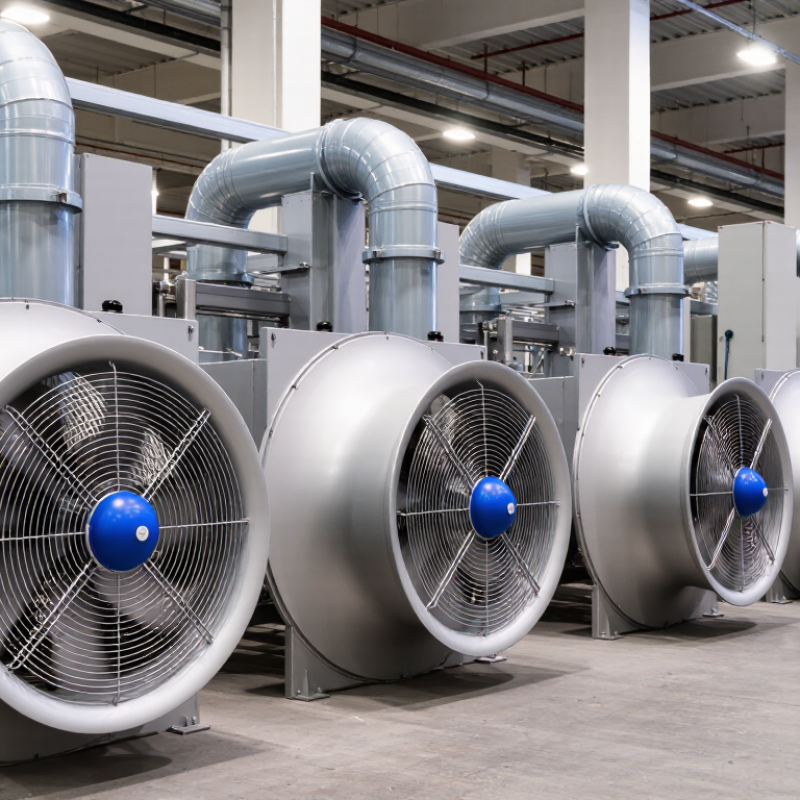
| 1 | Forward-Curved Fan | Centrifugal housing, motor, shaft, inlet cone, and a relatively small impeller with many narrow blades. | Blades curve in the direction of rotation; commonly used with a scroll casing. | 0.1–2.5 | 50–800 | 55–75% | Produces high airflow at relatively low pressure and compact size; widely applied in air-handling units, fan-coil units, and light-duty ventilation. |
| 2 | Backward-Curved Fan | A scroll or free-discharge centrifugal assembly with a rigid impeller and motor-driven shaft. | Blades lean opposite to the direction of rotation, reducing aerodynamic slip. | 0.5–20 | 300–2,500 | 70–85% | Provides stable pressure and comparatively efficient operation; suitable for commercial HVAC systems and process exhaust. |
| 3 | Backward-Inclined Fan | Centrifugal wheel mounted inside a scroll or plenum housing, normally with a direct-drive or belt-drive motor. | Flat or curved blades slope backward without the enclosed airfoil profile of an airfoil wheel. | 0.2–15 | 250–2,000 | 65–82% | Offers non-overloading power characteristics and good efficiency for general ventilation, filtration, and air distribution. |
| 4 | Airfoil Fan | High-efficiency centrifugal fan comprising an aerodynamic wheel, inlet cone, housing or plenum, shaft, bearings, and drive. | Hollow or streamlined airfoil blades minimize turbulence and friction losses. | 1–30 | 500–3,000 | 80–90% | Converts motor power into airflow efficiently and quietly; commonly selected for large HVAC plants and energy-conscious systems. |
| 5 | Radial-Blade Fan | Heavy-duty centrifugal assembly with a robust wheel, scroll housing, shaft, bearings, and protective frame. | Straight blades extend radially from the hub and resist abrasion better than streamlined blades. | 0.1–10 | 500–5,000 | 55–75% | Handles dusty, particulate-laden, or moderately abrasive air in workshops, material-handling systems, and industrial exhaust. |
| 6 | Radial-Tip Fan | Centrifugal wheel and scroll casing designed to combine moderate efficiency with contamination tolerance. | Blade tips are radial while the blade channels are shaped to support higher pressure development. | 0.2–15 | 300–3,000 | 60–78% | Suitable for systems requiring moderate-to-high pressure, including dust collection, drying, and industrial process ventilation. |
| 7 | Plug Fan | Motor and centrifugal impeller installed without a conventional scroll casing, usually inside a pressurized plenum. | Usually backward-curved or airfoil blades with a controlled inlet cone. | 0.5–25 | 300–1,800 | 70–85% | Discharges air radially into the surrounding plenum and allows flexible duct connections; common in modular air-handling equipment. |
| 8 | Inline Centrifugal Fan | Compact cylindrical housing containing a centrifugal wheel, motor, inlet, outlet, and mounting brackets. | Compact backward-curved or forward-curved impeller aligned with the duct axis. | 0.1–5 | 100–1,000 | 55–75% | Moves air through inline ductwork where installation space is limited; used for bathrooms, kitchens, offices, and small commercial systems. |
| 9 | High-Pressure Centrifugal Fan | Reinforced centrifugal housing, narrow wheel, high-speed shaft, bearings, and motor or belt-drive transmission. | Typically radial or backward-curved blades designed for pressure generation. | 0.05–5 | 2,000–15,000 | 50–75% | Maintains airflow against high system resistance; applied to combustion air, pneumatic conveying, spray booths, and specialized process equipment. |
| 10 | Dust-Handling Centrifugal Fan | Industrial fan with reinforced casing, wear-resistant wheel, inspection access, shaft, bearings, and protective guards. | Open radial or backward-inclined blades reduce clogging and tolerate suspended particles. | 0.1–12 | 500–4,000 | 50–75% | Designed for contaminated or particle-bearing air in woodworking, cement, metalworking, filtration, and general dust-extraction systems. |



 Close
Close