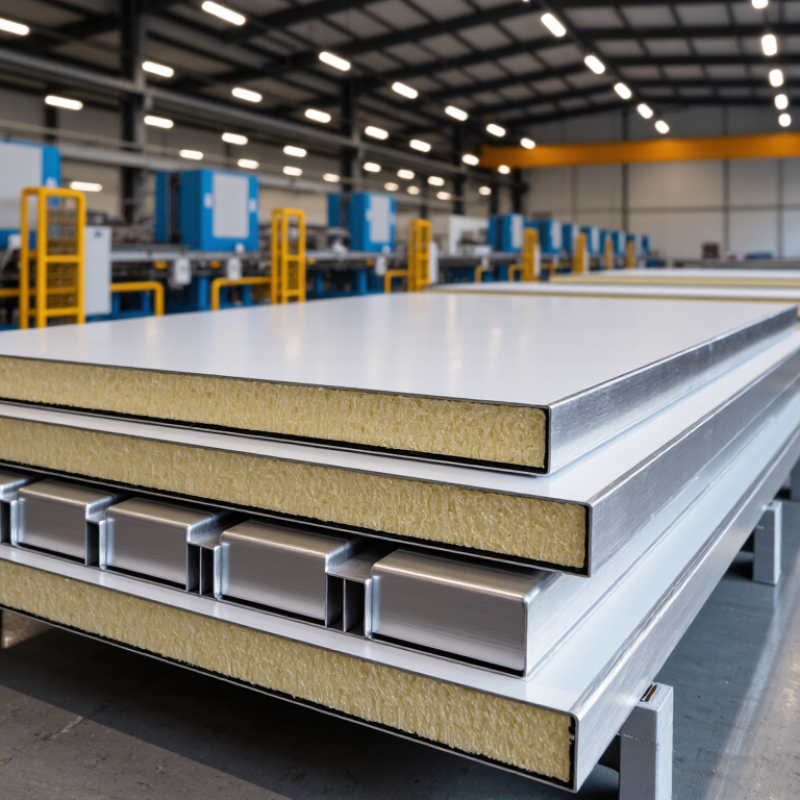
| 01 | Panel core and product range | PU and PIR insulated panels are used for roofs, walls, cold rooms, and other building-envelope applications. Available profiles and configurations differ by production line. | Current product catalogue, technical data sheets, cross-sections, and confirmation of the exact core material offered. | Do not treat PU and PIR as interchangeable; verify the product composition and performance for the specific model. |
| 02 | Panel dimensions and options | Panel thickness, effective cover width, metal facings, joint design, coatings, and cut-to-length options are product-specific. | Dimension schedule, available tolerances, facing specifications, coating details, and a written confirmation of custom-order limits. | Compare like-for-like configurations; different facings or joints can change performance and price. |
| 03 | Thermal performance | Thermal transmittance depends on core type, thickness, joints, facings, and test method—not thickness alone. | Test reports stating the tested panel construction, declared thermal conductivity or U-value, and applicable test standard. | Check that the report covers the quoted panel configuration rather than a different thickness or product family. |
| 04 | Fire performance | Fire reaction and fire-resistance results are specific to the tested product assembly and the relevant classification system. | Current third-party test or classification reports, including product identification, assembly details, and report validity. | A core-material description or a general fire claim is not a substitute for a product-specific report. |
| 05 | Quality-management certification | ISO 9001 concerns an organization’s quality-management system; it does not, by itself, certify the performance of every panel. | Certificate number, issuing and accreditation body, certified legal entity, scope, sites covered, and expiry date. | Check the certificate against the actual manufacturing entity and facility supplying the order. |
| 06 | Product and market approvals | Applicable approvals depend on the destination market, intended use, product specification, and project requirements. | Relevant declarations, test reports, listings, or approvals for the exact product and destination market. | CE marking applies only where the relevant EU rules and product requirements apply; FM approval is product- and system-specific. |
| 07 | Production capacity | Capacity figures are not directly comparable unless their units, operating schedule, product mix, and calculation basis are stated. | Rated and recent actual output, number of operating lines, shift pattern, product mix, and lead-time commitment. | Annual capacity claims may describe theoretical output and should not be assumed to equal available order capacity. |
| 08 | Manufacturing capability | Line configuration, profiling equipment, foaming process, cutting capability, and in-process inspection affect the products a plant can supply. | Facility details, production-process overview, inspection plan, calibration records, and recent product samples. | Confirm whether the quoted product is made at the stated facility or sourced from another producer. |
| 09 | Export reach and logistics | Export suitability depends on destination-specific documentation, packaging, shipping arrangements, and experience with the required delivery terms. | Recent redacted export documents, destination references, packaging specification, port options, and Incoterms quotation. | Past shipments to a region do not establish compliance with every local building code or project specification. |
| 10 | Commercial and technical verification | Warranty, minimum order quantity, sample availability, production lead time, payment terms, and after-sales support vary by supplier and contract. | Written quotation, contract terms, warranty conditions, approved drawings, sample approval process, and named technical contact. | Confirm all specifications and performance requirements in the purchase documents before production begins. |



 Close