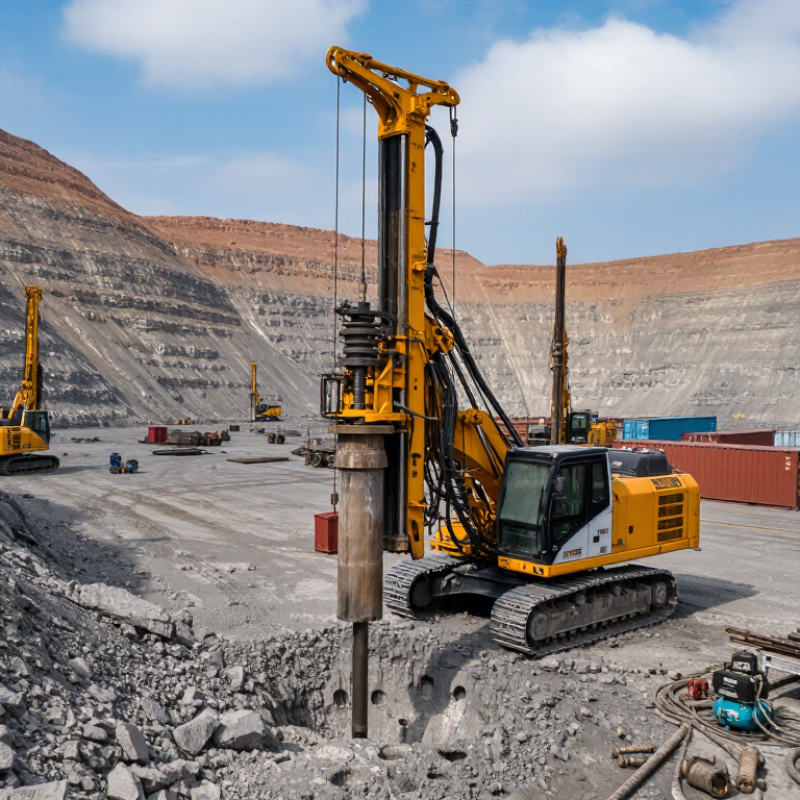
| Applicable drilling method | Down-the-hole hammer drilling with compressed-air flushing | Integrated DTH drilling system with adjustable air, rotation and feed controls | Determines suitability for hard rock, quarrying, mining, anchoring and foundation work. |
| Typical hole diameter | 90–305 mm | 90–400 mm, depending on hammer and casing configuration | Larger diameters require higher air volume, stronger feed systems and heavier tooling. |
| Maximum drilling depth | 30–200 m under site-specific conditions | Up to approximately 250 m with suitable rods, compressor capacity and ground conditions | Actual depth varies with geology, borehole diameter, deviation control and flushing efficiency. |
| Drilling angle range | Approximately 45°–90° or 90°–180°, depending on chassis design | Multi-angle positioning with hydraulic mast adjustment | Affects use in slope stabilization, blast-hole drilling and foundation applications. |
| Rotation speed | 0–120 rpm | Variable hydraulic rotation with torque matched to different rock formations | Variable speed improves bit life and penetration control across changing formations. |
| Rotary torque | 1,500–12,000 N·m | Up to approximately 20,000 N·m on heavy-duty platforms | Higher torque supports larger tools, casing advancement and fractured ground. |
| Feed force | 20–80 kN | Up to approximately 120 kN on heavy crawler rigs | Adequate feed force helps maintain bit contact and stable penetration in hard rock. |
| Recommended compressor pressure | 17–30 bar | Up to approximately 35 bar for deep-hole or large-diameter drilling | Pressure must match the DTH hammer design, depth and flushing requirements. |
| Compressed-air requirement | 10–30 m³/min | Approximately 30–40 m³/min for large tools and deep drilling | Insufficient airflow can reduce penetration rate and leave cuttings in the hole. |
| Power configuration | 75–250 kW diesel engine or equivalent electric-hydraulic system | Approximately 250–350 kW for heavy-duty crawler platforms | Power capacity influences compressor output, hydraulic performance and operating stability. |
| Chassis and mobility | Crawler-mounted, truck-mounted or skid-mounted | Crawler drive with independent leveling and remote-control options | Mobility and leveling determine performance on uneven, restricted or steep terrain. |
| Rod length and connection | 1.5–6 m rods; common thread sizes selected by hammer and hole diameter | Automatic rod changer with compatible DTH and casing systems | Rod handling affects drilling cycle time, operator safety and achievable depth. |
| Dust-control system | Dry dust collector, water injection or optional mist suppression | High-efficiency filtration with automatic cleaning and adjustable water injection | Effective dust control improves visibility, equipment life and compliance with site regulations. |
| Automation and monitoring | Manual hydraulic controls with basic pressure gauges | Digital monitoring of feed pressure, rotation, compressor status and drilling depth | Monitoring supports consistent drilling quality, preventive maintenance and lower downtime. |
| Common application sectors | Mining, quarrying, water wells, geotechnical drilling, anchoring and blasting | Multi-purpose configuration with interchangeable hammers, bits and casing tools | Application flexibility can reduce the need for separate machines across different projects. |
| Export-readiness indicators | CE documentation, English manuals, spare-parts lists and standard electrical options | Documented quality system, international service support and tested hydraulic/electrical components | Documentation and after-sales support are essential for overseas installation and operation. |



 Close