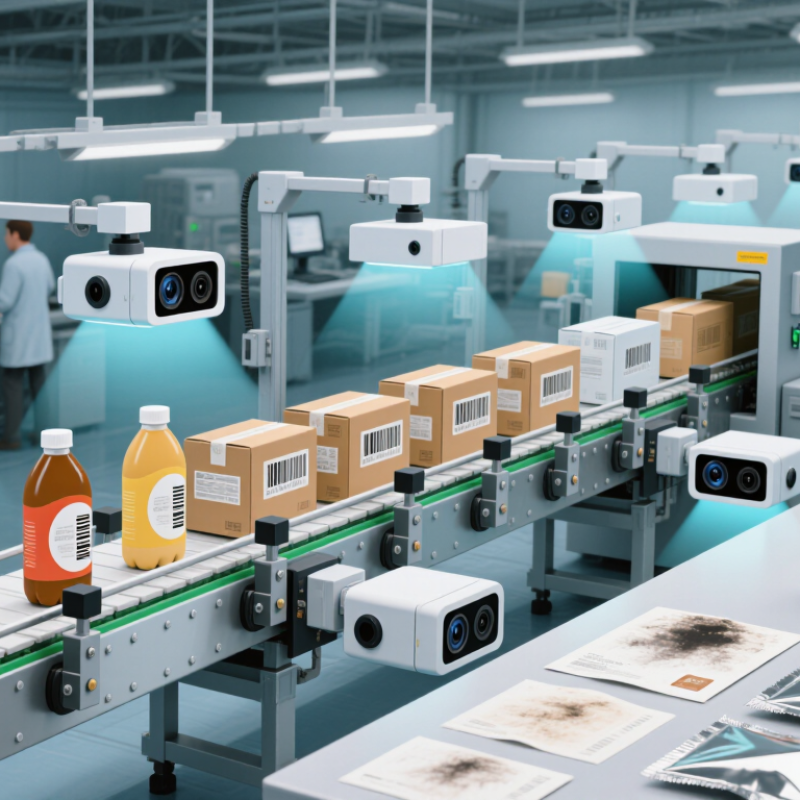
| Camera | Area-scan camera | Captures a two-dimensional image in one exposure; straightforward to set up for stationary or indexed products. | Motion during exposure can cause blur. Field of view, resolution, and working distance must suit the code or text size. | Products stop briefly at an inspection point, or move slowly enough for a suitable exposure. | Smallest character size in pixels, exposure time, lens coverage, focus stability, and trigger timing. |
| Camera | Line-scan camera | Builds an image line by line and can inspect continuous material or long surfaces as they move past the camera. | Requires consistent motion and synchronization with the line encoder or transport speed; setup is typically more involved. | Webs, rolls, or continuously moving products need inspection across a long field of view. | Encoder integration, line rate, motion stability, lighting uniformity, and achievable image resolution. |
| Image capture | Monochrome imaging | Often provides strong contrast for printed characters when color is not needed; can simplify image processing. | Does not preserve color information that may distinguish print from background or identify a specific label variant. | Inspection depends primarily on shape, contrast, and character pattern rather than color. | Contrast under production lighting and whether color carries inspection-critical information. |
| Image capture | Color imaging | Retains color cues that can help separate print, packaging, or label variants when those cues are consistent. | Color and exposure can vary with illumination and material; color alone does not guarantee more reliable OCR. | Color is part of the inspection specification or helps distinguish similar packaging layouts. | Color consistency, illumination, exposure control, and performance on actual production samples. |
| Lighting | Diffuse or angled illumination | Can improve character contrast and reduce unwanted reflections, depending on the surface and print process. | There is no single lighting geometry that works for every surface; glossy, curved, or reflective packaging may need trials. | Text is difficult to read because of glare, uneven brightness, low contrast, or surface curvature. | Test the actual substrate, ink, viewing angle, ambient light, and product-position variation. |
| OCR software | Rule-based or template-focused OCR | Can be effective for stable layouts, known character sets, fixed reading zones, and predictable print conditions. | May need retuning when fonts, layouts, or print quality change; unsuitable rules can reject valid variation or accept errors. | Product formats and text positions are controlled, and inspection rules are clearly defined. | Supported fonts and character sets, allowed text variation, confidence thresholds, and recipe-change workflow. |
| OCR software | Machine-learning-based OCR | May handle greater variation in fonts, print quality, or text appearance when trained and validated with representative samples. | Requires representative data and careful validation; performance can change with products or conditions not covered in testing. | Print or packaging variation is substantial and a fixed template is not robust enough. | Training-data coverage, confidence handling, version control, validation procedure, and behavior on unfamiliar samples. |
| Processing platform | Smart camera or vision sensor | Combines image capture and processing in a compact device, which can reduce separate hardware and simplify installation. | Processing capacity, storage, user interface, and expansion options may be more limited than a PC-based system. | The inspection is localized, the camera count is modest, and the required logic fits the device capabilities. | Processing time at line speed, recipe management, image storage, communications, and maintenance access. |
| Processing platform | Industrial PC-based vision system | Offers flexibility for multiple cameras, more complex processing, data storage, and customized interfaces. | Requires more attention to hardware, software deployment, operating-system maintenance, and recovery planning. | Several inspection stations, detailed image logging, or custom processing and reporting are needed. | Worst-case processing time, supported interfaces, spare strategy, software updates, backups, and restart behavior. |
| Integration | Discrete I/O and PLC signaling | Provides direct inspection triggers and pass/fail or reject signals for a production line. | Limited data compared with a network interface; signal timing and reject coordination must be engineered carefully. | The line needs straightforward machine control and a defined reject or stop response. | Trigger, result, fault, and ready signals; response time; reject timing; and fail-safe behavior. |
| Integration | Industrial network or data interface | Can exchange inspection results, product identifiers, recipes, and diagnostic data with other systems. | Requires agreed data formats, network configuration, access controls, and clear ownership of system responsibilities. | Inspection data must be shared with production, quality, or traceability systems. | Supported protocols, data fields, network policy, time synchronization, and behavior during communication loss. |
| Deployment | Local, on-device or on-premises processing | Keeps inspection processing near the production line and can continue without a cloud connection. | Local hardware, backups, software updates, and data retention need ongoing management. | Fast production decisions, predictable operation, or limited external connectivity are priorities. | Recovery after power loss, local storage capacity, backup process, and access permissions. |
| Validation | Production-sample acceptance test | Measures system behavior on real products, including good prints, known defects, normal variation, and line conditions. | Results are only representative if test samples and operating conditions reflect actual production. | Before equipment selection, commissioning, or a significant recipe or process change. | Read accuracy, false rejects, missed defects, throughput, changeover time, and performance across shifts and lots. |



 Close
Close