How to Choose Commercial Soup Kettles in 2026?
Choosing commercial Soup Kettles in 2026 requires more than comparing capacity and price. Restaurant operators now face higher energy costs, tighter labor conditions, and changing customer expectations. The National Restaurant Association’s 2025 State of the Restaurant Industry Report forecasts restaurant sales above one trillion dollars, while commercial cooking equipment reports from Grand View Research identify energy efficiency, automation, and flexible performance as important market trends. These pressures make equipment selection a daily operational decision.
A useful starting point is Thomas Keller’s well-known observation: “A recipe has no soul. You, as the cook, must bring soul to the recipe.” The same principle applies to Soup Kettles. A kettle should support the cook’s judgment, not hide poor design. Look closely at the details. Can staff control heat without scorching the bottom? Does the hinged lid stay steady beside a busy service line? Is the jacketed vessel easy to drain, wash, and inspect? Small weaknesses become expensive during a six-hour lunch rush.
Capacity also deserves honest reflection. A 20-gallon kettle may appear efficient, yet it can create waste when demand changes unexpectedly. Smaller units may offer better menu flexibility. Gas, electric, and steam models each bring different installation and maintenance requirements. Energy Star guidance also reinforces the value of efficient commercial kitchen equipment, although efficiency ratings do not tell the whole story. Real-world recovery time, batch consistency, warranty support, and staff training matter. There is no perfect choice. The strongest decision balances output, safety, cleaning access, energy use, and the actual rhythm of your kitchen.
What Is a Commercial Soup Kettle and How Does It Work?
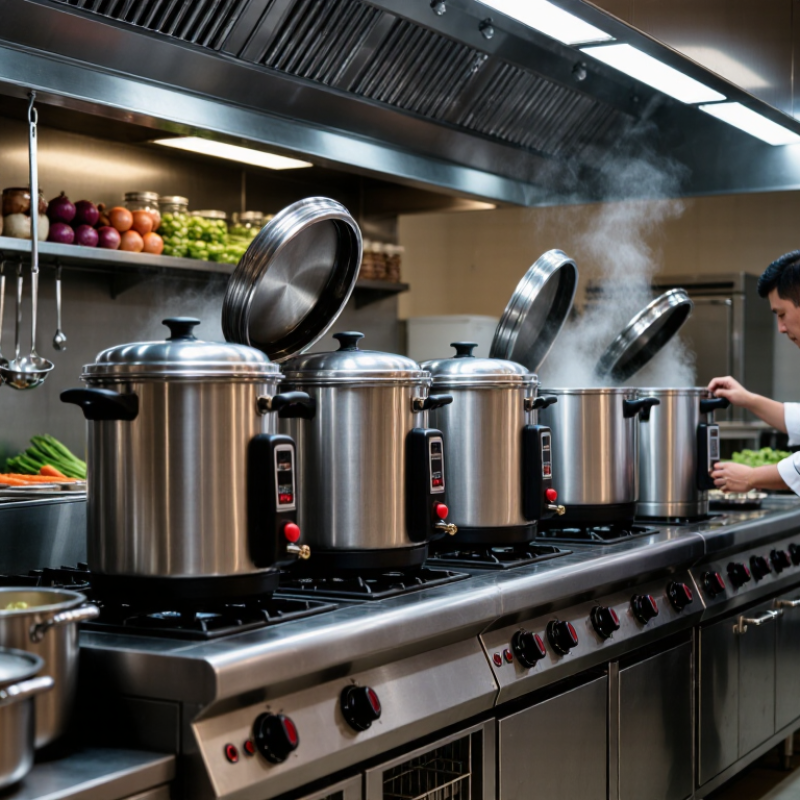
A commercial soup kettle is a heated holding vessel designed for restaurants, hotels, cafeterias, and catering operations. It keeps soup warm and ready for service. Most models use a water jacket between the inner pot and outer shell. An electric heating element warms the water gently. Heat then spreads around the soup instead of burning its base.
Some kettles use direct heat, while others rely on steam or induction systems. A thermostat controls the temperature, and an indicator light shows when heating is active.
The operator should stir thick soup regularly. This prevents uneven temperatures and improves texture. A hinged lid also reduces heat loss and limits contamination during busy service.
Choosing the right kettle requires more than checking capacity. A ten-liter unit may suit a small lunch counter, but a larger kitchen needs enough volume for peak demand. Check temperature accuracy, insulation, drain design, and cleaning access.
Stainless steel surfaces are practical, but hidden seams can still trap residue. That detail is easy to miss. Test the controls with a thermometer, because a dial setting may not match the actual soup temperature. I would also question very low prices. They can indicate weaker insulation, slower recovery, or difficult maintenance. A kettle should support safe holding procedures and follow local food-service requirements.
How to Match Soup Kettle Capacity to Your Foodservice Needs
Choosing the right commercial soup kettle starts with capacity, not appearance. A kettle that is too small creates refill pressure during lunch service. One that is too large may waste energy and occupy valuable counter space. Measure your busiest 30-minute period, then estimate portions served during that window.
For example, a 10-ounce serving requires about 0.078 gallons. If staff serve 80 portions before the next refill, the kettle should hold at least 6.25 gallons. Add practical headspace for stirring and safe handling. A 7.5- to 8-gallon model may fit better than a full 10-gallon unit. Check the math twice. Staff rarely fill every kettle to its stated capacity.
Menu texture also affects the decision. Thick chowder needs easier stirring and may require more working space. Clear broth can tolerate faster service and simpler ladling. If the kettle holds soup for several hours, confirm that its temperature control supports consistent holding without scorching. Foodservice operators should review local food safety requirements and their own monitoring procedures before purchase.
Space can change the answer. Measure the counter, ventilation clearance, nearby outlets, and staff movement. A large kettle beside a narrow pass may slow service. I have seen kitchens choose capacity by volume alone, then struggle with access and cleaning. That mistake is avoidable. Test the expected ladle size, refill routine, and cleaning path with the actual team before placing the order.
How to Compare Materials, Safety Features, and Energy Efficiency
How to Choose Commercial Soup Kettles in 2026?
Material choice affects heat control, cleaning, and service life. Stainless steel interiors resist staining, odors, and repeated scrubbing. They also suit acidic soups better than many untreated metals. Aluminum heats quickly, but it may dent more easily during busy service. A thick, polished interior is useful, though appearance alone proves little. Check welds, seams, handles, and the lid hinge closely. These small details often reveal manufacturing quality.
Safety features deserve practical testing, not just brochure claims. Look for adjustable thermostats, overheat protection, stable feet, and cool-touch handles. A hinged lid can reduce spills when staff serve soup quickly. Clear water-level markings help prevent dry operation in water-jacketed kettles. Check whether controls remain readable beside steam and splashes. A certified electrical design is important, but staff training still matters. Technology cannot correct careless filling.
Energy efficiency comes from insulation, accurate controls, and suitable capacity. A kettle that is too large may waste energy during half-full service. Choose a model matching your busiest menu period, not your largest imagined event. Variable heat settings can maintain serving temperature without constant full power. Measure warm-up time and power use during a real kitchen trial. Small inefficiencies become expensive over a long shift. I would also question impressive efficiency figures measured under ideal conditions. Actual kitchens are messier. They include open lids, frequent refills, and rushed operators.
What Cleaning, Maintenance, and Budget Factors Should You Consider?
Choosing a commercial soup kettle requires more than comparing capacity and purchase price. Cleaning design matters every service day. Look for a smooth stainless-steel well, removable parts, accessible seals, and a drain valve that does not trap soup residue. Avoid models with narrow gaps around controls. Those gaps collect grease and become difficult to inspect.
The FDA Food Code 2022, Section 4-602.11, generally requires food-contact surfaces to be cleaned at least every 24 hours. In practice, thick chowder may require cleaning sooner. After service, staff should disconnect power, cool the kettle safely, drain it, wash removable parts, rinse, sanitize, and air-dry them. Never spray water directly onto electrical controls. A soft brush is useful around valve threads. Harsh abrasives can damage surfaces, although this is often overlooked.
Maintenance should include checking gaskets, hinges, thermostats, and drain leaks every week. Calibration matters when soup must remain hot without scorching. The National Restaurant Association’s 2025 State of the Restaurant Industry report projected $1.5 trillion in U.S. restaurant sales, while highlighting continuing food and labor cost pressure. That makes total ownership cost important. Budget for labor, water, sanitizer, replacement seals, energy, and downtime. A cheaper kettle may need more cleaning time. I have seen purchase comparisons ignore that. They should not. Forecasts are never perfect, so leave room for unexpected repairs and slower winter sales.
How to Choose Commercial Soup Kettles in 2026?
Use these food-safety benchmarks when comparing kettle controls, cleaning access, maintenance features, and operating costs. The values are based on FDA Food Code 2022 guidance for temperature control and food-contact equipment cleaning.
Selection guidance: Choose a kettle that can reliably maintain hot food at or above 135°F (57°C), supports rapid cooling procedures, and allows food-contact surfaces to be cleaned at least every four hours during continuous use with time/temperature control foods. For budgeting, compare energy consumption, replacement gaskets and valves, descaling needs, service access, and expected downtime—not only the initial purchase price.


 Close
Close