How to Choose High Alumina Castable for Industrial Use
Choosing High Alumina Castable for industrial service requires more than checking the alumina percentage. Furnace temperature, slag chemistry, abrasion, thermal cycling, installation method, and drying conditions all affect performance. A castable that survives a kiln roof may fail quickly in a steel ladle. The details matter.
The U.S. Geological Survey reported approximately 390 million metric tons of global bauxite mine production in 2023, with alumina refining remaining concentrated in major industrial regions. The World Steel Association reported crude steel production near 1.9 billion tonnes in 2023. These figures show why refractory reliability remains commercially important. They also reveal a limitation: raw-material volume does not prove castable quality.
Refractory specialist Dr. John H. Chesters stated, “The life of a refractory depends on the conditions under which it is used.” That principle still deserves attention. Select low-cement or ultra-low-cement grades when reduced porosity and stronger corrosion resistance are needed. Consider calcium aluminate cement, reactive alumina, silicon carbide, and suitable aggregates as a complete system. Do not compare products by alumina content alone.
A practical evaluation should examine bulk density, apparent porosity, permanent linear change, cold crushing strength, thermal shock resistance, and slag penetration. Ask for test conditions, not only impressive numbers. Site experience is useful, but it can be incomplete. Even experienced engineers may overlook mixing water, vibration, curing, or rapid drying. The right High Alumina Castable is therefore the one matched to the actual heat, load, chemistry, and installation environment.
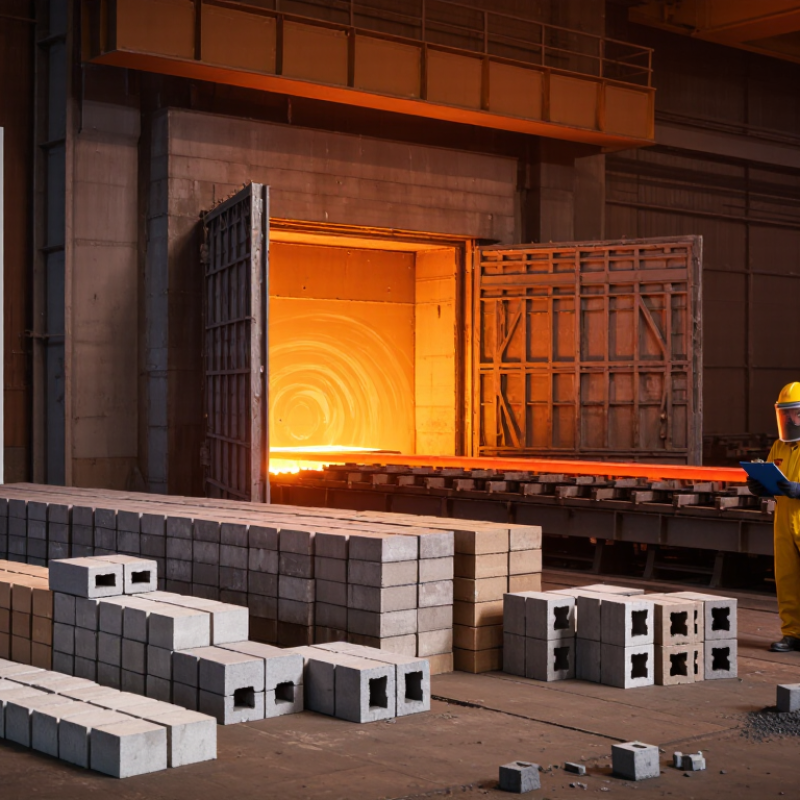
What High Alumina Castable Is and Where It Is Used
High alumina castable is a cement-bonded refractory concrete containing a high proportion of alumina-rich aggregates. It is mixed with water, poured into a steel form, and cured before controlled drying. Alumina improves resistance to heat, abrasion, and chemical attack. The material is not simply “more alumina, more performance.” Aggregate grading, calcium aluminate cement, porosity, and installation quality also control service life.
Its main uses are demanding furnace zones. Steel plants apply high alumina castable around ladles, tundish linings, burner blocks, and reheating furnace floors. The World Steel Association reported 1.89 billion tonnes of crude steel production in 2023. That volume explains the constant need for durable linings. Cement plants use high alumina castable in kiln hoods, coolers, preheaters, and transition zones. The International Energy Agency estimates global cement production at roughly 4.1 billion tonnes annually. Nonferrous smelters, waste-to-energy units, and heat-treatment furnaces also use it where abrasion and thermal cycling overlap.
Selection should begin with operating conditions, not a catalogue percentage. Check service temperature, atmosphere, slag chemistry, mechanical impact, and repair access. A 70% alumina grade may outperform a richer grade when installation is better controlled. Drying is often underestimated. Trapped water can create explosive steam pressure during heat-up. Field records, test certificates, and trial panels provide stronger evidence than marketing claims. Even careful specifications can fail when local water, vibration, or curing time changes. That is the uncomfortable part.
How to Evaluate Thermal, Mechanical, and Chemical Performance
How to Choose High Alumina Castable for Industrial Use
Thermal performance begins with the operating temperature, heating rate, and furnace atmosphere. Check refractoriness under load, thermal conductivity, and permanent linear change. A castable that survives high heat may still crack during rapid cycling. Low thermal conductivity can reduce heat loss, but excessive insulation may weaken the hot face. Review test data from controlled laboratory conditions. Real furnace conditions are less polite. Drying and curing deserve equal attention. Trapped moisture can cause explosive spalling during the first heat-up.
Mechanical performance should match the area’s physical stress. Compare cold crushing strength, modulus of rupture, abrasion resistance, and thermal shock behavior. A kiln floor may need strong abrasion resistance, while a burner zone may need better thermal shock tolerance. Test samples should follow recognized procedures, such as ASTM methods, when applicable. Installation quality changes the result. Incorrect water addition, poor vibration, or uneven thickness can damage even a well-designed castable. Field inspection often reveals these weaknesses.
Chemical performance depends on contact with slag, molten material, alkalis, and furnace gases. Examine alumina content, calcium oxide level, porosity, and apparent density. Low cement systems may offer cleaner high-temperature behavior, but they require stricter mixing control. Chemical compatibility should be checked through slag cup tests or service simulations. Do not rely on a single brochure value. Ask for batch records, test temperatures, and curing conditions. Some data look impressive until the test method is examined. Recheck assumptions before choosing the final grade.
How to Select the Right Binder, Aggregate, and Additives
Choosing high alumina castable begins with service conditions, not a catalog number. In furnace repairs, I have compared hot-face temperature, abrasion, chemical exposure, and installation space before selecting materials. A binder must match the curing schedule. Calcium aluminate cement gives reliable early strength, while low-cement systems reduce water demand and porosity. However, a faster set can punish careless mixing. That detail is easy to overlook.
Select dense alumina aggregate for abrasion and heat resistance. Use graded particles, from coarse grains to fine powder, so the castable packs tightly around anchors and corners. Aggregate purity matters when slag or molten metal contacts the lining. Reactive alumina can improve matrix strength, but excessive fines may increase mixing difficulty. I prefer trial batches that measure flow, bulk density, and fired strength at the intended temperature. Laboratory results need site verification.
Additives should solve a defined problem. Dispersants can lower water demand; microsilica can refine pores; stainless or polypropylene fibers may control drying cracks. Use fibers only after checking dryout procedures and ventilation requirements. Too much additive can weaken workability or create unexpected shrinkage. I once accepted a smooth mix that later dried unevenly because the water content was guessed. That mistake changed my practice: record batch moisture, mixing time, and installation temperature every time. Ask the installer to test a small panel. It often reveals more than a datasheet.



 Close
Close