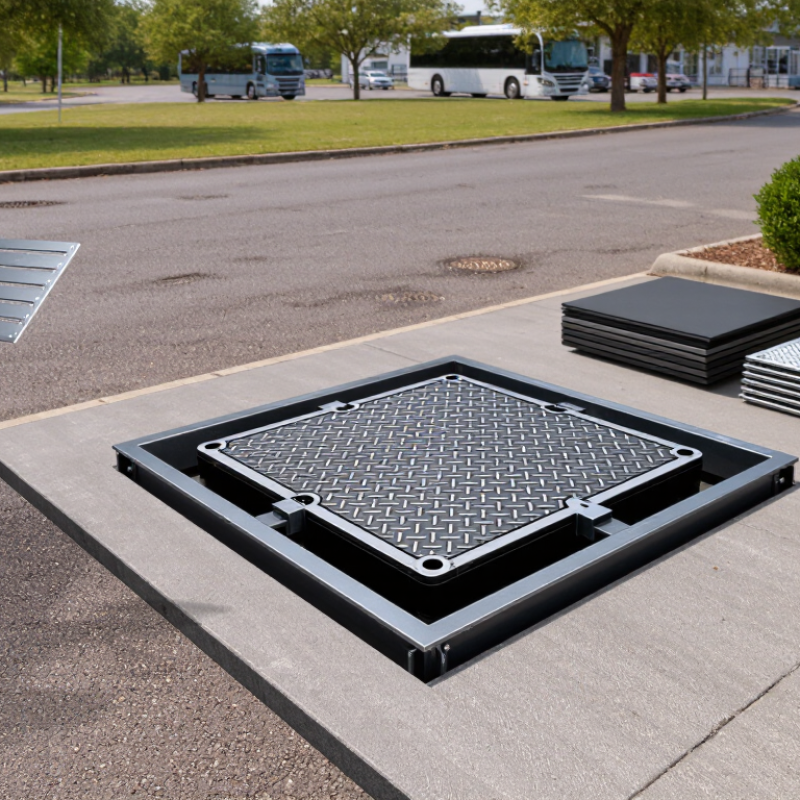
| Definition | A square manhole cover is a removable cover and frame used to close an access opening to an underground chamber, drainage system, utility vault, or service duct. | Usually consists of a square cover, a supporting frame, and optional locking, lifting, sealing, or anti-skid features. | Road drainage, utility access points, inspection chambers, cable vaults, and service areas. | Confirm whether the required measurement is the clear opening, cover size, or external frame size before ordering. |
| Shape and Fit | The square geometry provides four equal sides and can simplify alignment with square or rectangular chambers. | Typical clear-opening examples include 300 × 300 mm, 450 × 450 mm, 600 × 600 mm, 750 × 750 mm, and 900 × 900 mm. | Small inspection points, utility boxes, stormwater chambers, and larger maintenance access openings. | Measure the finished opening on site and allow sufficient bearing support for the frame. Sizes are not universally interchangeable. |
| Load Classification | Load class indicates the test-load category under EN 124-2 for ductile iron covers and frames. The correct class depends on the location and traffic exposure. | A 15: 15 kN
B 125: 125 kN
C 250: 250 kN
D 400: 400 kN
E 600: 600 kN
F 900: 900 kN | From pedestrian areas and landscaped zones to carriageways, industrial yards, ports, and aircraft movement areas. | Choose by actual installation environment, not by cover size alone. Local regulations may require a specific minimum class. |
| Pedestrian and Light-Duty Areas | Areas without regular vehicle loading generally require lower load classes than roads or industrial sites. | A 15 is commonly associated with pedestrian areas, cycleways, and landscaped spaces where vehicles are not expected. | Footpaths, gardens, courtyards, parks, and pedestrian-only zones. | Prevent vehicle access if the selected class is not designed for occasional or regular vehicle loading. |
| Parking and Slow-Traffic Areas | Vehicle-accessible areas need a stronger cover and a stable frame designed for repeated wheel loads. | B 125 is commonly used in pedestrian areas, car parks, and similar locations with limited or low-speed vehicle access. | Parking areas, residential driveways, private roads, and pedestrian zones occasionally used by vehicles. | Consider wheel-path location, turning movements, impact loads, and the possibility of future traffic changes. |
| Roadway and Industrial Loading | Regular traffic subjects the cover to repeated dynamic loads, impact, vibration, and braking forces. | C 250 may suit certain kerbside or verge areas, while D 400 is widely associated with carriageways, hard shoulders, and areas used by all types of road vehicles. | Public roads, loading yards, industrial sites, bus lanes, and commercial vehicle routes. | D 400 is generally the key reference for covers located directly in traffic lanes, subject to local design requirements. |
| Heavy Industrial or Special Areas | Extremely high wheel loads and concentrated traffic require higher-rated products and carefully designed supporting structures. | E 600 is associated with areas subject to high wheel loads, while F 900 is intended for exceptionally heavy loading conditions. | Ports, aircraft movement areas, heavily loaded industrial zones, and other special-purpose sites. | Obtain structural design confirmation for unusual loads, forklift traffic, cranes, solid tires, or aircraft-related applications. |
| Primary Material | Material affects strength, corrosion resistance, mass, service life, and installation requirements. | Ductile iron: high strength and impact resistance.
Cast iron: traditional heavy-duty construction.
Steel: fabricated designs with appropriate corrosion protection.
Composite or polymer: lightweight options for selected loads and environments. | Municipal infrastructure, utility projects, drainage systems, private developments, and controlled-access facilities. | Match material to loading, corrosion exposure, theft risk, handling requirements, and local approval rules. |
| Corrosion Environment | Moisture, de-icing salts, wastewater, chemicals, and coastal air can accelerate corrosion of exposed components. | Common protection methods include suitable coatings, galvanizing for compatible steel components, corrosion-resistant hardware, and drainage-friendly frame design. | Coastal regions, wastewater facilities, roads treated with salt, industrial plants, and wet underground chambers. | Specify the exposure conditions and verify coating performance, repair requirements, and compatibility with the surrounding installation. |
| Surface Pattern and Slip Resistance | The top surface should help reduce slipping while allowing water and debris to move away from the contact area. | Raised anti-skid patterns, textured surfaces, and recessed designs are commonly used. | Footways, roads, ramps, industrial floors, wet service areas, and drainage locations. | Check that the surface pattern is suitable for pedestrians, bicycles, vehicles, and the cleaning conditions at the site. |
| Security Features | Security features help prevent unauthorized access, accidental displacement, and theft. | Options may include locking bolts, captive hinges, concealed lifting points, tamper-resistant fasteners, and sealed access designs. | Schools, airports, utility compounds, public spaces, telecommunications sites, and high-risk locations. | Use a lockable or hinged design where access must be controlled. Ensure authorized personnel can open it safely. |
| Sealing and Odor Control | A gasket or close-fitting contact surface can reduce water ingress, odors, noise, and movement between the cover and frame. | Options include elastomeric gaskets, machined contact surfaces, bolted covers, and sealed access assemblies. | Wastewater systems, pumping stations, indoor service rooms, and areas requiring odor or water control. | Confirm the required level of water, gas, and odor resistance; not every standard cover is gas-tight or watertight. |
| Handling and Maintenance | Cover mass, lifting points, hinges, and opening tools affect worker safety and maintenance time. | Lift-assist mechanisms, hinged covers, removable panels, and dedicated lifting keys can improve access. | Frequently inspected utility chambers, wastewater plants, public infrastructure, and confined maintenance areas. | Plan for safe manual handling or mechanical lifting, and keep lifting tools available at the maintenance location. |
| Installation Requirements | Correct bedding, frame support, level, alignment, and surrounding pavement are essential for long-term performance. | Installation normally requires a stable, level bearing surface and adequate structural support around the frame. | New construction, road reconstruction, drainage upgrades, and utility access installations. | Follow the applicable installation instructions and ensure the frame is fully supported before traffic is permitted. |
| Standards and Verification | Standards provide a common basis for load classification, testing, marking, and product performance. | EN 124-1 provides general principles, while EN 124-2 covers cast iron access covers and gratings. Other material-specific parts may apply to other product types. | Public works, infrastructure projects, engineering specifications, and regulated construction. | Request load-class marking, dimensional drawings, test documentation, and installation instructions relevant to the selected material and market. |
| Recommended 2026 Checklist | A practical selection should consider the opening, location, loading, material, security, environment, and maintenance method together. | Confirm: clear opening; frame dimensions; load class; material; corrosion exposure; anti-slip surface; locking or sealing needs; access method; applicable standard. | Any project involving drainage, utilities, inspection chambers, service ducts, or underground infrastructure. | Use site conditions and project specifications as the final basis for selection, and obtain professional approval for public roads or unusually heavy loads. |


 Close
Close