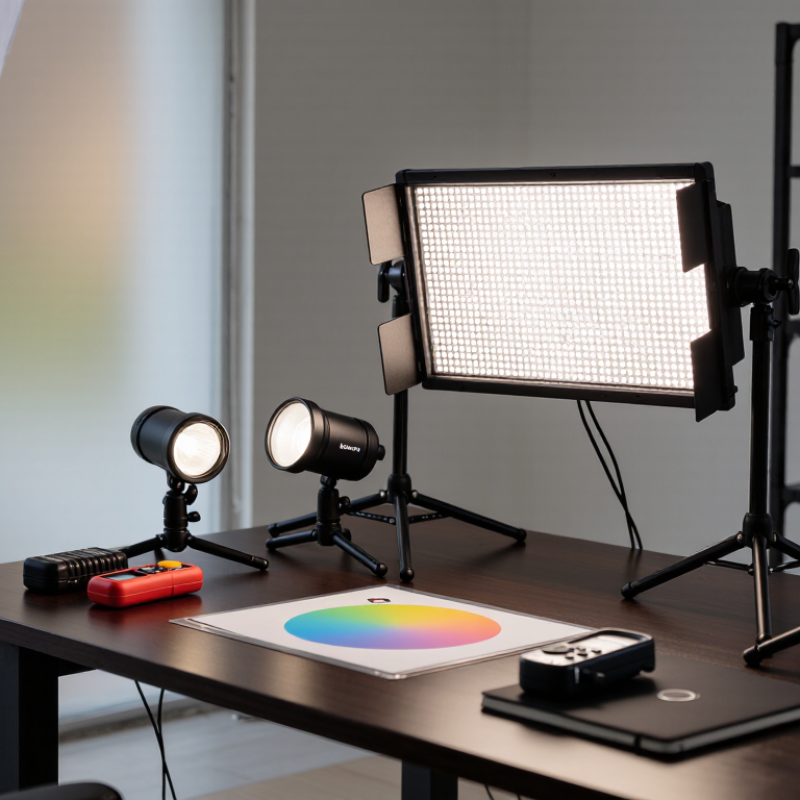
| Daylight COB | About 10,000–60,000 lux with a reflector; varies widely by power and reflector design. | Many video-oriented models specify CRI and TLCI of 95 or higher. | Usually fixed near 5,600 K; some models offer limited adjustment. | Bright key or fill light, daylight-balanced sets, and use with softboxes or reflectors. | A reflector gives a harder, brighter beam. A softbox spreads and softens the light but reduces output. |
| Bi-color COB | About 8,000–50,000 lux with a reflector; output depends on wattage and color-temperature setting. | Many models specify CRI and TLCI of 95 or higher; check ratings at more than one color temperature. | Commonly around 2,700–6,500 K. | Interviews, mixed indoor lighting, and shoots where matching warm and daylight sources matters. | Some fixtures produce less output at the warm or cool ends of their range. |
| RGBWW COB | About 5,000–40,000 lux with a reflector; saturated colors are often dimmer than white output. | White-light CRI/TLCI ratings are often 95 or higher; colored output should be assessed separately. | Often includes adjustable white light around 2,700–10,000 K plus RGB color mixing. | A versatile key light for white light, colored accents, and effects. | Compare white-light output and saturated-color output separately; RGB features do not guarantee high brightness in every color. |
| Bi-color soft panel | About 1,000–8,000 lux at 1 m, depending on panel size, diffusion, and power. | Many models specify CRI and TLCI of 95 or higher. | Commonly around 2,700–6,500 K. | Soft, broad illumination for faces, product shots, and small spaces. | The built-in diffusion is convenient, but the broad beam may be harder to control than a COB with a modifier. |
| RGB panel | About 1,000–6,000 lux at 1 m; colored output may be substantially lower than white output. | White-light CRI/TLCI ratings are often 95 or higher; color-gamut coverage varies by fixture. | Often offers adjustable white light plus a broad range of RGB colors; white-light CCT ranges vary by model. | Colored backgrounds, creative accents, and soft fill in compact setups. | Check whether the panel can provide the required brightness at the chosen color and white balance. |
| RGB LED tube | Often about 300–1,500 lux at 1 m; output depends on tube length, design, and measurement direction. | White-light CRI/TLCI ratings of 95 or higher are common on video-oriented models. | Many models provide adjustable white light and RGB colors; exact CCT range varies. | Practical lights, edge lighting, tight locations, and colored accents. | Tubes are easy to position but generally provide less concentrated output than COB fixtures. |



 Close