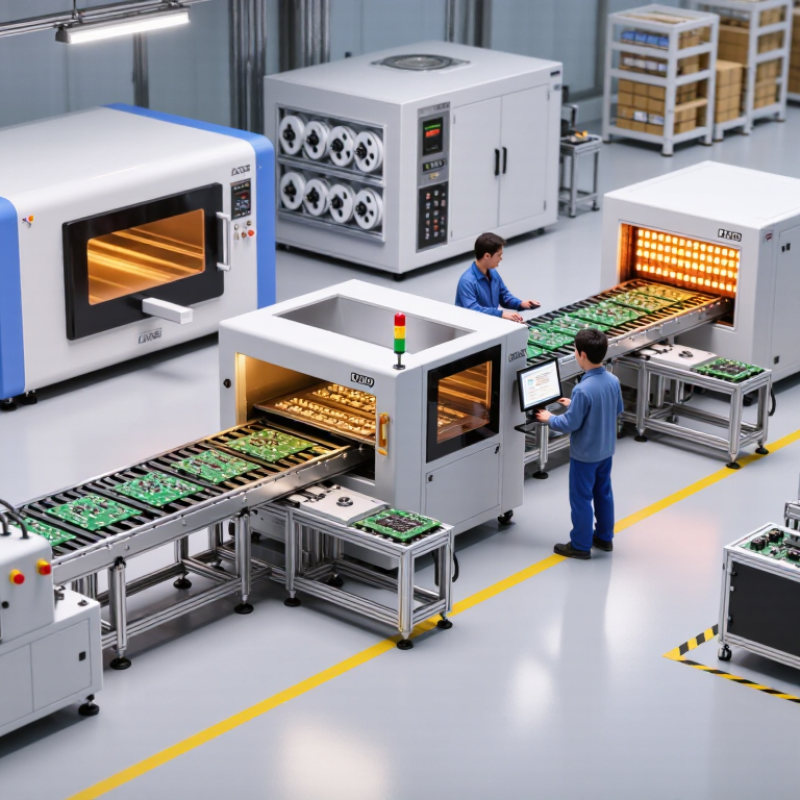
| PCB Loader and Unloader | Feeds bare boards into the line and collects finished boards. | Useful when boards need to move automatically between production stages or when reducing manual handling is a priority. | Check board dimensions and thickness, magazine capacity, changeover method, transfer height, and compatibility with the rest of the line. | At the beginning and end of the line |
| Solder Paste Printer | Deposits solder paste onto PCB pads through a stencil. | Required for processes that use solder paste to attach surface-mount components. | Evaluate print repeatability, stencil support, alignment method, board-size range, cleaning options, and setup time for product changeovers. | Before component placement |
| Solder Paste Inspection (SPI) | Measures printed paste deposits for issues such as insufficient volume, excess paste, bridging, or misalignment. | Especially valuable for fine-pitch components, high-mix production, and processes where print defects can cause downstream rework. | Consider inspection coverage, measurement capability, recipe programming, false-call controls, and how results are linked to the printer process. | After the solder paste printer |
| Pick-and-Place Machine | Places surface-mount components onto solder-pasted PCB pads. | Required for SMT assembly; machine configuration should match the product mix and production volume. | Assess component-size range, placement accuracy, feeder capacity, changeover needs, supported packages, and expected throughput for your actual board mix. | After SPI, or after printing when SPI is not used |
| Reflow Oven | Heats the assembled PCB according to a thermal profile so solder paste forms reliable joints. | Required for most solder-paste-based SMT processes. | Check usable heating zones, conveyor width and speed, temperature uniformity, profile control, board clearance, and whether nitrogen is needed for the process. | After component placement |
| Automated Optical Inspection (AOI) | Uses cameras and inspection software to identify visible assembly defects, such as missing, misplaced, or incorrectly oriented components. | Useful when consistent inspection and faster defect feedback are needed, particularly in repeat production or complex assemblies. | Choose inspection coverage and software based on component types, board complexity, inspection location, programming effort, and false-call tolerance. | Commonly after reflow; some lines also inspect before reflow |
| 3D X-ray Inspection | Inspects solder joints that are hidden from optical view, including joints beneath ball-grid-array components. | Needed when product risk, customer requirements, or package design calls for inspection of hidden solder connections. | Consider the assemblies and packages to be inspected, image analysis requirements, inspection throughput, operator training, and applicable safety controls. | Usually after reflow, as an offline or in-line inspection step |
| Wave or Selective Soldering Equipment | Solders through-hole components; selective systems apply solder to chosen areas of a PCB. | Needed when assemblies include through-hole components that are not soldered by the SMT reflow process. | Base the choice on component placement, board design, required soldering area, thermal sensitivity, production volume, and masking or pallet requirements. | After SMT assembly, according to the board’s process sequence |
| Board Conveyor and Buffer | Transfers PCBs between machines and provides temporary accumulation between process stages. | Useful for creating a connected line and managing short stops or differences in machine cycle time. | Match transfer height, board width range, conveyor direction, buffer capacity, board-edge support, and line-control signals. | Between production machines |
| PCB Cleaning Equipment | Removes process residues when the assembly design or cleanliness requirements call for cleaning. | Required only when the selected soldering materials, product application, or customer requirements make cleaning necessary. | Confirm residue type, cleaning chemistry, component compatibility, drying needs, wastewater handling, and cleanliness verification method. | After soldering, when specified by the process |



 Close