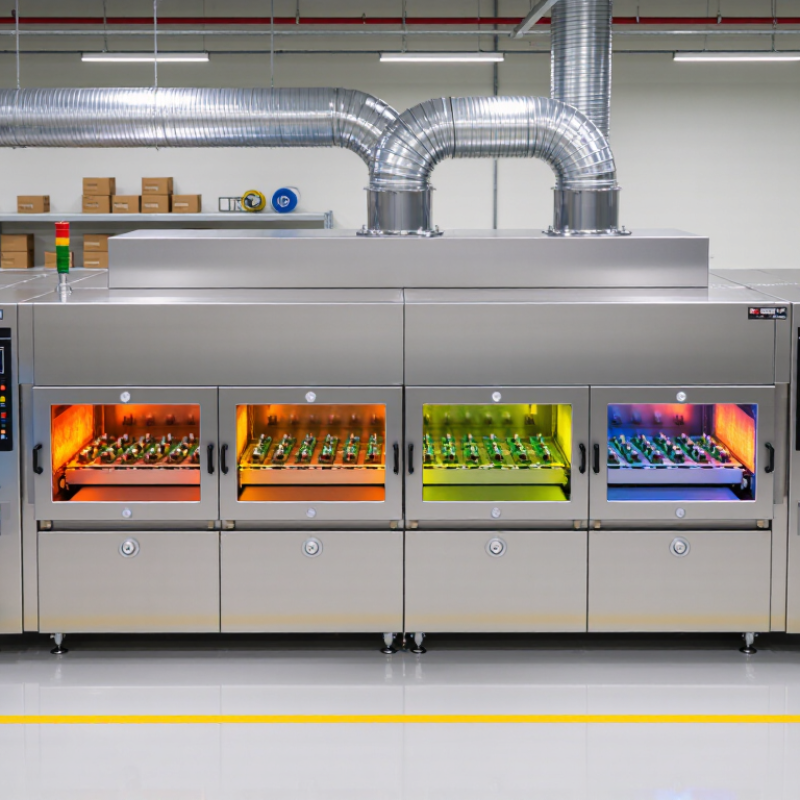
| Heating Zones | 8–12 independently controlled zones | More zones provide finer control of ramp, soak, reflow, and cooling stages, especially for lead-free assemblies. | Confirm the number of top and bottom heating zones and whether each zone has independent temperature control. |
| Cooling Zones | 2–4 controlled cooling zones | Controlled cooling helps manage solder-joint structure, component stress, and the final board temperature. | Check cooling capacity, cooling-air control, and whether the cooling profile can be monitored in real time. |
| Temperature Range | Approximately 室温 to 300°C or higher | A sufficient operating range supports common lead-free solder profiles and a broad range of PCB materials and components. | Review the actual process-temperature range rather than only the heater’s maximum rated temperature. |
| Temperature Uniformity | About ±1–2°C across the working area | Uniform heating reduces solder defects caused by uneven melting, insufficient wetting, or excessive thermal stress. | Request uniformity test results at production temperature and across the usable conveyor width. |
| Temperature Stability | Typically within ±1°C during steady operation | Stable temperature control improves repeatability between batches and reduces profile variation. | Ask how stability is measured and whether data is recorded continuously during production. |
| Conveyor Speed | Approximately 0.3–1.5 m/min, adjustable | Adjustable speed allows the oven to achieve the required time above liquidus and total thermal exposure. | Verify speed resolution, actual speed accuracy, conveyor load limits, and compatibility with the target board size. |
| Conveyor Width | Commonly 400–600 mm working width | The working width must accommodate the largest PCB, panel, carrier, or pallet used in production. | Measure the usable process width, not only the machine’s external width. Check edge clearance and dual-lane options if needed. |
| Maximum PCB Size | Select a capacity at least 10–20% above the largest planned panel | Additional capacity provides clearance for tooling, edge rails, fixtures, and future product changes. | Compare the manufacturer’s stated maximum length, width, thickness, and board weight with actual production requirements. |
| Profile Capability | Support for ramp-soak-spike and custom lead-free profiles | Different solder pastes, board materials, component packages, and thermal masses require different profile shapes. | Confirm recipe storage, profile editing, password control, traceability, and automatic profile comparison. |
| Ramp Rate | Typically controlled around 0.5–2.0°C/s | Controlled ramping helps reduce component cracking, solder-ball formation, paste spattering, and PCB thermal shock. | Check whether the oven can maintain the required ramp rate under the actual board load. |
| Time Above Liquidus | Commonly about 45–90 seconds, depending on solder paste | The correct time above liquidus promotes reliable wetting without unnecessarily increasing component and PCB heat exposure. | Use the solder-paste technical data sheet as the primary reference and verify the oven can reproduce that window. |
| Peak Temperature | Often approximately 230–250°C for lead-free SAC alloys | Peak temperature must be high enough for proper soldering while remaining within component and PCB limits. | Set the profile according to the solder alloy, component specifications, PCB construction, and supplier recommendations. |
| Nitrogen Capability | Optional for standard assemblies; closed-loop control for oxidation-sensitive work | Nitrogen can reduce oxidation and may improve wetting for certain solder alloys, finishes, and process conditions. | Evaluate oxygen concentration, nitrogen consumption, sealing quality, automatic control, and operating cost. |
| Oxygen Level | For nitrogen processing, commonly controlled below 1,000 ppm; tighter levels may be required for specialized work | Lower oxygen concentration can support oxidation-sensitive processes, but the required level depends on the assembly and solder materials. | Verify the measurement location, sensor accuracy, alarm limits, and stability during normal production loading. |
| Temperature Profiling | At least 6–12 thermocouple channels with data logging | Profiling confirms that critical components and PCB locations meet the solder-paste process window. | Check thermocouple attachment methods, sampling interval, software functions, calibration procedure, and export formats. |
| Energy Efficiency | Insulated chamber, optimized airflow, standby mode, and automatic power management | Heating is a major operating cost, particularly in continuous production and nitrogen-assisted processes. | Compare rated power, warm-up time, standby consumption, heat leakage, and energy use under representative loads. |
| Exhaust and Flux Management | Dedicated exhaust with accessible flux collection and filtration components | Flux residues can contaminate fans, heaters, ducts, and sensors, reducing performance and increasing maintenance needs. | Inspect duct design, filtration, cleaning access, residue collection, exhaust requirements, and recommended service intervals. |
| Conveyor System | Stable rail or mesh conveyor with adjustable support and smooth board transfer | Mechanical stability prevents board vibration, edge damage, solder displacement, and transfer interruptions. | Check rail parallelism, center support, chain or mesh maintenance, board transfer height, and maximum board weight. |
| Control and Traceability | Recipe management, alarms, access levels, data logging, and network connectivity | Digital records improve process control, troubleshooting, quality audits, and production traceability. | Confirm recipe backup, user permissions, historical data storage, communication protocols, and integration with factory systems. |
| Safety Features | Over-temperature protection, emergency stop, door or cover interlocks, and fault alarms | Safety systems protect operators and equipment from excessive heat, mechanical faults, and control failures. | Review safety certifications, emergency procedures, alarm behavior, guarding, and restart protection after a fault. |
| Maintenance Access | Tool-accessible panels, removable covers, and easy-to-clean heating and exhaust areas | Accessible maintenance points reduce downtime and help preserve temperature uniformity and airflow performance. | Ask for the preventive-maintenance schedule, cleaning procedures, replacement-part list, and expected service time. |
| Process Validation | Documented qualification using loaded-board thermal profiles | A successful empty-oven test does not guarantee consistent performance with real boards and production fixtures. | Require installation qualification, operational qualification, and performance qualification using representative products. |



 Close
Close