| Burr Material | Hardened stainless steel burrs for regular home use | Stainless steel burrs resist corrosion and are generally more durable than ceramic burrs when exposed to impact or uneven beans. | Confirm that the burrs, not only the outer body, are made from stainless steel. Check whether replacement burrs are available. |
| Burr Size | Approximately 38–48 mm for a balanced home grinder | Larger burrs can process beans more quickly and may reduce the effort required per grinding session. | Choose a smaller burr for portability and a larger burr when grinding several cups or brewing methods frequently. |
| Grind-Size Adjustment | Stepped or stepless adjustment covering fine to coarse settings | A broad adjustment range allows one grinder to support espresso-style brewing, pour-over, French press, and cold brew. | Look for clearly defined settings or a secure adjustment dial that does not move during grinding. |
| Grinding Consistency | A narrow particle-size distribution with limited fines and large fragments | More uniform grounds improve extraction control and help produce a cleaner, more repeatable cup. | Check independent tests or user measurements rather than relying only on advertising descriptions. |
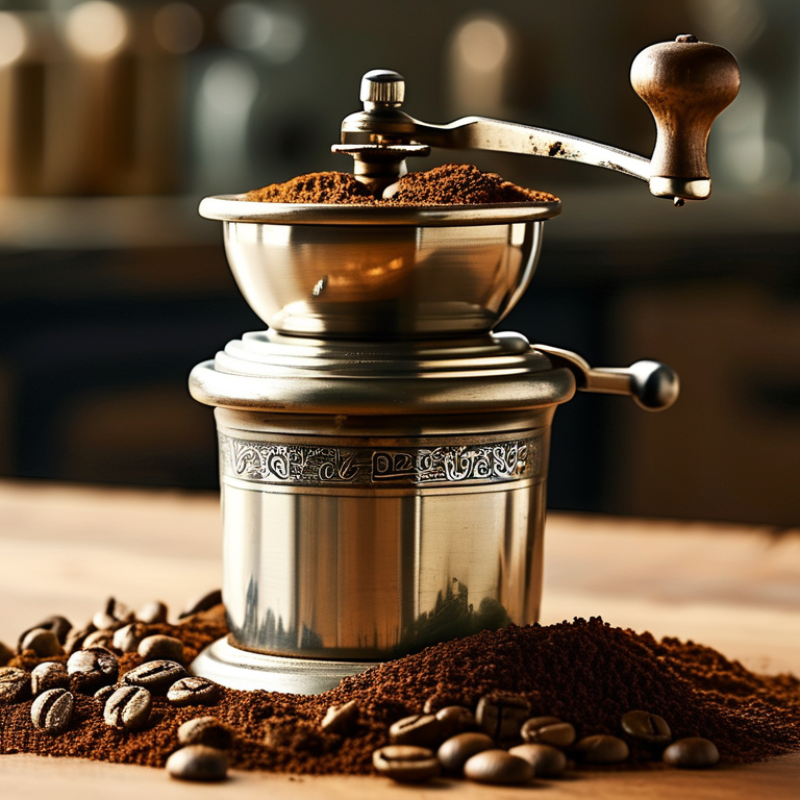
| Body Construction | Stainless steel body with minimal plastic in load-bearing areas | A rigid body helps keep the burrs aligned and can improve durability during daily use. | Inspect seams, threads, bearings, and the connection between the handle and drive shaft. |
| Bearing Stability | Two or more accurately fitted bearings supporting the central shaft | Stable bearings reduce shaft wobble, which can contribute to uneven particle sizes and inconsistent extraction. | Rotate the handle without beans and check for side-to-side movement, grinding noise, or rough spots. |
| Bean Capacity | Approximately 20–35 g for most single-serve home brewing | This range commonly supports one to several cups, depending on the coffee-to-water ratio and brewing method. | Select a larger hopper for batch brewing, but avoid unnecessary capacity if compact storage is important. |
| Grounds Container | Removable container with a secure threaded or magnetic connection | A well-fitted container reduces spills and makes it easier to transfer grounds to a brewer. | Check the container capacity, stability, internal corners, and ease of cleaning. |
| Handle Design | Removable or foldable handle with a comfortable grip | A secure, ergonomic handle improves control and reduces hand fatigue during coarse grinding. | Look for a firm connection, a non-slip grip, and enough leverage for the intended grind size. |
| Portability | Compact cylindrical design; typically about 400–800 g for travel-friendly models | A compact stainless steel grinder is convenient for travel, office use, and outdoor brewing. | Compare total weight, packed dimensions, handle storage, and resistance to scratches or dents. |
| Cleaning and Maintenance | Tool-free access to the burr chamber and removable external components | Easy cleaning helps prevent stale coffee buildup and preserves grind performance. | Confirm which parts can be washed, which must remain dry, and whether the burr calibration can be restored after cleaning. |
| Corrosion Resistance | Food-contact components made from corrosion-resistant stainless steel | Corrosion resistance is useful in humid kitchens and helps maintain a clean, neutral-tasting grinding environment. | Keep the grinder dry after cleaning and verify whether the steel grade is specified in the product documentation. |
| Static and Retention | Low residual coffee retention in the burr chamber and grounds container | Lower retention reduces waste and helps prevent old grounds from mixing with a fresh dose. | Check for smooth internal surfaces, a compact grind path, and easy access to trapped grounds. |
| Noise and Heat | Smooth manual operation without excessive friction or heat buildup | Manual grinding is usually quieter than electric grinding and generates little heat when operated at a controlled speed. | Test the handle movement and avoid models with grinding resistance, squeaking, or rough burr contact. |
| Value and Serviceability | Replaceable burrs, seals, bearings, or adjustment components | Serviceable parts can extend the useful life of the grinder and reduce long-term replacement costs. | Review the warranty terms, spare-part availability, calibration procedure, and repair instructions. |



 Close
Close