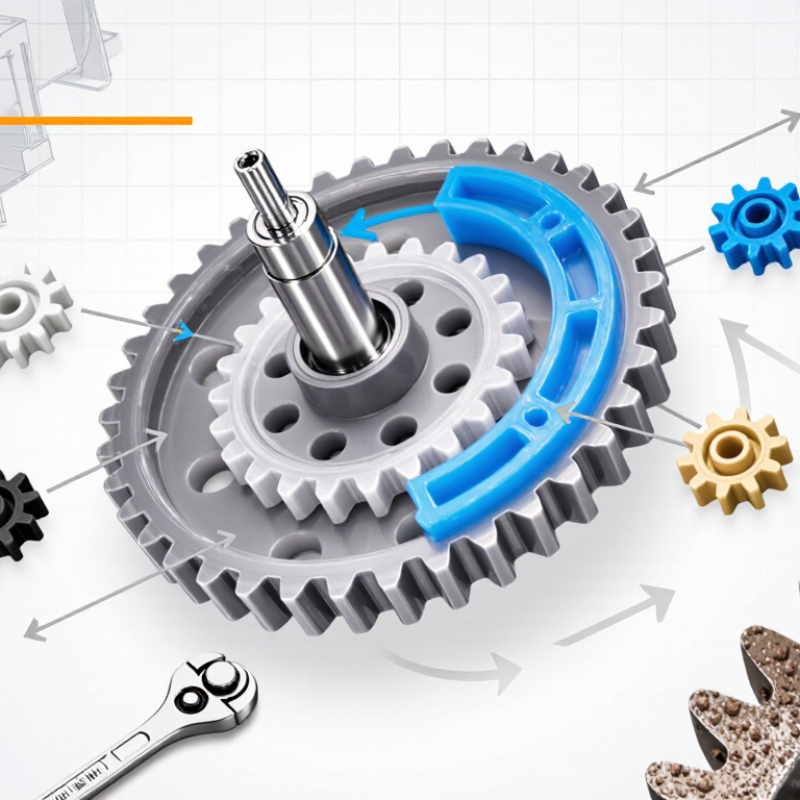
| Spur | Parallel shafts; compact drives, small actuators, and general-purpose mechanisms. | Module: 1.0 mm; teeth: 30; pitch diameter: 30 mm; face width: 10 mm; pressure angle: 20°. | Acetal (POM) for dimensional stability and low friction; nylon (PA) where toughness is useful. | Simple geometry, easy to manufacture, and typically efficient at moderate speeds. | Check center distance, tooth-root strength, noise, lubrication, and temperature. Spur gears produce no ideal axial thrust. |
| Helical | Parallel shafts where smoother, quieter operation is desired. | Transverse module: 1.0 mm; teeth: 30; helix angle: 20°; transverse pitch diameter: 30 mm; face width: 12 mm. | Acetal (POM) or nylon (PA), selected for the required load, moisture conditions, and operating temperature. | Gradual tooth engagement can reduce vibration and noise compared with a similar spur gear. | Account for axial thrust and bearing support. Specify helix hand and angle, and confirm the mating gear has compatible geometry. |
| Bevel | Intersecting shafts, commonly arranged at 90°, in compact right-angle drives. | Example straight bevel pair: 20 and 40 teeth; ratio: 2:1; module at the large end: 1.0 mm; face width: 8 mm. | Acetal (POM) for low-friction, accurately molded parts; nylon (PA) for applications needing toughness. | Changes the direction of rotation between intersecting shaft axes. | Confirm shaft angle, tooth counts, mounting distance, and matched pitch-cone geometry. The listed module is measured at the large end. |
| Worm and wheel | Right-angle drives requiring a large reduction in a compact package. | Example: single-start worm with a 30-tooth wheel; nominal ratio: 30:1; wheel module: 1.0 mm; wheel pitch diameter: approximately 30 mm. | Acetal (POM) or nylon (PA) for the wheel; select the worm material and finish to suit wear, heat, and lubrication needs. | Can provide high reduction in one stage and quiet operation when correctly designed. | Check sliding friction, heat generation, lubrication, efficiency, and wear. Do not assume the drive is self-locking; verify under actual conditions. |
| Rack and pinion | Converts rotary motion to linear motion in positioning systems and small actuators. | Example pinion: module 1.0 mm; 20 teeth; pitch diameter: 20 mm; rack pitch: approximately 3.14 mm. | Acetal (POM) for smooth motion; nylon (PA) where impact resistance is important. | Provides direct linear travel related to pinion rotation and is straightforward to lay out. | Match rack and pinion module and pressure angle. Check alignment, backlash, support, and tooth loading across the rack width. |



 Close