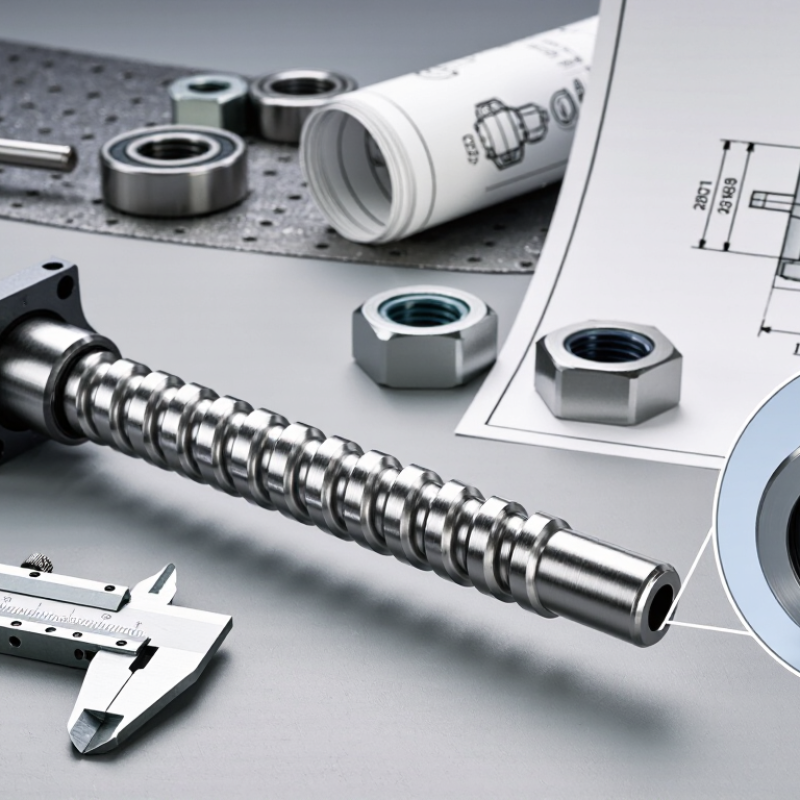
| Thread form and nominal size | Confirm the thread profile, nominal diameter, and pitch or lead. | The shaft and nut must use the same thread form and matching dimensions. A trapezoidal thread is not interchangeable with an Acme or metric V-thread merely because the nominal diameter is similar. | Metric trapezoidal examples include Tr8×1.5 and Tr12×3. Check the drawing or product specification for the exact thread designation. |
| Nut hand and lead | Check right-hand or left-hand thread and the distance the nut travels per shaft revolution. | The nut’s hand and lead must match the shaft. For multi-start threads, lead differs from pitch; lead equals pitch multiplied by the number of starts. | A single-start Tr12×3 thread has a 3 mm lead. A multi-start thread with the same pitch can have a greater lead. |
| Bearing fit and shaft journal | Check bearing bore, journal diameter, fit tolerance, and shoulder dimensions. | Bearings typically mount on a smooth, accurately sized journal—not directly on the threaded section. The journal must suit the bearing bore and specified fit. | A bearing with a 10 mm bore requires a compatible 10 mm journal, subject to the bearing and application’s fit requirements. |
| Radial and axial load support | Determine whether the system needs radial support, axial thrust support, or both. | Do not assume a radial support bearing alone can handle the screw’s axial load. Select and arrange supports according to the load direction and bearing ratings. | Use a suitable thrust-capable arrangement where the screw must react significant axial force; check static and dynamic load ratings. |
| Nut mounting and alignment | Check nut housing dimensions, mounting pattern, clearance, and alignment with the shaft. | The nut must be secured without forcing it out of alignment. Misalignment can increase friction, wear, and binding. | Compare the nut’s mounting drawing with the carriage or bracket drawing, including bolt spacing and available clearance. |
| Coupling or pulley interface | Check the shaft-end diameter, keyway or clamp style, and available engagement length. | The drive component must fit the machined shaft end and transmit the required torque. Do not select it using the thread’s nominal diameter alone. | Match a coupling bore to the actual motor and screw-end diameters; check the coupling’s torque and misalignment ratings. |
| Motor speed and travel | Match motor speed and screw lead to the required linear travel rate. | Approximate travel speed equals rotational speed multiplied by lead, using consistent units. Higher lead increases travel per revolution but can reduce mechanical advantage. | At 600 rpm, a 4 mm lead gives a theoretical travel speed of 2,400 mm/min before accounting for operating limits. |
| Stroke and end machining | Check usable thread length, support locations, shoulders, and drive-end features. | The threaded working length must cover the required stroke and nut length, while the machined ends must accommodate bearings and drive parts. | Allow for end supports, nut length, and any required overtravel when specifying overall shaft length. |
| Speed, buckling, and critical speed | Evaluate unsupported length, end-support arrangement, rotational speed, and compressive load. | A long or slender screw may be limited by buckling or rotational vibration before reaching the motor’s maximum speed. | Use the screw supplier’s critical-speed and buckling calculations for the actual diameter, length, and support conditions. |
| Accuracy and backlash | Specify positioning accuracy, repeatability, and allowable axial play. | Thread lead accuracy and nut clearance affect motion performance. A standard nut may have more backlash than a preloaded design. | For positioning tasks, compare the stated lead accuracy and backlash with the system’s required tolerance. |
| Lubrication and environment | Check material, lubricant, temperature, contamination, and maintenance needs. | Lubrication and material pairing must suit the application. Dust, moisture, or inadequate lubrication can accelerate wear. | Follow the component manufacturer’s lubrication guidance and consider shielding the thread in contaminated environments. |



 Close