How to Choose a Wooden Mechanical Vehicle Model?
Choosing a Wooden Mechanical Vehicle Model requires more than admiring its polished surface. The best choice combines mechanical function, material quality, safety, and lasting play value. Circana’s 2023 global toy industry reporting showed softer demand across many categories, increasing pressure on brands to prove quality and durability. That matters here. A model with clean gear movement and repairable parts can offer stronger value than a cheaper display piece.
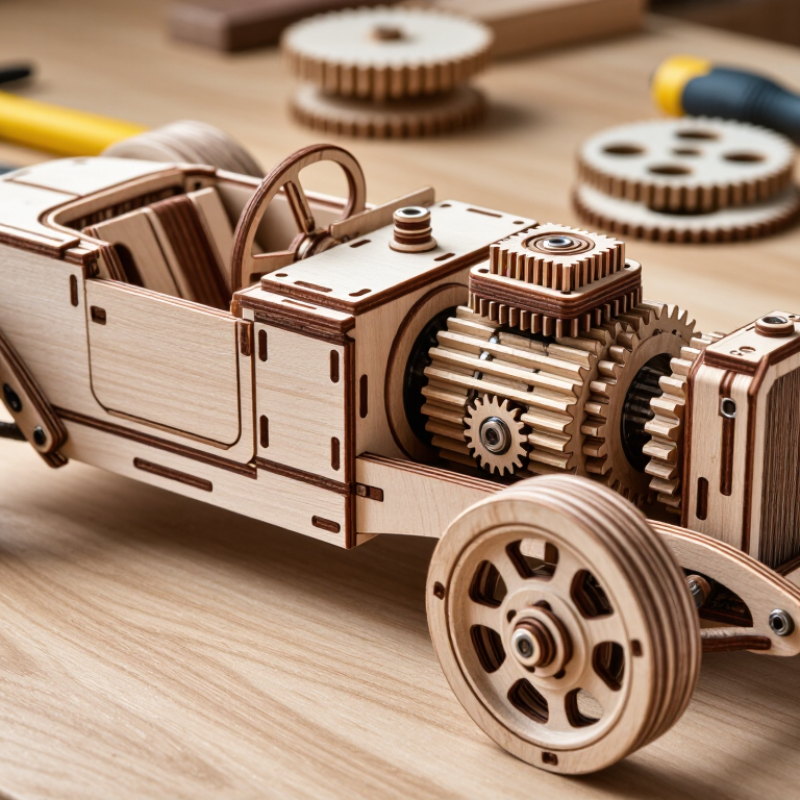
Look closely at the wood grain, axle alignment, and gear teeth. Birch plywood usually provides stable layers, while solid beech can feel smoother in the hand. Avoid rough edges, splitting, loose axles, or excessive glue marks. The mechanism should move steadily, without grinding sounds or sudden stops. Test the vehicle on a flat table. Watch whether the wheels track straight. Small details reveal manufacturing discipline. I have found that attractive packaging can hide weak engineering. That is easy to miss.
Age suitability also deserves careful attention. Check whether the product follows recognized requirements, such as ASTM F963 in the United States or EN 71 in Europe. These standards address important risks, including small parts, mechanical hazards, and surface coatings. The Toy Association’s 2024 trend discussions also emphasized hands-on, screen-free play, supporting interest in buildable and interactive wooden products. However, trend data does not guarantee quality. Compare assembly difficulty, replacement-part availability, instructions, and seller transparency. A trustworthy Wooden Mechanical Vehicle Model should identify its materials, recommended age, testing information, and care instructions. Choose function first. Beauty should follow.
Define Model Purpose and Scale: Compare 1:12, 1:24, and 1:32 Ratios
Choosing a wooden mechanical vehicle model starts with its purpose. Is it a display piece, a working project, or a weekend challenge? Scale controls almost everything: size, detail, assembly time, and storage space. ISO 5455 defines scale as the ratio between a drawing and its real object. For a 4.5-meter vehicle, 1:12 produces a model about 375 millimeters long. A 1:24 version measures roughly 188 millimeters, while 1:32 reaches only 141 millimeters.
The 1:12 scale suits builders who want visible gears, steering parts, and stronger moving mechanisms. It needs more shelf depth and usually demands careful alignment. The 1:24 scale offers a practical balance. Small cabin details remain readable, but the model is easier to store and transport. The 1:32 scale saves space and material, although tiny joints can become frustrating. Circana’s 2023 U.S. Toy Industry Retail Sales Report recorded an 8% decline in total toy sales. That pressure makes purposeful buying more sensible, rather than choosing only by appearance. Still, market data does not measure personal satisfaction. My own preference can change after one difficult assembly session.
Tips: Measure your intended shelf first. Mark the maximum length, width, and height. Choose 1:12 for hands-on mechanisms, 1:24 for balanced display and building, and 1:32 for compact collections. Check the finished dimensions, not only the box size. Leave extra space for turning wheels or opening panels. A smaller model may look less impressive initially, but its details can reward closer viewing.
Evaluate Gears, Axles, and Joints for Smooth Mechanical Performance
How to Choose a Wooden Mechanical Vehicle Model?
A wooden mechanical vehicle should move with steady resistance, not sudden stops. I begin by turning the drive gear slowly by hand. The teeth should meet evenly across their faces. Uneven contact often creates clicking, drag, and premature wear. Look for cleanly cut teeth without crushed corners or loose fibers. A useful test is simple: rotate the gear train ten times and watch for repeated tight spots. Small errors become obvious here.
Axles deserve equal attention. They should sit straight in their supports and remain parallel to nearby axles. Roll the vehicle across a smooth table. If it veers sharply, inspect axle alignment before blaming the wheels. A slight wobble may come from uneven wheel holes, not the axle itself. I once ignored this detail, and the model ran beautifully in one direction but poorly in the other. That mistake changed how I evaluate construction.
Joints must provide movement without excessive looseness. Check connecting rods, steering points, and hinged sections for clean rotation. They should move freely, yet resist side-to-side shaking. Wood expands with humidity, so a joint that feels perfect today may tighten later. Leave enough clearance for movement, but do not accept sloppy fitting. The best models balance precision with repairability. Smooth motion matters more than decorative complexity. Listen closely. A quiet gear train usually signals better alignment, although sound alone cannot prove quality. Handmade parts may vary, and that is worth remembering before making a final judgment.
Check Safety Compliance with ASTM F963, EN 71, and ISO 8124 Standards
How to Choose a Wooden Mechanical Vehicle Model?
A wooden mechanical vehicle should be judged by safety evidence, not appearance. The U.S. Consumer Product Safety Commission reported about 231,500 toy-related emergency-room injuries in 2023. Ten children died in reported toy incidents that year, according to its Toy-Related Deaths and Injuries report. These figures make small design details important.
Check whether the product is tested against ASTM F963, EN 71, and ISO 8124, according to its intended market. ASTM F963 covers U.S. toy requirements, including mechanical hazards, flammability, and chemical limits. EN 71 addresses similar risks for the European market. ISO 8124 provides an international framework, but it does not automatically replace local legal obligations. Ask for current laboratory reports, not only a printed compliance claim.
Look closely at the wheels, axles, gears, and connecting pins. They should resist breakage during reasonable pulling and twisting. Run a finger along every edge. It should feel smooth. Check paint and coatings for peeling, strong odors, or unclear material information. Loose parts can become choking hazards for younger children, especially after repeated play. Age grading must match the model’s actual mechanism and parts. I would also inspect the packaging and instructions. They are easy to overlook. A polished finish is not proof of safety, and test documents can still leave practical questions about misuse, wear, and supervision.



 Close
Close 
